


A century of expectations rests on Rhun ap Iorwerth’s shoulders
Martin Shipton
Fending off a concerted attempt by a racist English nationalist party with unlimited resources to fundamentally undermine Welsh democracy is a considerable achievement and deserves a collective pat on the back.
Nothing could have symbolised the evisceration of Wales as a nation more than the election of a Reform-led Welsh government.
But a majority of voters recognised the danger and ensured that the threat was defeated.
Nevertheless, it’s apparent that there is a considerable sense of alienation and disenchantment among large sections of the community, particularly those who are poor.
Many misguidedly believe that Nigel Farage has the answers to our society’s problems, failing to recognise that the gross inequality that leaves them at a disadvantage is enabled by those who fund his party.
Reform hasn’t gone away and will have a significant presence in the new Senedd. How the party’s 34 MSs choose to behave will largely determine the dynamic of the term that is about to begin.
Can we expect the kind of disruptive performative stunts that Farage got his group of UKIP MEPs to participate in at the European Parliament: filibustering to the point where they were thrown out of the chamber, and turning their backs on the Chair as a mark of contempt for the institution.
Such stunts quickly become tiresome and carry the danger for Reform of exposing them as unserious. Added to which, Farage has never actually run anything, while for all his faults Dan Thomas, the contender he hand-picked as Reform leader in Wales, has led a local authority in London and knows the ropes (at least the low-hanging ones).
We’ve already had instances of Thomas following Farage’s lead – for example over the appalling and probably unlawful suggestion that migrant detention centres would deliberately be located in places that voted against Reform.
But hopefully that won’t stop the Reform group from contributing to the necessary but often dull committee work that makes up much of the Senedd’s business.
Meanwhile the responsibility for governing Wales – or those elements of its governance that are devolved – rests with Plaid Cymru.
During the election campaign, Reform and the Conservatives tried their best to tie Plaid in with Welsh Labour, claiming that “Labour and Plaid” or latterly “Plaid and Labour” were responsible for all that was wrong with public services in Wales throughout the 27 years of the Assembly’s and then the Senedd’s existence.
This vastly overplayed the reality. The two parties were in coalition for four years – from 2007 to 2011 – with Plaid as the junior partner; and subsequently there were deals where Plaid supported – or didn’t vote against – the Welsh Government’s Budget in return for specific policy commitments.
Only now can it truthfully be stated that Plaid is in charge.
Pwllheli
It’s approaching 101 years since the party was founded in a cafe in Pwllheli. For decades it was more of a cultural pressure group than a conventional political party, and even today that is reflected in the broad diversity of its candidates that enables one to assert without fear of contradiction that in Plaid there is no bar on eccentricity.
That said, Rhun ap Iorwerth is a sensible politician who has solid principles without the off-putting aggression of a zealot.
As an incoming government, Plaid will have to get the balance right between convincing people it won’t be Continuity Labour while taking the time to ensure effective actions are taken.
People are impatient for improvements to public services and need to be reassured that plans to that end are being implemented.
The First 100 Days document published by Plaid in March contained a “to do” list that, if implemented, could result in tangible steps forward, but offer little in the way of instant gratification.
People are in a hurry for developments that will make them better off, but the nature of government usually means it takes time to deliver on promises.
It’s important that Plaid in government communicates with the public about progress towards the improvements it makes in terms of hospital waiting times etc. There will be plenty of opponents desperate to dish the dirt, so the incentive is there for tangible progress to be made.
Experience
Rhun ap Iorwerth will announce his ministerial team within days of being formally elected First Minister, and it’s important that those he appoints have experience and communication skills.
While he is obviously the central and leading figure in the new government, the impression must not be given that he is a one man band with a group of minions whose identity is of minor significance.
I’m sure ap Iorweth doesn’t need me to remind him what a significant moment this is in the history of Plaid Cymru and the history of Wales. A century of hope rests on his shoulders.
Ever since Plaid was formed in that cafe, people have dreamed of the day when the party was in charge of Wales. Running a devolved administration is a long way towards that final aim which, as polls tell us, only a minority would currently support.
Yet as Plaid gradually matured from being a cultural pressure group into a political party that competed on the same basis as others, many invested their hopes in a future that has now come to pass.
When in 1970 Dafydd Wigley, Eurfyl ap Gwilym and the late Phil Williams wrote An Economic Plan for Wales, they were thinking of a time in the future when such a plan could be implemented by the party of which they were prominent members.
Some 56 years later, an updated version of the plan will inform Plaid’s thinking as it enters government with a pledge to create a new economic development agency for Wales with the aim of increasing the nation’s prosperity.
Unprecedented opportunity
A consensus is developing that Plaid Cymru’s victory in this year’s Senedd election was made possible because it was seen as the only party that could defeat Reform. There is plenty of anecdotal evidence to suggest that was the case, and there is every likelihood that academic and polling research will confirm that to be so.
However the victory came about, Plaid now has an unprecedented opportunity to prove it can govern Wales with competence and a deliverable vision to make lives better. It may be the only chance it gets.
Failing in that mission should not be an option.
Support our Nation today
For the price of a cup of coffee a month you can help us create an independent, not-for-profit, national news service for the people of Wales, by the people of Wales.
Get more trusted Welsh news
Choose Nation.Cymru as a preferred source in Google News to see more of our journalism.



Undoubedly Reform will do whatever it can to distrupt the forthcoming Welsh Parliament. It does not give a toss about what’s best for the Welsh public – it’s just about getting into power at all costs. It’s goal – get Farage into Downing street, if Cymru sufferers along the way – so be it. Plaid has a major task ahead to make Cymru a better place, what with Reform and Westminster – but it can done.
67 years ago my young life was enlivened by Plaid setting up campaign HQ in the stock rooms above my mother’s shop, a lifetime !
A programe for S4C? I love stories like that.
We can be sure that the moment it became clear yesterday that plaid cymru was going to win this election that the party’s opponents in Wales (and in the british state) began thinking about what they can do to stymie a plaid (minority) Welsh govt. And so it was no surprise to see Labour functionary Mike Hedges first out of the traps today hinting darkly that he and his colleagues will make it difficult for Plaid to get its first budget through. Hedges even opining that such calculated and cynical sabotage could force another Senedd election within a year. And… Read more »
I don’t think it’s fair to expect significant change. Major improvements in economics and finances are out of their control, and I’ll argue this is largely the same at Westminster. But they have some good people and a genuinely good guy as leader. I’m hoping they lead without division and in the best interest for the country, and I think they will. people like Carrie harper are a great addition to the senedd.
We don’t need to be constantly negative about reform, by the way. people voted for them in the thousands, and they’re not going away any time soon.
“We don’t need to be constantly negative about reform (sic)” Are you serious? These people are fascists! I’m not saying that the thousands who voted Reform are bad people, but the Reform UK ‘representatives’ don’t and won’t represent them. Those thousands of people do need to be heard, and the incoming Pliad goverenment will need to focus on and prioritise those people, for they are the ones hurting the most. I believe that most people do not realise what Reform UK really is, not because they are stupid, or gullible, but because their fundamental decency does not allow them to… Read more »
No they absolutely aren’t. Incredibly offensive to say 30 odd percentage of wales is facist.
Yes they are. There’s no way of supporting reform without being a fascist.
Reform is a rather obvious fascist party, with fascist aims and known fascist members. There’s no other way of putting it.
Genuinely curious. What policies of theirs would you consider as fascist? Ie Hitler/Mussolini level? Distasteful, yes, but can’t see the fascist policies?
There’s a checklist you can check.
https://washingtonmonthly.com/2017/01/31/the-12-early-warning-signs-of-fascism/
There are no specfic Reform policies on there? The question remains, what Deform policies would you say are specifically fascistic? It’s an important question y’see because this is why they do so well. People just have tantrums and shout fascist all the time instead of actually analysing their policies. Anyway, over to you.
You imagine the Hitler/Mussolini manifestoes were an accurate list of their plans? What a contrived defence. It’s what they say and the way they say that matters.
And as I’ve already pointed out below, not every Reformer is a fascist. Many are desperate, many are naïve and many are simply opportunistic.
You’ve proved his point. Obnoxious as they are, I cannot see any fascist policies. They just need to be debated and beaten.
And you’ve not read the post. Ask yourself if historical fascists were only fascists when they started doing bad things, or were they always facists.
Their voters fall into three categories – the desperate, the naïve and the genuine fascists. Their candidates have one further category which is the opportunists. You empower them by lumping them altogether. Focusing on what divides them is the way to respond.
Not all reform voters are racist but all racists vote reform
There’s also Restore.
I agree. Too many obsessing about Reform on here. They are in the minority and Plaid can govern without too many votes in the Senedd. We can’t expect overnight transformation; but Plaid need to set out a clear agenda quickly which is where Starmer has completely failed.
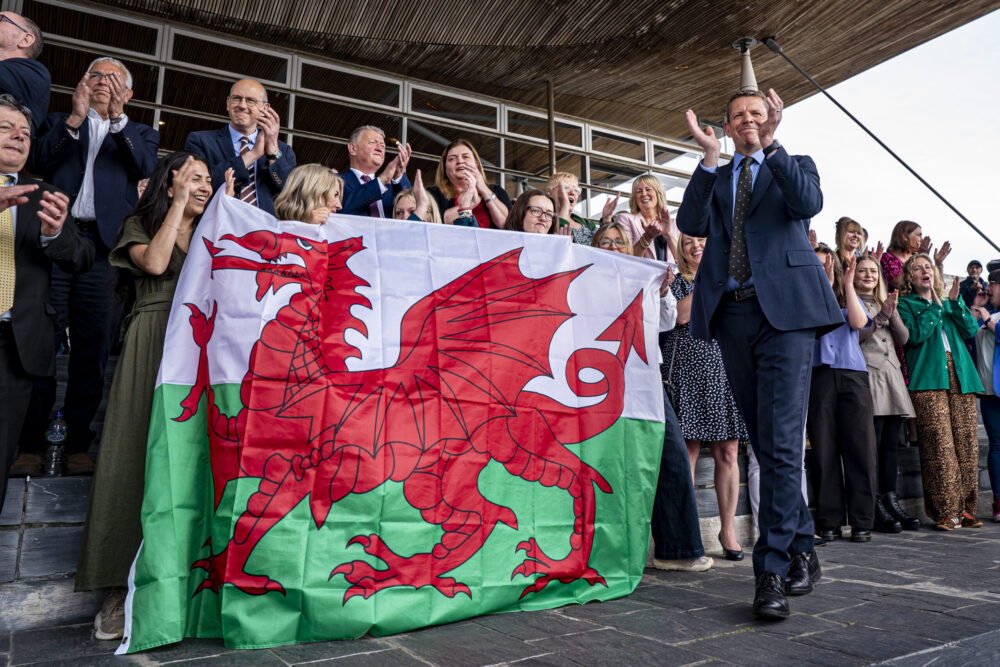
It was great to see the scenes outside the Senedd yesterday, and to hear Rhun ap Iorwerth’s sterling speech, as well as the rousing singing of Hen Wlad fy Nhadau by our newly elected 43 Plaid Cymru members and the celebrating crowd. As a true First Minister of Wales, Rhun ap Iorwerth promised to stand up for Wales and to fight for all, whether you voted for Plaid Cymru or not. This would never have happened under a Reform First Minister, Dan Thomas, who would have ransacked the Senedd and with spite punished those areas that voted for Plaid Cymru.… Read more »