


A decade that changed the independence debate in Wales

Hedd Gwynfor
On 20 February 2016, in The Old Library in Cardiff, YesCymru held its official launch and first Annual General Meeting, marking the formal beginning of a national movement for Welsh independence.
Its roots lie in 2014. The referendum in Scotland led many in Wales to ask similar questions, and there was concern that Wales would be left behind, submerged into ‘England and Wales’. A solidarity rally, ‘Wales Supporting YES’, outside the Senedd in September that year drew around 800 people.
Meetings followed at Chapter Arts Centre in Cardiff and later in Carmarthen, where the name YesCymru was adopted and a formal statement, vision and structure agreed. A logo was adopted in early 2015, and membership opened later that year.
The founders believed Wales needed a non-party political mass movement to make the unfiltered case for independence, at a time when constitutional change in Scotland and Ireland seemed increasingly likely.
By 1 March 2016, membership stood at 350. In hindsight that may seem small, but at the time it felt like real momentum.
Credibility
In the early years, the focus was on building credibility. Local groups were established, beginning in Cardiff, and rallies organised in Cardiff, Swansea and Carmarthen.
At the June 2017 AGM in Aberystwyth, Independence in Your Pocket was launched. It was widely seen as one of the most detailed arguments yet made for Welsh independence, an attempt to move the debate beyond slogans into substance.
That same year saw broader civic engagement.
IndyFest was held in Cardiff in September 2017, bringing together talks, workshops, music and activism in a day-long celebration of independence culture. The following month, a rally to Support Catalonia, ‘For Democracy – Against Violence’, was held in Cardiff, showing solidarity with democratic movements beyond Wales and reflecting the international outlook within YesCymru.
Support for Welsh independence was growing, politically and culturally.
In February 2019, the ‘Yes is More’ gig at Tramshed in Cardiff became a significant moment. It sold out, with Charlotte Church performing. The event brought together artists and activists and showed that independence was not confined to political meetings; it was becoming part of the cultural mainstream.
Momentum
In May 2019, the first March for Welsh Independence in Cardiff, organised by AUOBCymru and inspired by the AUOB marches in Scotland, brought around 3,000 people onto the streets. A few months later in Caernarfon, the number rose to around 8,000. Merthyr Tydful followed in September 2019, where the rally included an impassioned speech by the late, great Eddie Butler.
In December 2019, the late Dewi ‘Pws’ Morris released Yes, Yes, Yes (Cymru), donating all proceeds to YesCymru. The song has since been streamed tens of thousands of times, becoming part of the soundtrack of that period of renewed confidence and growth.
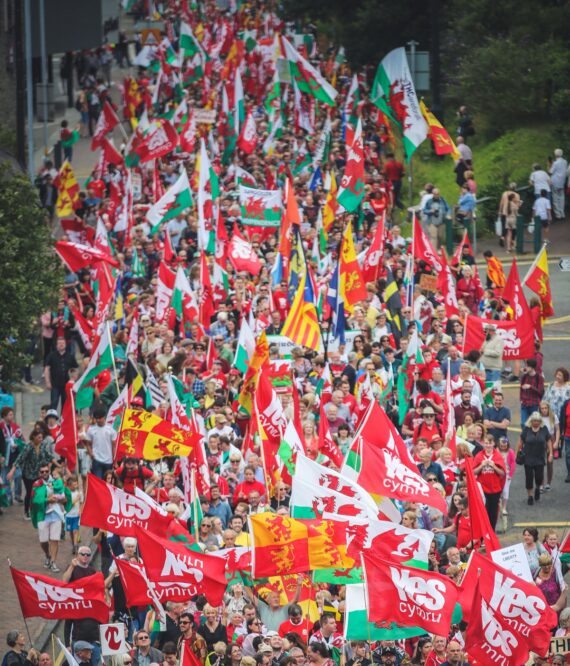
By the end of 2019, the movement was more visible and growing in confidence, and its membership had reached 2,000.
The January 2020 AGM in Merthyr included speakers such as David Buttress, founder of Just Eat, who addressed the business and entrepreneurial opportunities of independence. Media, sport and finance were also explored, and independence was being discussed in practical terms rather than simply as an ideal.
The Covid Surge
Then came the pandemic. Instead of fading, YesCymru grew faster than anyone expected. Membership doubled within weeks in spring 2020 from 2,500 to 5,000. By October it had passed 8,000, by November 15,000, and by March 2021 it had reached 18,000.
Even allowing for disputes over how membership was counted, including differing interpretations of how many were full members and how many were supporters, the growth was widely regarded as remarkable.
This was one of the fastest periods of civic mobilisation in recent Welsh history.
The Welsh Government’s distinct Covid response and policy divergence from Westminster led people to think more seriously about how Wales is governed, accelerating that mobilisation. For many, it demonstrated how differently Wales could act when decisions were taken in Wales rather than London.
In the years that followed, a YesCymru newspaper was distributed to most homes in Wales. “Yma o Hyd” reached number one on the UK iTunes chart after a coordinated campaign, and an ‘Art for Independence’ exhibition was held in Neath, demonstrating that the movement’s reach extended beyond politics into culture, creativity and civic expression.
The marches resumed after the pandemic: Wrexham and Cardiff in 2022; Swansea and Bangor in 2023; Carmarthen in 2024; Barry and Rhyl in 2025. Town after town saw thousands turn out behind the simple proposition that Wales should govern itself.
The difficult years
Like many fast-growing organisations, YesCymru went through periods of internal challenge.
There were governance difficulties, including the 2018 constitutional issue and subsequent resignations, followed by an Extraordinary General Meeting; the 2021 resignations of the existing committee; interim arrangements; the transition to a board governance model; and an independent investigation report by Elfyn Llwyd LLB.
During this period, a Chief Executive Officer was appointed, but the role was later discontinued when the organisation no longer had the financial resources to sustain it.
Some disagreements reflected genuine differences of opinion about accountability and structure.
At times, however, internal tensions distracted from campaigning and slowed momentum.
Yet YesCymru and the wider movement endured.
Membership fell from its peak but stabilised at between 9,000 and 10,000 in 2023 and 2024. Marches continued, and YesCymru maintained a strong presence at major Welsh events such as the Eisteddfod, the Royal Welsh Show and Tafwyl.
Leadership structures were refined as the movement adapted to rapid growth, and the past two years have brought greater stability and a firmer organisational footing.
Ten years on
Ten years on from the launch and first AGM, Welsh independence has moved into the mainstream, with recent opinion polls showing support at between 30 and 40 per cent among decided voters.
YesCymru did not achieve that alone, but it played a decisive role in normalising the idea of Welsh independence. It made independence more visible, more confident and more accepted across Wales. Thousands joined as members, and many thousands more marched with them.
The first decade showed what passion can achieve. The next will depend on hard work and cooperation.
A decade ago, around 150 people gathered in Cardiff. Ten years later, after ten national marches and countless events, the independence question is embedded in Welsh political life.
That is something to be proud of, but the work is far from finished.
The next decade needs focus. Disagreements are part of any democratic movement, but at times they have taken energy away from campaigning. To build on what has been achieved, we need to use our energy to make the case for independence in our communities.
The wider constitutional landscape is shifting in ways that make the next decade especially significant. In Wales, Plaid Cymru has led recent polls ahead of the next Senedd election and could form part of the next Welsh Government.
In Scotland, calls for a second independence referendum remain prominent, with the SNP continuing to be a major force in national polling. Irish reunification is increasingly part of mainstream debate, with Sinn Féin a dominant force in Northern Ireland. In England, the Green Party has grown in strength, and its leadership has expressed support for the right of Wales and Scotland to choose their own futures.
All of this suggests a wider shift. The future of these islands is being debated openly, and Wales needs to be part of that conversation.
If we want an independent Wales, the responsibility rests with us.
Supporters and former members should consider rejoining YesCymru. If you believe in independence, a growing membership gives the movement strength, credibility and reach.
Supporters and members alike should become active in their local groups. Go to meetings. Take part in the events and activities they organise. Simply turning up, helping out and being part of the effort moves us forward. It is also a good way to meet like-minded people.
And members, from all backgrounds and ages, and with all kinds of skills, should think seriously about standing in the YesCymru board election. The movement needs leaders, co-ordinators, campaigners and creative thinkers who are ready to shape the next stage of the movement. Welsh independence is within our grasp, but it will only happen if members step forward and take responsibility for making it happen.
The progress of the past decade shows what is possible. What happens in the next ten years will be decided by those who step forward now.
Hedd Gwynfor was part of the group that organised the solidarity rally, ‘Wales Supporting YES’, outside the Senedd in 2014 and was a YesCymru national committee member between 2016 and 2021.
Support our Nation today
For the price of a cup of coffee a month you can help us create an independent, not-for-profit, national news service for the people of Wales, by the people of Wales.



Good to see so many of your stickers out and about Monmouthshire, given we’re right on the border it’s quite a pleasant surprise to see how much support Yyes Cymru has.
‘Internal Challenges ‘ and ‘Governance Issues’ is putting it mildly. Have they kissed and made up yet!