


A future in the air
Brian Davis
I was raised in a Welsh-speaking community on the edge of the Cambrian Mountains.
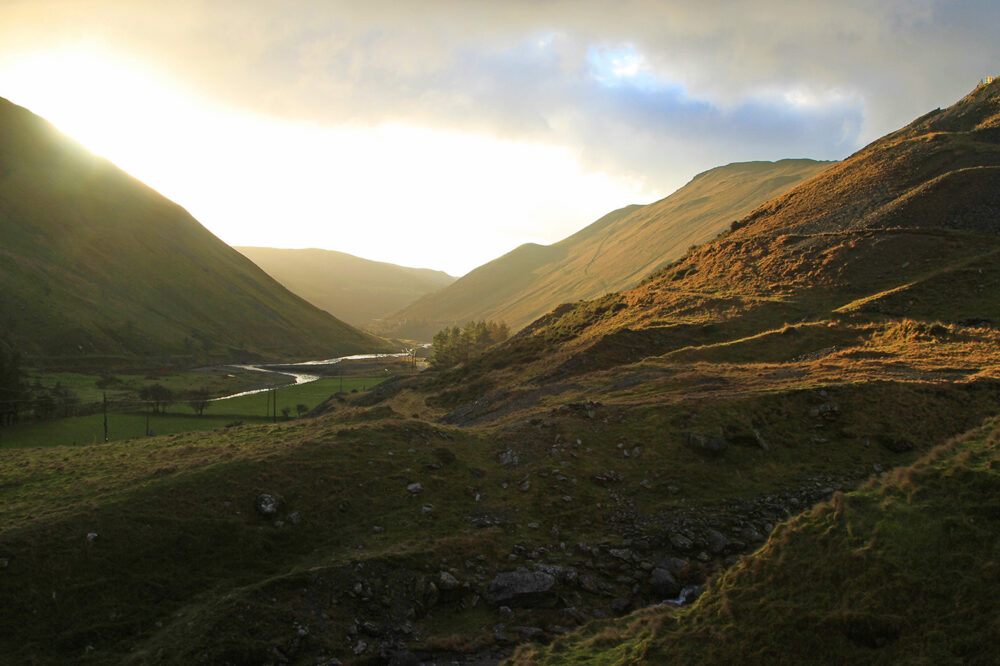
Both sides of the family, both paternal and maternal, have associations going back many generations within the area. I spent very many days in my formative years walking and exploring the hills. This led to a deep-rooted affection and appreciation of this unique area, and their matchless landscapes. I was very fortunate to grow up among people whose connections to their cynefin are embedded in their historical language and culture.
The Cambrian Mountains are the central part of the upland spine of Wales, and Cymraeg (Welsh) is, in many ways, still is the language of the area. The ancient language has survived within isolated communities whose traditions and cultural practices have ensured its persistence.
It is devastating, therefore, that all of this is now under threat from wholesale industrialisation. Wales’ upland communities face an inordinate number of planning applications for wind power stations, especially in some of the most isolated and beautiful areas. Unlike other regions targeted for renewable power, building giant turbines in the remote Cambrians would also require construction of substantial access roads and power infrastructure. In combination, these would inflict severe damage to the landscape and its tourist potential, as well as collateral, unquantifiable and long-lasting effect on the region’s biodiversity, like the fragile population of red squirrels.
Construction would exacerbate carbon emissions, both from the activities themselves and from the release of carbon in excavated soils and peats. These releases are not included in most lifetime carbon analyses for wind power, because for most projects elsewhere, the infrastructure is already there.
The proposals which would potentially undermine local communities are backed by faceless foreign investors. Despite Bute Energy’s office in Cardiff, it is supported by Danish investment firm Copenhagen Infrastructure Partners. Lluest y Gwynt is owned by Statkraft. Galileo Energy is a Swiss Company backed by investors from as far afield as New Zealand. These firms have little understanding of the unique cultural background and the importance of the language which underwrites the Welshness of the Cambrian Mountains. To add insult to injury, most of any energy generated by these new schemes will be exported.
Historically, sheep and cattle farming by Welsh-speaking families constituted the backbone of the economy. Metal mining, long since abandoned, from as far back as the 17th century, required the importation of specialist labour from as far afield as Cornwall.
In the nineteenth and twentieth centuries, a number of valleys were drowned for reservoirs, enforcing removal of isolated rural communities and impacting on an abundance of Welsh speakers.
Since the First World War commercial conifer forestry, too, has encroached on the landscape. Fewer people are needed now to farm the area, and the workforce is far less homogeneous, further eroding the status of Cymraeg as an everyday working language. Afforestation of farming land today is being rapidly expanded by a combination of government grants and foreign investment on the pretext of carbon offsetting schemes – despite these increasingly being recognised as ineffectual to reduce the carbon load in the atmosphere.
Tourism
The only industry remaining with potential for growth within the Cambrian Mountains is tourism, based on the attraction of the landscape, its peace and timelessness, and the associated biodiversity.
Many local individuals and organisations have significantly invested in tourism with the establishment of high-quality accommodation from hotels and self-catering, to glamping and shepherd huts. Formal visitor attractions include mining museums, narrow gauge railways, and red kite feeding stations – set up to provide an allure to both day and residential visitors.
Local communities, the historical culture and language, now have further additional support from enthusiastic émigrés who wish to reconnect with rural life and nature. Many learn Cymraeg and become embroiled in supportive community and environmental work within their adopted home.
With mutual effort and support from all in the community today, the indigenous language, values and culture can stay strong and remain a vital part of the Cambrian Mountains.
The wind power plant proposals threaten to undermine the local businesses upon which my friends and family rely and also threaten to diminish the old communities, forcing them to dwindle further, taking with them their language and cultural heritage.
Risk
It is easy to solicit support for renewable energy development by asking questions emphasising only on its benefits, but a fairer assessment would also account for what we risk losing in our haste to embrace the next big thing.
Rather than simply succumbing to fine words and the dazzle of wealth, we need to ensure that any wind of change blows in the right direction.
Support our Nation today
For the price of a cup of coffee a month you can help us create an independent, not-for-profit, national news service for the people of Wales, by the people of Wales.



The carbon statistics presented in this article are dishonestly framed. Firstly, a normal wind turbine covers its carbon output within 2 years of its 30 year lifespan. So even allowing for more significant damage; it would usually offset within less than a decade. If someone genuinely cared about nature damaging carbon intensive industries you’d be looking to ban sheep farming and rewinding the landscape. Windfarms are negligible in comparison. As a side note; utterly nauseating to see another NIMBY demanding people are dependent on the poverty wages of tourism from wealthier people. When they could instead have a choice of… Read more »
How many people does a 100 MW onshore wind farm employ during operation, and where would those jobs be based, ie at the wind farm or in a central control room and/or maintenance base?
Both.
Safer and alternative job for fishers driving and crewing the service vessels and boatyards for maintaining them, there is a lovely Bristol Channel Pilot Cutter like Bill Tilman’s Mischief in Y Felinheli at present I noticed the other day…
How many boat yards are there in the Cambrian Mountains, again?
The wages for that work would be better and more reliable than grovelling to entitled tourists.
Notice you didn’t defend the dishonest nonsense about carbon.
The wages for that work wouldn’t be for local residents, though. My business would be ruined – it’s a recording studio and it has nothing to do with tourism or “grovelling”, so what about me? And the carbon from production may be offset, but what about the 2,500 metric tons of concrete and 200 tons of steel per turbine base permanently embedded in the earth? When does that get offset?
The environmental destruction and loss of agricultural land caused by the intensification of wind and solar energy will render Wales a massive industrial area of no benefit to the inhabitants reprising the effect of the reservoirs on the country. The main problem is excessive energy consumption for pointless tasks like Bitcoin mining. There is a whole other argument about net CO2 production from steel and rare earths needed to make the windmills.
Wind farms compared to the catastrophic damage of sheep farming is not as bad.
Especially as the jobs would pay better and you can rewild landscapes around wind farms.
BUT NOT MANY JOBS!!! We should consider the catastrophic, unsustainable, pressure and damage caused to the planet by more than 8 billion humans, rather than blame sheep and cattle. If the human race has any intelligence at all, it will realise that it must take stock of its own tendency to overpopulate in total disregard of the actual environment.
The guy probably lives in a city well away from it all and is set on reducing the countryside to something resembling a mid 20th century industrial landscape … without the jobs!
Totally agree. More romantic tosh about some mythical rural land where humans lived in harmony with nature. Cymru has been industrialised for centuries and there is virtually no “natural” landscape left. Metal mining did not end centuries ago; Ceredigion was classed as an industrial area until the 1960,s, it also underwent the highest percentage increase in population (of the entire UK) in the 60’s and 70’s, and the last time I looked, it was still there. As you point out, to say that windfarms “exacerbate carbon emissions” is nonsense, as is the hysteria about “substantial access roads”. Of course the… Read more »
I so agree with your every word,it,s what I call Corporate rape of our Country,in pursuit of extreme profit,
Wales can easily generate all the electricity it needs for net zero, and remain a major exporter, by only using offshore wind
Offshore wind employs more people per MW installed and generates significantly more electricity
I fully agree with Brian Davis – we are threatening our magnificent uplands with insensitive and over-scale energy developments, today’s equivalents of unwelcome reservoirs and poorly located conifer plantations. That the energy is being extracted from Cymru just adds insult to injury. At least Plaid Cymru and the Greens appear aware of some the issues and this needs to be reflected in their policies for 2026 – a moratorium and a big think would be good ideas… I doubt that tourism will prove either a sustainable or desirable option in the longer term. Something else to benefit others, not necessarily… Read more »
“Magnificent uplands” ha ha ha, you mean sheepwrecked, acidic, bare, boggy hillsides which exacerbate flooding in the valleys and have no agricultural value. Much of them cannot even be walked over without sinking to your knees in black mud. When they have been reforested (not by conifers), and the wildlife restored, then you can describe them as magnificent. Until then, they may as well provide sites for renewables, which, by the way, could easily coexist (even the big ones) with reforestation, and with the small-scale production you advocate.
Flooding in the valleys has increased where the natural surfaces on high ground have been torn up to build concrete and reinforced steel foundations for turbines. Leave the bogs alone as they serve a purpose in slowing down the run-off of heavy rains.
Your post is so inaccurate, it doesn’t deserve a reply
A heartfelt piece. I believe there isn’t one energy policy fits all here. It is my belief that in some cases certain energy projects are right for an area and not in others. But my first concern is alway, does the policy build a future for Wales? And, bound into that, does a policy detract from future generations?
The sad thing for me is that our uplands have already been trashed by overfarming and deforestation. I despair when I venture deeper into Wales and see nothing but sheep, bog and the occasional conifer forest. I dont think the windfarms will make any substantial difference to be honest, even though I do find them unsightly. Also, how are these companies getting access to the land? Presumably it is being sold to them or rented out by whoever owns the land. I assume local farmers, who aren’t getting much from the land, are doing this and getting windfalls in the… Read more »
Peanuts, with scope for compulsion on the horizon.
More resource extraction in a land scared by exploitative resource extraction is a legitimate concern that should be solved by levying proper business rates that are rebated on local ctax bills.
But I don’t agree they look bad in moderation, and don’t believe they will affect tourism.
*Scarred
I’d rather wind power than tourism.