


A Welsh system of justice, not a devolved English one
Peter Ainsworth
On Tuesday, 16 June 2026, the new constitution minister, Dafydd Trystan Davies, was asked when and how justice might be devolved. His answer was both everything and nothing: “justice should be fully devolved to Wales” … and there is “work to be done.”
The Thomas Commission concluded, six years earlier, that the people of Wales are being let down by the justice system in its current state, and recommended a Welsh legal jurisdiction.
With a Plaid government now in office and the question live in the Senedd chamber, the question is no longer whether Wales gets its own jurisdiction, but what sort of jurisdiction it gets.
What has been considered so far is mostly administrative in nature. The Thomas Commission’s blueprint includes a Welsh Justice Department, a dedicated Justice Minister, a Welsh High Court and Court of Appeal, and a legal profession regulated in Wales rather than from London.
None of that, on its own, touches the substance of the law that would be applied. Commercial law, contract, tort – the daily law most people and businesses actually encounter – would carry on much as it does now, just as Scotland’s and Northern Ireland’s commercial law remains closely aligned with England’s despite their having had separate courts for centuries.
Architecture matters. But it is not the same question as what the new institutions should actually be trying to do.
That question has become more urgent now that Westminster is once again considering assisted dying for England and Wales. Whatever one thinks of the policy, the constitutional fact is stark: the legal system would be asked to authorise decisions that end human life, often for people who are ill, frightened, dependent or exhausted. The safeguards may work – judges, commissioners, doctors and panels may act with real seriousness and care – but if they make a mistake, there is no remedy. The patient cannot appeal their own death.
The Magna Carta established that nobody was above the law, and in the centuries that followed, the king’s arbitrary power was stripped from the Crown and distributed to ministers, judges, officials, regulators, and managers of private bodies entrusted with public functions. But something was lost in that transfer, something essential to the healthy functioning of a modern state.
A king who governed badly faced a real and personal reckoning – at the most extreme, his own head was at stake. The people who inherited his power acquired none of that personal exposure. Separating power from responsibility is not a neutral piece of constitutional housekeeping. It creates small dictators: judges and others who can act, decide, reward and harm, with none of the personal stake that once came attached to authority.
Bring that lack of personal exposure to life and it looks like this: a judge who rules against you, wrongly, faces no consequences unless their conduct off the bench was a problem. A planning officer who refuses your application on a mistaken reading of policy keeps their salary and pension whether the mistake was reasonable or careless. A regulator who fines the wrong business, or licenses the wrong operator, moves on to the next file. Even where the wrong has been catastrophic and admitted, the pattern holds.
Years after the Post Office prosecuted hundreds of sub-postmasters on the strength of a faulty computer system, contributing to wrongful imprisonment and, by some accounts, suicides, the executives involved have not faced sanctions remotely commensurate with the harm done.
National pride
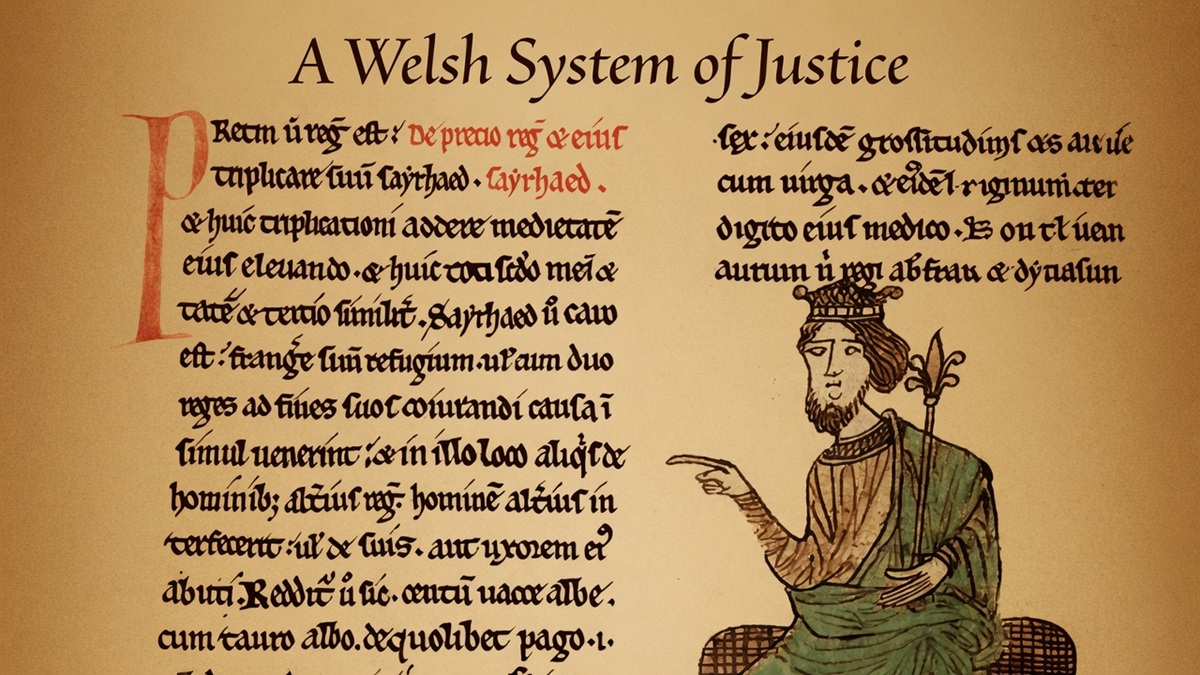
This is where Wales’s own legal past becomes more than an antiquarian curiosity. The medieval laws associated with Hywel Dda are often treated as a source of national pride and little else, which is understandable. They survive only in later manuscripts, none earlier than the second quarter of the thirteenth century, although they contain material of earlier origin, and they describe a vanished world of princes, kinship obligations and social rank that was hierarchical and often severe. They were the law of native Wales until the Statute of Rhuddlan in 1284 brought Wales under English criminal jurisdiction, although Welsh legal custom lingered in places for a further two and a half centuries before being finally extinguished by the Acts of Union under Henry VIII.
None of this should be romanticised into a claim that medieval Wales had a superior legal system, or a proto-constitution waiting to be rediscovered. But it preserved a legal imagination genuinely different from what we now have, in which authority was never merely power. It was an office carrying defined consequences.
That difference is visible in how the ancient lawbooks treat judges. If a litigant challenged a judge’s ruling, both sides had to provide pledges, and if the judge was defeated, the law was unambiguous:
Os methlir yr ynad llys, taled i’r brenin werth ei dafawd ac na farned byth [i]
“if the judge of the court be foiled, let him pay to the king the worth of his tongue, and let him never judge again.”
Symbolism
The symbolism is striking: the lawbooks fixed a value for the loss of body parts – eyes, for example – and here the fine was the value of the tongue, because that was the body part by which the judge exercised authority. The rule was not crudely anti-judge, though. If the challenger lost, he had to compensate the judge for the reputational harm of having wrongly challenged him, his sarhaed, as well as pay the king his tongue-worth – a reciprocal mechanism in which both sides had something to lose.
The lawbooks also place moral demands on judging. One passage lists among the ‘five keys’ of the judge’s office the need to despise riches, hate falsehood and love truth. Another warns the judge not to judge wrongly for wealth: “Let not the worth of a penny be more in thy sight than the worth of God.” Office, in other words, came with expectations and consequences.
It has not been possible to find any concrete historical examples of a Welsh judge actually paying the tongue-worth and losing their job. Certainly, the law prescribed the sanction; whether it was often enforced is a separate question the surviving sources do not answer. The point, however, is not what can be shown by example, it is the instinct set out in recorded manuscripts: that authority is an acceptance of responsibility, not merely a grant of power, and that a person should answer for it when their power is exercised badly.
What might this look like in practice? The old Welsh procedure cannot simply be copied, but it points to a practical principle. Judicial authority was not sealed inside a closed professional hierarchy: it could be challenged from below, and the challenge itself was made serious by pledges on both sides. The challenger had something to lose if the challenge failed; the judge had something to lose if the judgement was defeated. That is the element worth translating.
Ordinary citizens
In a modern Welsh system, the equivalent would not be another tribunal of fellow professionals reviewing process from above, but a route by which ordinary citizens could test the exercise of power from below. A citizen seriously harmed by a judge’s bad judgement or an official’s poor decision, after first persuading a lay panel that the claim was reasonable, could bring a civil claim against that individual, tried by a jury of ordinary citizens. This would be a genuine departure from the present arrangements, where most routes of complaint – ombudsmen, regulators, professional bodies – test whether the correct process was followed, not whether the underlying judgement or decision was right.
Yet it is through judgement and decision making, not process, that power is actually exercised. Had such a mechanism existed, the executives who pursued sub-postmasters through the courts might finally have answered for it personally. Judges or officials whose decisions are shown not merely to have turned out badly, but to have been made carelessly, recklessly or without proper regard to the evidence, would now face consequences appropriate to the harm their incompetence caused. In that respect, it would make today’s ‘small kings’ of the administrative state no different from the Welsh rulers of old: answerable, in the end, to those they governed.
Wales should not settle for an English legal system run by Welsh judges. It should build a Welsh legal system, run by the Welsh – one that asks, as the law of Hywel Dda once did, what power owes to those it is exercised over.
Support our Nation today
For the price of a cup of coffee a month you can help us create an independent, not-for-profit, national news service for the people of Wales, by the people of Wales.
Get more trusted Welsh news
Choose Nation.Cymru as a preferred source in Google News to see more of our journalism.



There is nothing pertinent to the modern practice of law in Wales in this article. Agreed, a separate Welsh jurisdiction could bring advantages. In particular, a streamlined commercial court, guaranteeing decisions on smaller claims within 6 weeks of issuing a claim, could steal business from the other side of the Severn. Fee income from a much faster commercial/ debt recovery court (with a genuinely effective enforcement mechanism) could subsidise less lucrative areas of law like family and criminal courts. The real problem is with public law. There are relatively few judges at present who hear judicial review claims in Wales,… Read more »
“Don’t try to fix what ain’t broken”? I’ll just mention Justice Jeremy Johnson who handed down an unprecedented ruling in the sentencing of four activists from the direct-action group Palestine Action—collectively known as “the Filton 4” (Charlotte Head, Samuel Corner, Leona Kamio, and Fatema Rajwani). The core of the controversy lies in the judge’s historic application of counter-terrorism laws to a case originally tried under ordinary criminal law. English law is slanted to favour those with money & privilege. Like independence we need the dignity of trust & belief in our own justice not the blinkered, monarchist, class ridden Anglocentric… Read more »
The judge doesn’t really get to decide which charge is brought, that’s up to the prosecutor and the prosecutor may use any applicable charge they please not just the traditional charge.
Thanks for your feedback. Judges already face the prospect of losing their jobs – but only for things they do outside of work. For being a bad judge and making unreasonable rulings there is no penalty. Same applies with many other people with power over us. Starmer just got sacked for incompetence, as did Sunak, Truss, Johnson and May before him, and yet others are still pretty keen to be PM. My point is that Welsh law and custom recognised that all should be liable for their actions when exercising power, whereas the English system makes the powerful (apart from… Read more »
I think you are right in wanting to go back to basics, and to draw on something specifically Welsh. Matthew Paul misses the point, which is that Welsh laws, in their day, were better than English ones. And they were the result of something like a Constitutional Convention, called by Hwyel Dda and consisting of all the best Welsh jurists. Wales is starting to break away from English law, in a way which is intended to improve on English law. The problem is that, in typical top-down UK fashion, it is doing this without a basic statement from the Welsh… Read more »
Devolution within the UK is currently an illogical, half-witted hotchpotch. Some issues are devolved only to Scotland (the most), some to Scotland and Northern Ireland and some to Wales (the least number) as well as to Scotland and Northern Ireland. The only sensible and rational solution is to standardise devolution across all 3 countries to that of Scotland.
The Labour Party adopted “Home Rule all round” as a manifesto policy in 1918. Based on Dominion Status. What happened after 1918 was that Ireland did Dominion Status, had a civil war and got Indy, all quite quickly. Plaid was pro-Dominion Status for obvious reasons and then forgot all about it because it went left/woke. We need to re-learn basic real-politik. Yes, Gwyn, your are right. Dominion Status all round. (It could in fact be bespoke tailored to Wales, Scotand and NI.) So what’s not to like?
What would the Welsh justice system look like today if Cyfraith Hywel had been left to evolve? Our prisons are full and we have a lot more prison inmates per head of population than the countries of continental Europe. More restorative justice less punitive justice? If we could ditch British exceptionalism and “ee-uh”, are there aspects of the continental system, we might want to consider- more inquisitorial, less adversarial, less dependence on barristers’ eloquence? The question of legal aid needs revisiting. Easier to navigate civil courts procedures for litigants in person are needed. Are there roles for AI?
… I see Reddit being referenced in that image. But pattern recognition aside. While I don’t disagree with more devolution to Wales I am a touch concerned about the “English justice” narrative. England’s justice system is largely of European heritage, from the Vikings, to the Normans and the Saxons, indeed even the Romans. There is very little “English” in there. The Welsh system of justice, prior to being conquered by England had its own issues, but also a lot of merit. Unfortunately, I don’t believe that enough people in Wales would be willingly onboard with the idea of Welsh Justice.… Read more »
Pick and Mix