
After Iran, is Cuba next in the US firing line?
Adam Johannes
Donald Trump stood outside the White House recently, helicopters chopping the air behind him, and mused that the United States might stage a “friendly takeover” of Cuba.
He dismissed the island as a “failed nation” and bragged that its government was desperate: “They have no money, they have nothing right now.”
As his administration moved to choke off Cuba’s oil supplies, Trump hinted – pure mob-boss patter – that Washington might cut some kind of “deal” with Havana. He didn’t bother explaining what that deal might look like.
Under Trump, the US is once again asserting its claim to what it has long arrogantly described as “its” backyard. It has revived the old imperial doctrine that the Western Hemisphere is its exclusive sphere of control.
Its goal is to push economic rivals such as China and Russia out of the region while disciplining any government that refuses to align with US strategic and economic interests.
The raid in Venezuela that abducted its president, the demand that Greenland be handed over to the US, and mounting pressure on Cuba are all moves on the same imperial chessboard.
Blockade
For more than sixty years, the US has waged economic war against Cuba. The blockade was imposed after the Cuban Revolution nationalised US-owned property on the island.
Since then, Cuba has been denied normal trade with a neighbouring country just ninety miles away. Instead, it has been forced to import essential goods from distant markets, dramatically increasing costs and placing a heavy burden on the entire economy.
Despite this relentless pressure, this small island of eleven million people built a system that for decades guaranteed universal healthcare, free education and a wide range of social protections. Cuba has one of the highest doctor-to-population ratios in the world and has sent thousands of doctors to work in more than forty countries.
While Cuba’s social achievements always coexisted with political restrictions on human rights, the revolution in its heyday demonstrated something powerful, that a relatively poor country could still guarantee basic economic rights to its people.
For millions watching from the margins of the global economy, that alone made Cuba a symbol. For those searching for alternatives to the dominant economic model, it suggested that a different set of priorities could exist.
For the victims of imperialism everywhere, the island’s survival in the face of relentless US hostility has always meant something larger. It has served as proof that resistance is possible, that not everything must be surrendered to the dictates of the market, and that not every country has to bow before the Washington consensus.
Cuba’s survival under decades of US pressure was never simply a matter of luck. During the Cold War, the Soviet Union helped keep the island afloat, buying Cuban sugar and supplying oil, food, arms and machinery.
When the Soviet Union collapsed, Cuba was plunged into what became known as the Special Period, a time marked by severe shortages, rationing and deep economic hardship.
In the 2000s, Venezuela under Hugo Chavez revived Cuba’s lifeline, shipping in subsidised oil in return for medical and technical services. But the situation changed dramatically after the US kidnap of Nicolas Maduro in January 2026.
Crisis
In late January, Venezuela’s interim government agreed to the humiliating ritual of submitting monthly a budget for inspection by the Trump administration, which then releases funds from an account funded by the country’s oil revenues and initially managed by Qatar.
With Venezuela under intense pressure from Washington, oil shipments to Cuba stopped, and Caracas instead resumed export to Israel, something that Chavez had halted after Israel’s assault on Gaza in 2008-9. The loss of Venezuelan supplies triggered a severe energy crisis on the island.
Washington quickly moved to deepen the crisis. Trump declared a national emergency, absurdly describing Cuba as an “extraordinary threat” to the American people. His administration threatened punitive tariffs against any country that sold oil to the island. Mexico, Cuba’s main oil supplier after Venezuela’s crisis, cancelled its shipments.
Since December, no oil has entered the island. Cuba imports roughly two-thirds of its energy needs. The total energy embargo has cut Cuba off from crucial oil supplies. Without them, electricity blackouts, already severe, have dramatically worsened, lasting up to sixteen hours a day in some provinces.
State-owned companies have scaled back operations, moving to a four-day workweek and remote work wherever possible. Public transport has been gutted. Inter-city buses, trains, and ferries now run on skeleton schedules, leaving ordinary Cubans stranded.
Cultural life is collapsing. Major events, including the Havana International Book Fair and the Cigar Fair, have been cancelled. Schools have shortened hours, universities have shifted to remote learning, and hospitals are postponing non-urgent procedures to prioritise essential treatments.
International airlines have been told that Cuba has run out of jet fuel, forcing suspended flights and dealing another blow to tourism, one of the country’s main sources of revenue.
Even the state media is feeling the strain. Granma, the Communist Party official newspaper, will now appear only once a week, while regional papers have stopped printing altogether. Radio stations are cutting back broadcasts or going off the air as repeated blackouts damage equipment.
In Havana, mountains of cardboard, plastic bottles, torn bags, and rotting food choke the streets, attracting swarms of flies. Residents dodge the piles while others scavenge for anything usable. With fuel critically low, fewer than half of the city’s garbage trucks are operating, leaving much of the capital to rot under the sun.
Jacob Lesniewski, a regular visitor, said: “When you arrive in Havana, you can tell something isn’t right, but it’s nothing compared to what you see as you travel farther east. Entire cities look like ghost towns. Factories, schools, and hospitals that once functioned now stand empty and deteriorating.”
Put bluntly, by choking off every drop of oil and gas headed for Cuba, the US aims to tip the island’s economy off the cliff edge into outright collapse – destroying the country – an exercise in collective punishment whose costs will be borne by the Cuban people.
Hope
Although many governments denounce Washington’s actions, none are prepared to confront the US directly. Some have sent humanitarian aid, but none have supplied the oil Cuba desperately needs.
There’s a sliver of hope. Resistance is emerging from the grassroots. In Brazil, the United Petrobras Workers Federation has launched an Oil for Cuba campaign, pressing the state oil giant Petrobras to send emergency shipments and demanding that the Lula government stop talking and start acting.
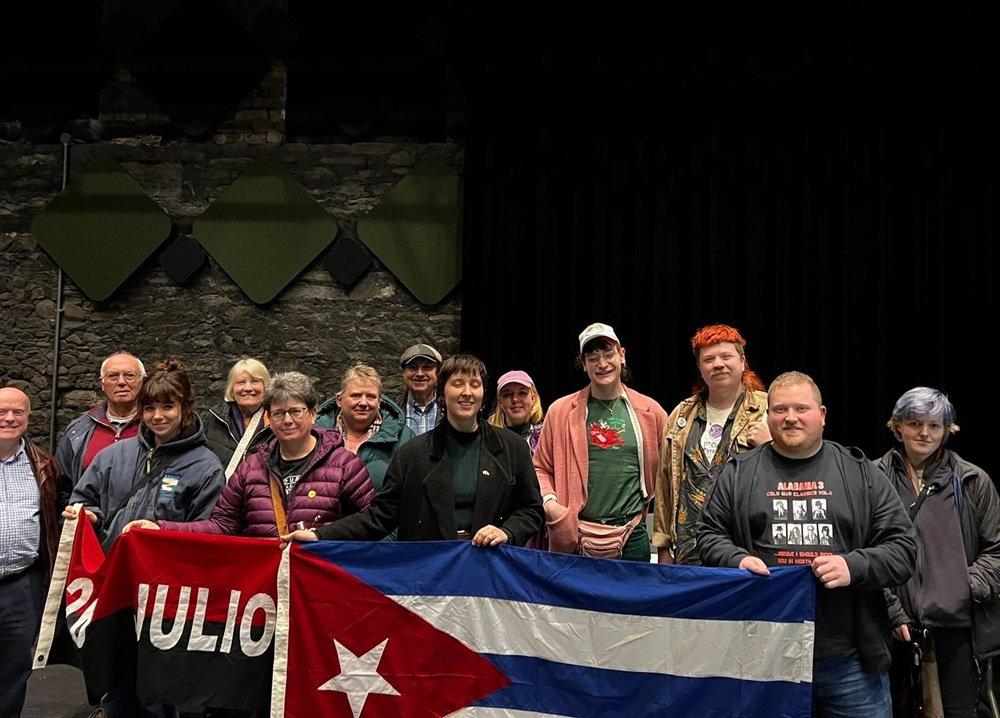
The Landless Workers Movement is sending medicines. It’s a reminder that solidarity often starts with ordinary people.
In Santiago, Chile, a comrade tells me posters reading “Cuba is Not Alone” are appearing everywhere across the city. Some Chileans remember the US-backed coup of 1973, and what happens when a powerful country decides yours has stepped out of line. Those memories matter. They remind people why international solidarity is important.
The Nuestra América Convoy to Cuba is a global mobilisation delivering humanitarian aid by air, land, and sea, scheduled to reach Havana on 21 March 2026. Inspired by the flotillas that sought to break the siege of Gaza, the convoy is supported by prominent figures of the international left, including Greta Thunberg, former Barcelona mayor Ada Colau, Jeremy Corbyn, and US Congresswoman Rashida Tlaib, linking grassroots solidarity with high-profile political backing in defiance of the US blockade.
The only thing that can really make a difference is mass pressure from below around the world, enough to push governments to stand up to the US and break the oil blockade. The slogan must be: Cuba today, us next? Economic warfare against one country is always a warning to others.
As the US resurrects the Monroe Doctrine and tries to reassert its grip over Latin America, the task for anti-imperialists internationally is to build real mass opposition to military threats, sanctions and economic strangulation. That means defending the right of people in the countries targeted by Washington to decide their own future, free from US coercion
If Cuba is crushed, as the Palestinians are being crushed with even greater brutality, the lesson will be clear: those who refuse submission to powerful states will be broken. In the new global order, alternatives are not permitted – they are isolated, starved, and erased.
The question for the rest of us is whether we accept this – or stand against it before it is too late.
Support our Nation today
For the price of a cup of coffee a month you can help us create an independent, not-for-profit, national news service for the people of Wales, by the people of Wales.



Cuba should be left alone. Nevertheless, as Amnesty etc have repeatedly noted, it is a dictatorship and deeply repressive towards journalists, political opponents etc. Even the Manics have expressed regret at their dalliances with the regime. A simple Google will tell you all you need to know.
But does this in any way justify inhumane treatment of a whole society?
Repressive towards journalists, political opponents etc?
A dictatorship?
Is it run by paedophiles who are only interested in enriching themselves?
Do they have a network of concentration camps and gangs of masked thugs roaming the streets, grabbing people on the basis of skin colour?
Reminds me of somewhere……..
Cuba maybe a communist dictatorship but that does not give the USA the right to intervene. Furthermore Trump insisting that Cuba, Venezuela, Greenland etc are in the USA’s sphere of influence is no different to Russia making the same claim about Ukraine. If a country wants a sphere of influence then they have to earn it. Its pretty simple: respect the sovereignty and territorial integrity of your neighbours.