


Banking on it…
Desmond Clifford
I was pleased to note that Rhys Phillips, from Baglan, is the first Welshman appointed Chief Cashier at the Bank of England.
It’s a job with long provenance and prestige. The Chief Cashier is the person whose signature sits on the bottom of every Bank of England banknote.
At one time, the banknote was redeemable against its value in gold if you took it to the Bank of England. That was the reason why banknotes were adopted in the first place: to end the inconvenience of people carrying lumps of precious metal around.
Banknotes, of course, have no real intrinsic value; their value rests on the prestige of the bank which issues them. For all Britain’s economic challenges, the Bank of England and sterling are still a safer bet than most, though I think you’d get funny looks these days if you turned up demanding gold from the bank.
In an obvious sense, this matters rather less than it used to do. An unexpected consequence of Covid was the rapid decline of physical money. As a result, fewer people will see Rhys’s signature than would once have done.
If my memory is accurate, I met Rhys at an earlier stage in his career. In 2014, or thereabouts, Mark Carney, newly appointed Governor of the Bank of England, visited the First Minister, Carwyn Jones. I worked for Carwyn as a civil servant, while Rhys Phillips was the Bank staff officer accompanying Carney.
Carney was easy and friendly. We talked rugby. Both of us had attended the Wales–Canada match in Cardiff in 1993 when Canada beat Wales for the first and, so far, only time (24–26). Wales was going through one of its periodic bad patches. At the time, it was Canada’s greatest-ever victory – and for Wales, perhaps the worst defeat, though even then there was some competition for that spot.
That meeting in 2014 was very congenial. Under the direction of a Canadian, the Bank had become slightly embarrassed about its Englishness and aimed to address this by introducing national symbols onto its notes.
Modern banknotes, although still primarily English in character, do carry national images, including a Welsh heraldic shield, dating back to this period.
Carwyn Jones wanted to go further and see fully bilingual banknotes (or multilingual; they’d have to carry Scottish and Irish Gaelic too). Lots of countries have them and it’s perfectly doable. Canada, where Mark Carney had just come from, has bilingual notes.
Carwyn began writing letters to the Bank of England. The first response was detailed and courteous. The second was a little less so. The third response arrived by return and was barely polite.
The Bank refused to carry Welsh on its notes and still does. There’s no rhyme or reason about these things. Everything is impossible until suddenly it’s possible. It used to be “impossible” to have Welsh on a British passport until Rhodri Morgan, if I remember rightly, insisted and it became possible overnight. No one thinks less of a British passport as a result – it only adds character – and Welsh people are able to see direct recognition of their language.
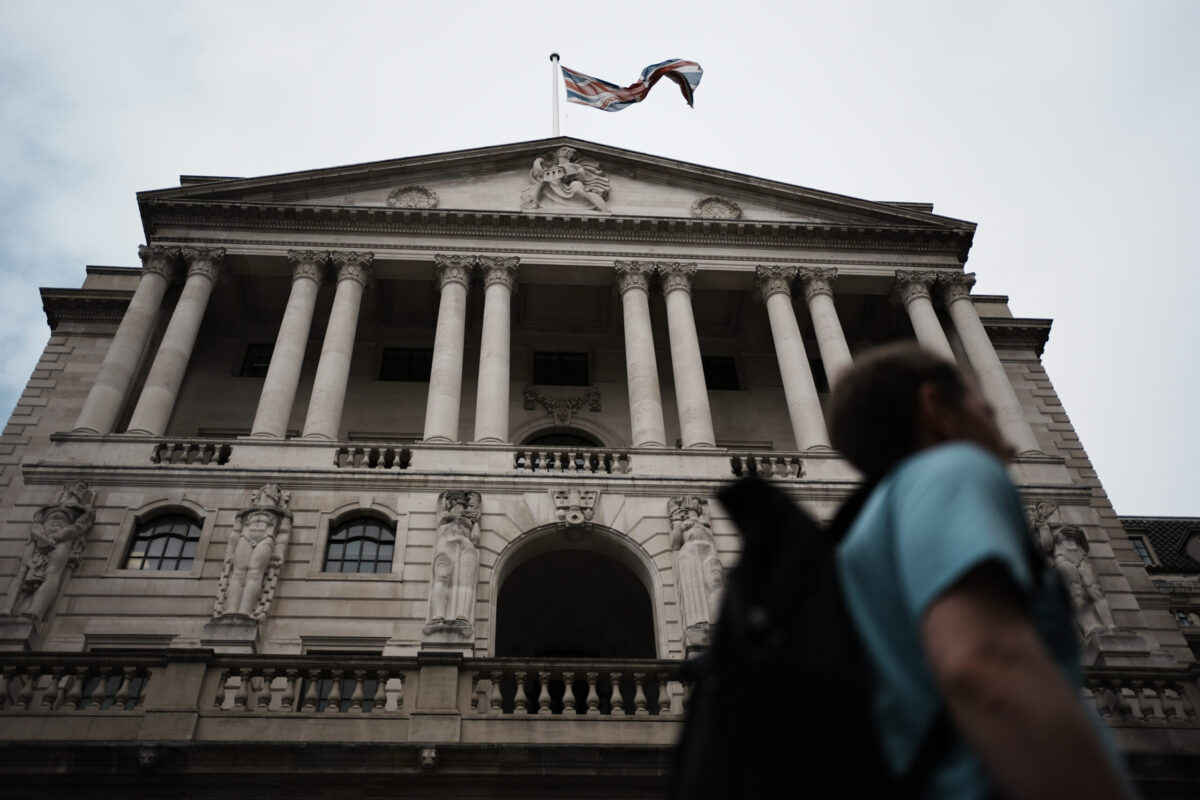
The Bank of England has powerful branding but is, of course, deeply anomalous. The fact that the central bank for Wales, Scotland and Northern Ireland is named only for England is strange and part of the weird spaghetti of nomenclature which characterises the United Kingdom.
It is particularly interesting to note that the UK’s chief financial institution is so closely associated with England and, notwithstanding Rhys Phillips’ pleasing appointment, so distant from Wales.
This tells us something important about England, about Wales and about the distribution of power in the United Kingdom. In fairness, I should add that the Bank engages very diligently with the Welsh Government and regularly provides economic briefings to the First Minister, although the very helpful agent who covers Wales is based in Liverpool. Again, not ideal.
‘Fractional banking’
The Bank of England was created by legislation in 1694. It became the cornerstone of England’s emerging wealth-creation capacity as a global trading nation. The Bank was established using the concept of “fractional banking”. This means, in essence, that the same money can be lent many times over as a paper transaction.
Without banks, physical money can only be lent once. After you’ve lent me £100 in cash, you don’t have that money again until I give it back. Through fractional banking, money can be lent to many people at once – millions of them today. In effect, the bank is lending the same money to different people in the hope that its own creditors won’t all turn up at once demanding their deposits back.
This is exactly what happened when Northern Rock went belly-up in 2007, starting Britain’s version of the international banking crisis. Among other things, it’s the Bank of England’s job, as the chief among banks, to ensure that rules are followed and that banks don’t overexpose themselves.
The Bank of England financed Britain’s imperial expansion. Its credit financed wars and speculative trading voyages, including, tragically, those involved in slavery. It also helped finance railways, ports, shipbuilding and expeditions. It paved the way for England’s union with Scotland, since Scottish banking had failed at the international level. Access to English banking facilities was a key motivation for Scotland to join the union and, as it turned out, the Scots proved to be natural bankers themselves.
Not so Wales. Money and Wales have always been rather distant from each other. Wales has a workforce as good as anyone else’s and has produced some notable entrepreneurs. What it has always lacked, and lacks still, are indigenous sources of non-government finance. Welsh business is largely dependent on British banks or investment from elsewhere.
Territory
Does this matter? Does it materially damage Welsh business culture? It’s hard to prove a negative, but I’d argue that the absence of a native banking sector militates against a domestic financial and entrepreneurial culture. It contributes to the idea of Wales as a territory from which money is extracted, along with its resources. Historically, this has often been true, as George Monbiot reminded the BBC Question Time audience in Brecon the other week.
As ideas for the Welsh Government’s new Economic Development Agency take firmer shape, it will be interesting to hear what proposals emerge on access to finance.
Banking is an underexplored idea in Welsh politics, and nationalism especially. An independent Wales would require a central bank and a currency. This was a weak flank during Scotland’s referendum in 2014. Alex Salmond argued, rather feebly I thought, that Scotland would keep the pound sterling, at least to begin with. It raised an important question.
Assuming the British government couldn’t stop an independent Scotland using the pound (and why would it really want to?), the position would be that the new Scottish government wasn’t truly sovereign. Interest rates and other important decisions would be taken in London and Scotland would have no say over them. It’s not really independence, is it?
Doubt
Tremendous doubt was generated around this topic during the 2014 referendum (Carwyn Jones contributed to the doubt through his intervention in Scotland). It would be surprising if the Scottish Government went into another referendum with the same policy in place. In fact, no policy is entirely robust. What SNP strategists are afraid of – very rationally – is the sort of speculative attacks which drove sterling from the Exchange Rate Mechanism back in 1992, after costing the Treasury billions in spent reserves. It stands as one of the gloomiest days in modern financial history and is the reason why this seemingly arcane topic should be taken seriously.
The best policy I have to offer, if similar circumstances were to arise again, is the creation of a Scottish pound (or a Welsh pound) pegged to the value of sterling, at least as a starting point. This offers a stable value for the currency (in theory, at least) while also establishing a notionally independent national currency (again, in theory). Then keep your fingers crossed and hope that nothing goes wrong. In slower time, other options such as joining the euro – or pegging the currency’s value to the euro – might come into the frame.
This may all seem a little esoteric but, if Plaid win the next election too, their aim is to trigger a referendum and to persuade voters of the case for independence. If so, this is one of the many questions that will need an answer.
Support our Nation today
For the price of a cup of coffee a month you can help us create an independent, not-for-profit, national news service for the people of Wales, by the people of Wales.
Get more trusted Welsh news
Choose Nation.Cymru as a preferred source in Google News to see more of our journalism.


