
Blackweir Live: What should happen about the lack of planning permission?
Jeremy Sparkes, Cardiff resident & campaigner to keep public space public
After Nation.Cymru published my Opinion article asking whether there was a lawful basis for Blackweir Live, it seems that the Council decided – several months after it knew that the 28 days temporary change of use permission was not sufficient to take the largest open parkland part of Bute Park out of its normal use and access – that it should review the legal situation.
On 10 July 2025 its Officers made a Decision not to require a retrospective application for permission beyond the 28 days to be made and that it would take no further action in respect of the breach. This Decision was confirmed and signed off by the Chair of the Planning Committee.
There is provision in the Council’s mechanisms and processes for this approach to be taken to the planning matter.
Blackweir campaigners were not aware of there being a review until the Decision was provided to them on 22 July, nearly 2 weeks after it was made. There was, apparently, no provision in the process for the community to have its voice heard which, of course, would have been possible if a retrospective application was made.
Two-year commercial agreement
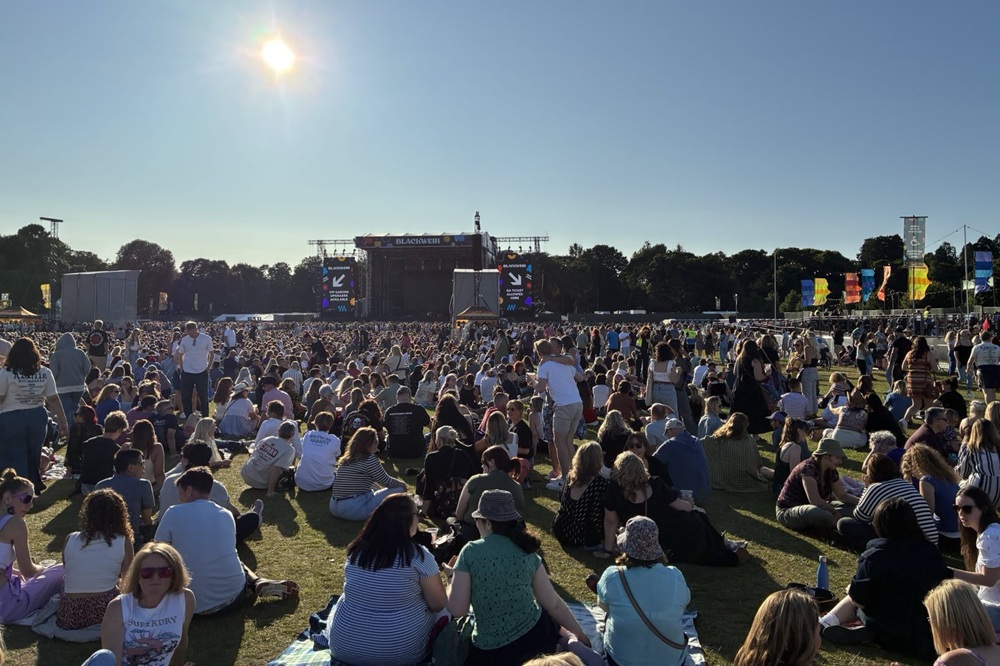
This decision does not make any sense because the Council announced last year that it had entered into a two-year commercial agreement for Blackweir Live to be staged in Bute Park and the private music operators have already started their marketing campaigns for 2026.
Unless the Council and event promoters give an undertaking that the whole thing – from the very start of public use and access being changed, through all the events and the break down of the site, to finally giving it back to the people – will not again exceed 28 days then the question of applying for permission is a key dependency. Perhaps it will mean that tickets will be sold with “Subject to planning permission” replacing “Sold subject to Licencing” which happened for 2025.
Councillors and planning
Most folk have a planning story and ward councillors know that this can be a key area of concern for their local residents. This can place them in tricky situations where they perhaps know some of those involved well or they may have a conflict of interest.
It is interesting to see what sort of things can happen.
At ward level, Councillors have been told that they cannot speak at planning meetings where they know one of the parties even if it is only incidentally. For example, in relation to their non-representation at a planning meeting on 06/10/2022 a ward councillor explained:
“I’m afraid that both Cllr Wild and I have discovered that we have a conflict of interest as we found out – after registering our objections – that we both know the applicants (Caro knows Charles Williams and I know his wife, but under a different surname). We are therefore not able to be part of the discussion or speak to the item. I’m sorry about this but we have had formal advice to this effect and need to heed it.” Cllr Leonora Thomson in subsequent media interview.
Llandaff North’s Councillor Dilwar Ali was also advised in 2023 that he could not present ward residents’ concerns at a full open meeting of the Council because of the fiduciary duty he owed to the Council.
Legal cases
Beyond Cardiff there have been two significant legal cases around the duty of councillors in planning decisions and loyalties creating conflicts of interest that may require councillors to recuse themselves from the decision-making process.
In the matter of CPRE (Somerset), R (On the Application Of) v South Somerset District Council in October 2022 the High Court found that where advice is not correct in law, then the decision should be set aside.
It set out as follows: “That advice flowed from [Monitoring Officer’s] honest analysis and application of the Code. The Monitoring Officer went wrong in law, as many public decision-makers and most judges do at some point, but was not otherwise at fault.” [Paragraph 57]
Even more recently – and relating to a local authority in Wales – the Court of Appeal ruled that councillors had been given unlawful advice by the council’s monitoring officer to the effect that they had no discretion to reject the plan when it came before the Full Council in December 2023 and could
face prison, fines, seizure of assets or Ombudsman complaints if they voted to reject it again. [Jones v Wrexham Council & others, Dec 2024].
The Welsh Government sought permission to have this decision reviewed by the Supreme Court but this was denied, so the Appeal Court ruling stands.
So it has given me cause to wonder that although the Council’s choice of an Officer/Planning Chair Decision process for Blackweir Live was an option, the fact that the Council itself stands to reap a significant financial benefit from the changed use of the land for the period that far exceeded the 28 days – Council Leader, Cllr Huw Thomas, has drawn attention on several occasion to this being one of the most important factors – means it is valid to ask whether it is possible for councillors, for the Cabinet, and for Council Officers to attempt to manage planning regulations in a fair way in the eyes of the public?
Welsh Government involvement
There is an alternative option which would have managed the Council’s significant financial conflict of interest, provide transparency in the process and so deliver trust in whatever final decision is made. This is well known with planning applications where they can be subject to a “call in” by Welsh Government but how can you ask for something to be called in when there hasn’t been an application?
As the initial opinion piece – which seemed to trigger the review – noted there is provision for such a circumstance in Welsh Government’s reserve powers. Its Development Management Manual which sets out: “LPAs [Local Planning Authorities] are primarily responsible for planning enforcement within their areas. However, the Welsh Ministers hold reserve powers in this regard, allowing them to issue enforcement notices and breach of condition notices following consultation with the relevant LPA. Such a step would override the planning authority’s decision on an issue that falls under its responsibility and would be justified solely in exceptional cases, such as when there is a significant failure or dysfunction within an LPA and failure to intervene could harm the broader public interest if left unaddressed.”
Note that it covers enforcement notices and breach of conditions.
Cardiff Council has already confirmed that the 28 days temporary change of use has been breached by a significant period adversely impacting public access and normal use of the largest piece of open parkland in a Grade 1 Listed Park with over 2m visits in 2024, with more champion trees than any other municipal park in the whole of Britain and with an arboretum containing over 3,000 individually catalogued specimens.
As a Grade 1 Listed Park it comes under the remit of CADW and CADW comes under the remit of the Minister for Culture, Skills and Social Partnership, Jack Sargeant.
So the provision to intervene is there and I believe that such important decisions should not be made by a local authority which has a direct and substantial financial interest in the decision.
I have written today to the Minister to ask him to confirm that he will – if he has not already – liaise with his colleagues to understand this matter and establish a way forward.
Support our Nation today
For the price of a cup of coffee a month you can help us create an independent, not-for-profit, national news service for the people of Wales, by the people of Wales.



Cardiff Council seem to do whatever they like and get away with it. Good luck resolving anything.
A clearer case of self-dealing would be hard to find.
There’s an under-current of corruption and general mismanagement in Cardiff council that’s been evident since this shady Huw Thomas character has been at the helm.
As is usually the case, there are other worrying clues that this might well be only the tip of the iceberg and a wider public enquiry into Thomas, his cronyism and the wider public interest feels justified.
Some people are simply not fit for public service
I agree. The way this council kept on heaping pressure on WG to approve the construction of a massive business park in St. Mellons was just wrong, immoral and without any business case. The initial planning application categorically stated the train station would be built first. Then controversially in the next altered planning application, this train station in East Cardiff would only need to be built after 3/5ths of the large site was constructed on. The developer was building massive 15 storey office blocks so this would take several years to build and there are so many office spaces vacant… Read more »
Some residents seem to forget they’re in Wales’s capital city not a UNESCO protected heritage village. Campaigning to do this better in future is one thing but trying to prevent similar events altogether is to undermine the city and the nation which are both damaged if high-profile events like this can’t happen at all.
So that justifies Cardiff Council doing things illegally? Also there are other places in Cardiff where these events could have taken place without cutting down trees and disrupting wildlife. Cardiff used to be proud of it’s “green wedge” creating a wildlife corridor from Forest Farm right into town. Being against a certain location and illegal decisions doesn’t mean being against live music events,