


Bring Back the Birch
Ben Wildsmith
Are we giving upon redemption? Over the last few days, news, both local and international, has provoked responses that suggest it’s heading that way.
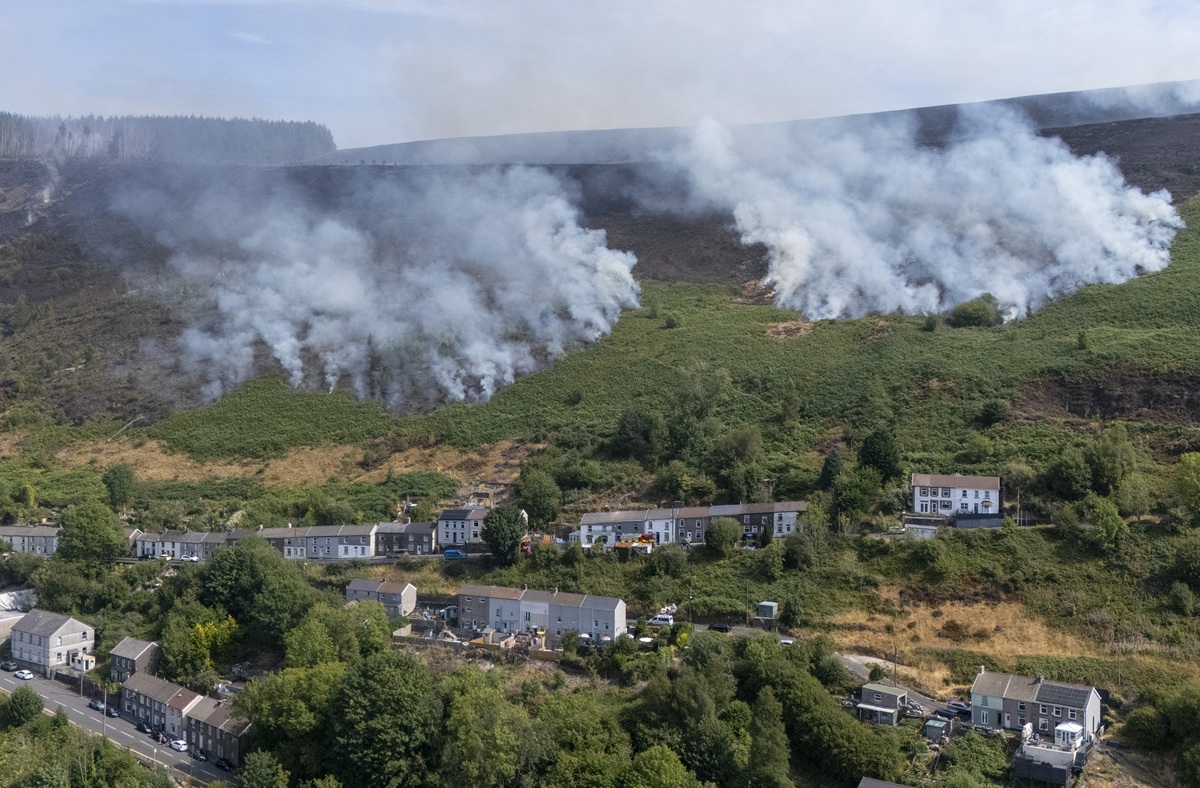
The wildfires on the mountains around our home in the Rhondda have been dangerous, frightening, and relentless. As soon as one was tackled, it seemed, three more had broken out. The army was eventually sent in a couple of days ago to assist exhausted fire fighters, and it’s to be hoped that a spell of cooler weather will ease the situation going forward.
Beneath the scorched surface, though, the fires continue to smoulder, with devastating effects on wildlife that will take decades to rebalance. It’s a horrible business that has affected everyone in the area one way or another.
From the outset, social media speculation focussed on identifying culprits. Overwhelmingly, people blamed ‘kids’ for setting the fires deliberately. So, when four local teenagers were arrested for doing just that, many felt vindicated in their beliefs.
Some spoke of a TikTok challenge that supposedly inspired the crimes, with others pointing to a decline in parenting skills. The unifying theme was that these fires were emblematic of a decline in societal values. They said that last year though, as well, and the year before that.
A common post on the local Facebook group, cropping up from multiple users, demanded that we ‘Bring back the birch.’ Others explicitly hoped that teenage offenders would be burned in the fires.
Devilment
I don’t know precisely what motivated my grandfather to set fire to the same mountain back in the 1920s when he was a kid, but it certainly wasn’t TikTok.
His devilment wasn’t deterred by fear of the birch, either; that was in use until 1948. He went on to become a teacher and choir master, served in World War II, and founded Birmingham Welsh RFC.
Could he be a little sod when he was young? Clearly. Was he beyond the reach of anything but violent retribution? Clearly not. Grandad’s gang of pre-teen delinquents got clean away with their misdeeds and just, well, grew up.
Zero-tolerance attitudes always seem to be tightly focussed on particular groups. When the Bullingdon Club at Oxford was trashing restaurants and burning £50 notes in front of homeless people, members like David Cameron and Boris Johnson had no need to worry about the implications for their future careers.
The mindless thuggery of the lower orders is indulged in the privileged as high jinks – evidence of an independent spirit. For some, a refusal to play by the rules is unacceptable from the off, for others it’s a qualification to rewrite them.
A person on the dole who does a morning’s cash-in-hand cleaning will provoke more vitriolic condemnation than all the tax-avoiding CEOs of vulture capital firms put together.
The chief sin of monarchical subjects is to obtain privilege, however tiny, that has not been granted through the correct chain of command. Know your place.
Rage
In the sad tale of Jason Arday, the recently deceased academic, it is his elevation to unearned privilege that has ostensibly provoked rage. In a country that boasts Charles Windsor at the apex of society, and which has recently entertained Liz Truss, Boris Johnson, and Keir Starmer as prime ministers, the idea that some Herbert should game the system to get a job for which he was under-qualified is, apparently, beyond the pale.
Over 250 articles in print newspapers, followed by the man’s apparent suicide are not enough to satisfy justice in this case. Now, before his funeral, commentators feel moved to double-down on the rectitude of their case against him. There should be no sympathy, he was a fraud, DEI is a cancer on society, etc. etc. etc.
Caught between the breathless joy bleeding from their prose, and the absurdity of posed indignance, hacks like Julia Hartley-Brewer and Alison Pearson refuse to leave the feast until the last bone is picked clean. Theirs is a moral crusade, you see, ranged against one man who offended against the sacred hierarchy. So what if he died? It was pour encourager les autres.
Empathy
A society that can offer no empathy or opportunity for amends to those who transgress is on the bones of its civic arse. Are we really so impoverished now that we don’t have the bandwidth to accept frailties in others at all?
We are increasingly addressed as if we are in perpetual crisis, on a war footing that means nothing is affordable and nothing forgivable. Every penny is jealously guarded for ‘our NHS’ as if survival is the limit of our ambition.
In that atmosphere, all bad behaviour can be framed as treachery for which no quarter can be given. Our social scope is being narrowed to a fixed point of obedience that grace cannot penetrate.
Support our Nation today
For the price of a cup of coffee a month you can help us create an independent, not-for-profit, national news service for the people of Wales, by the people of Wales.
Get more trusted Welsh news
Choose Nation.Cymru as a preferred source in Google News to see more of our journalism.



Obedience or compliance?
Your grandad no doubt had at least a bollocking probably a clout around the ear but no police record and went on to be a good citizen. I doubt those teenagers will be so lucky they’re now in the system which cares not one bit for them. Not one of the things that is better now in my view.
It was only a bit of a fire, but to be chased off the side of Cader by a cross farmer on a large white horse who ran the legs off us was enough. Didn’t do that again…
Jason Arday’s death is a reminder of how we are still a class riven society. He was racially hounded by the right-wing press, the Telegraph and Spectator, in particular no doubt cheered on by the hierarchy in Cambridge. It is a reminder of the evils of “Burtism” which resulted in the insertion of falsehoods into our education system designed to protect the privileges of the ruling rich classes. They took full advantage of Francis Galton and Sir Cyril Burt and their role in maintaining the UK Class System One of Galton’s most significant, and most dangerous, contributions was to develop… Read more »
Lord Gove of Moral Maze, editor of Spectator, Brexit champion, BBC construct and a Treasonist along with Fat Shanks. Boy are we feeling Burt’s and their effects…
He was exposed by The Guardian no less – hardly right wing to say the least! It’s a sad tale but it’s obvious that he made a number of false claims. Also worth noting that he sent the police after an innocent academic and a journalist who began to question his claims, his work etc.
The Guardian borrowed freely from attack lines against Jason carried by the Mail, Times, Telegraph and elsewhere, says Jo Maugham
I’ve been publicly critical of the Guardian’s conduct on this story and so, as neutrally as I can, I want to set out the facts as I know them before making some general points.
Hounding to death of this poor man is despicable, yet people like Johnson get a gig at the Daily Mail. Seems to have started with Cofnas, yet the UK press went for it.
And JHB, reprehensible bit of slime.
Reform have started a go fund me page so they can have whip-round.
Lack of education for those starting these fires and the fools wanting to beat kids. The birch was an abuse of power, all corporal punishment becomes that. I say that as someone who was hit with rulers big or small, threatened with the cane and slapped. More things like a spelling wrong. Or if I corrected someone. The shock of the animals they might have killed surely would be a better thing to pint out, educate them.
Bring back community! 1920’s Rhondda, “The Street”, was a community. At some point, it must have dawned on Mr Wildsmith’s “little sod” of a grandfather the extent to which he and those around him relied on mutual support. No DWP. No adulation online for silly stunts. Transgress the norms and rules of where you lived and it wasn’t sanctions from anonymous state agencies or the criminal justice system that would have worried him, so much as fear of being ostracised by family and friends, or ending up in Llwynypia or Pontypridd workhouses that probably turned bamby around.
When I read the headline, I thought someone had asked for birch trees to be planted instead of what’s there now, presumably because they’re more fire-resistant.