


Cambria Will Not Yield!
Mudiad Eryr Wen
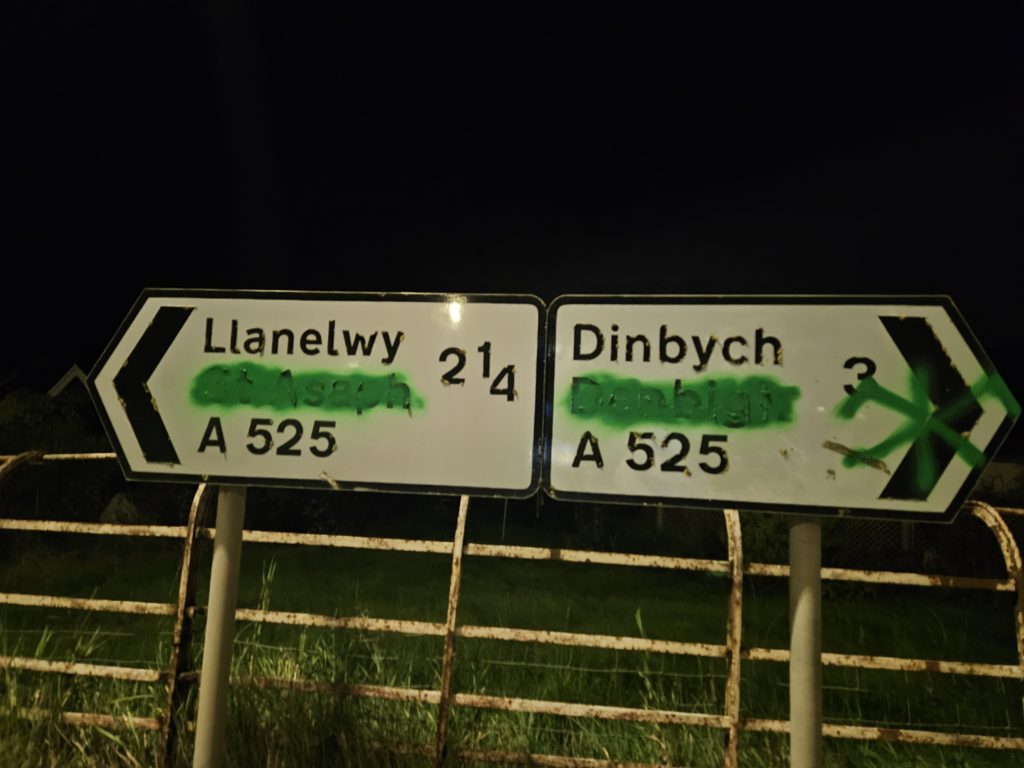
Very recently, GB News decided to draw a connection between a recent action by Mudiad Eryr Wen activists in Wrecsam and the (now) rapidly growing Senedd petition to officially refer to Wales as Cymru.
Given the standard of “journalism” one can expect from GB News, it should come as no surprise that the apparent link between MEW and the petition doesn’t exist.
While the movement has long campaigned for the removal of anglicised names for our towns and villages, it has never formally taken a position regarding the name of the country itself.
In light of this, we would like to take the opportunity to clarify our position regarding naming conventions in Wales, in addition to our proposal in relation to this particular debate.
When it comes to places within Wales, our position is unequivocal: anglicisations should be consigned to the dustbin of history.
Most of these names are mere corruptions of the original Welsh, such as “Crickhowell”, “Cardiff”, “Denbigh”.
In other, more ridiculous instances, the corruption barely, if at all, registers in pronunciation, such as with “Merthyr Tydfil”, “Ruthin”, “Caerphilly”, “Kidwelly”, “Treorchy” etc.
This isn’t without precedent, as the likes of “Dolgelley”, “Carnarvon”, and “Conway” were previously removed from use over the course of the last century and have since faded into obscurity.
There are many Welsh exonyms for places in England, most of which predate the English names. Nevertheless, these names do not appear on road signs in England, nor would anyone reasonably expect them to.
In a similar vein, Germany doesn’t display “Nuremburg” on signs for Nürnberg, nor does it display “Munich” on signs for München.
A nation’s adoption of its own endonym for domestic use does not constitute a “ban” on others using an exonym in their own language, despite GB News’ attempt to frame it as such.
Modest revision
With regard to the national name, we propose a modest revision to the petition’s current proposal.
While we broadly support the petition, especially its call for changes to naming conventions in Wales in line with the principles set out above, we believe a more nuanced approach would be preferable.
In a domestic context, the Welsh Government should transition to using Cymru exclusively, just as Germany refers to itself as Deutschland, or Albania refers to itself as Shqipëria.
However, as with these examples, a different name should be used in an international context. This is primarily because it reflects the existing international standard, with only a handful of recent examples, such as Türkiye, departing from this convention.
Another consideration is simply pronunciation. While we firmly reject such arguments in relation to domestic place names, we believe that, in an international context, it is preferable to use a name that is more readily pronounced.
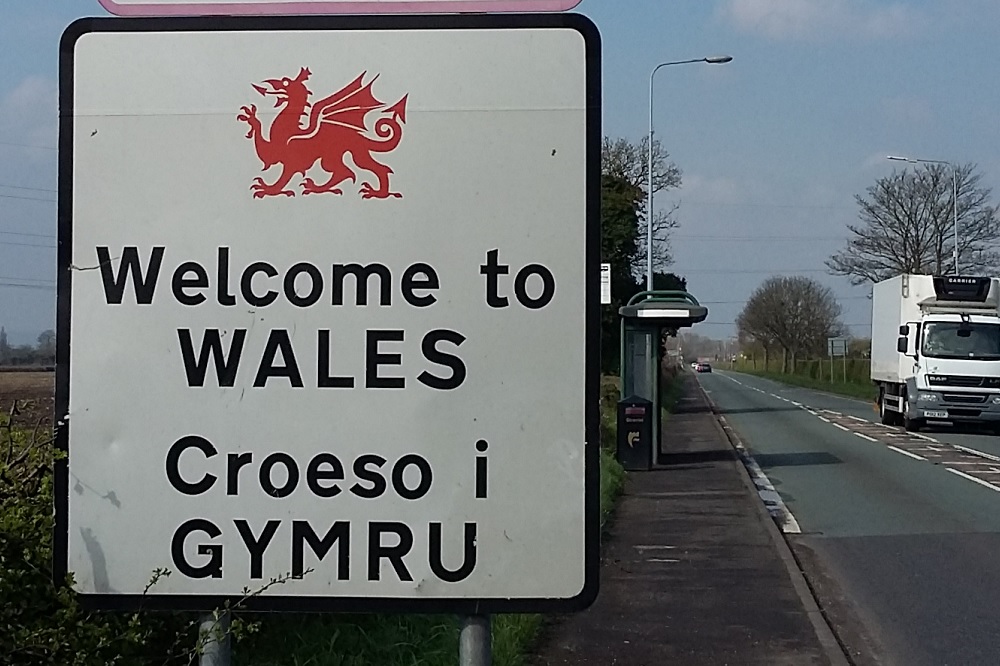
Despite the relatively simple pronunciation of Cymru, many people, both English and non-English alike, continue to mispronounce it on a regular basis.
For these reasons, we propose an alternative name on the international stage.
Many may simply suggest that Wales is sufficient in this role; however, as the petition identifies, the name is controversial for some.
The exact etymology of the name has been the subject of debate, but the prevailing consensus has moved away from the commonly held claim that it means “foreigners”.
Whatever its ultimate etymology, the name remains an English exonym that bears no relation to the nation’s own name. It is this distinction that leads us to our proposal.
Derived from the Welsh endonym and rooted in Latin, the name Cambria offers a viable alternative.
The name is already embedded within the English language and enjoys significant existing usage, as demonstrated by examples such as the Cambrian Mountains, Coleg Cambria, and the Cambrian Line.
An entire geological period, the Cambrian, derives its name from this term, owing to the discovery of its defining rocks in Wales.
Many European countries already have English exonyms derived from Latin, including Germany (Germania), Spain (Hispania), and Italy (Italia), among others.
Although Latin in form, it is believed that Geoffrey of Monmouth coined the term rather than the Romans, though this would not be without precedent.
Our national flag, Y Ddraig Goch, also owes much of its prominence to the works of Geoffrey.
In any event, we believe that the first priority should be addressing the naming of places within Wales itself.
That being said, we would encourage people to sign the petition so that the issue can be brought forward for debate in the Senedd, now that we finally have a Welsh party in government.
View the petition calling for us to use Cymru not Wales as the official name for our nation, and one name only for our place names
Support our Nation today
For the price of a cup of coffee a month you can help us create an independent, not-for-profit, national news service for the people of Wales, by the people of Wales.
Get more trusted Welsh news
Choose Nation.Cymru as a preferred source in Google News to see more of our journalism.



I wouldn’t be opposed to it. I do think, however, that if you can say Cambria, you can say Cymru. Having said that, people can’t seem to pronounce my name without intense tuition and I’ve got one of the really easy ones.
The English appear genetically predisposed to mangling Welsh place names, personal names etc, yet manage far better fluency when tackling other foreign names. Odd, innit?
Diffyg parch.
i dont think its as simple as that having a welsh accent and growing up in wales and being exposed to people pronoucing welsh place names is an advantage as for me i was born in england and grew up thier but have been living in wales for some 15 years dispite this i do have a go at pronouncing some welsh placenames myself i should imagine the problem is the same for anyone moving to any country where english is not the first launage
All new build homes, as well as all homes that go on the market should be returned to welsh. There should be a professional team within the government to achieve this. As well as a small team in charge of maps and pushing changes out to places like google to achieve it.
I don’t think it’s justified to expect that non-Welsh speakers be obliged to use Cymru. After all, you use the terms Finland and Finns, and not Suomi and Suomalaiset, which are the Finnish (Suomi!) terms for the same. Similiarly for any nation and its people – every language has its own version, and it would be excessively peevish to demand Cymru and Cymry to be used in any language other than Welsh. Thinking about it, if the term Welsh derives from the old English term for (romanised, or Latin-speaking) foreigner, why should we balk at that? From an English (cultural)… Read more »
Bigger problem east of the Llwchwr?
Why have the people of Llanelli let the language die?
In many parts of Carmarthenshire, Pembrokeshire and Ceredigion you’ll rarely hear a Welsh accent, let alone yr hen iaith!
I hear plenty of Welsh in Llanelli and its environs all the time. The fact one might not hear a Welsh accent, is maybe because the speaker isn’t Welsh? That’s a completely different phenomenon (and issue) than the one to which I referred. So what’s your point?
I’ll admit my observation is purely anecdotal, but I will stand by it until it’s proven otherwise.
Welsh used to be the majority language of Llanelli in the 70s but in recent decades people living locally refused to pass the language on to their children… when parents in the Valleys were fighting to ensure Welsh medium schools for their children. Sad!
My poinabout the lack of accent is that Welsh people are now a minority in Dyfed. The English who’ve settled there are now the dominant, formative culture.
I just wish they’d use white paint and do it neatly.
No one likes an scruffy eye-sore, no matter what they think about place names and language
That’s got nothing to do with the article. Stop complaining will you
“When it comes to places within Wales, our position is unequivocal: anglicisations should be consigned to the dustbin of history”
I think that it forms a part of the article, along with the discussion of Cambria as a place name.
Deeply ironic to post this article with anglicisation in the title.
One suspects that the authors care more about posturing than about the language.
Nothing wrong with Wales, mun. Cambrian Mountains is a nonsensical name – that area is the Elenydd.
Swansea am byth! Has the benefit of not actually being English, but Norse. Abertawe is a very limp name.
Someone once pointed out to me that Casnewydd, Newport in old money was built as a new port for the Roman settlement of Caerleon some of the Welsh names given are modern and don’t reflect the history of the place. Mind I don’t want them to change it, Porthladd Newydd is too much of a mouth full.
While I agree with the main point of the article, I would like to point out that in the case of “Cardiff”, the spelling in medieval Welsh was “Caerdyf”. I would dare say the modern English name is actually less confusing than the modern Welsh name, as a Welsh speaker seeing “Caerdydd” without knowing the etymology will reasonably assume the city is named “fort day” when it is in fact “fort taff”.