

Christian nationalism’s unexpected and sinister comeback
Rhys Llwyd
On a warm afternoon on the Maes at the Swansea National Eisteddfod in 2006, I found myself in Bangor University’s tent, clutching a glass of red wine and the optimism of a newly funded research student.
I was about to begin doctoral work on what I then described, without irony, as The Christian Nationalism of R. Tudur Jones. One senior university figure, hearing the title, smiled indulgently and asked why on earth I would choose such an irrelevant subject in the twenty-first century.
Almost twenty years later, on the eve of a Welsh election in 2026, that “irrelevant” subject has returned — though not in a form many of us would have recognised or welcomed.
Christian nationalism is once again in public view. But it is not the Cenedlaetholdeb Gristnogol of Lewis Valentine, Gwynfor Evans or R. Tudur Jones that has resurfaced.
What we are encountering instead is something far more troubling: a politicised, reactionary ideology that borrows Christian language while being shaped by fear, grievance and the pursuit of power.
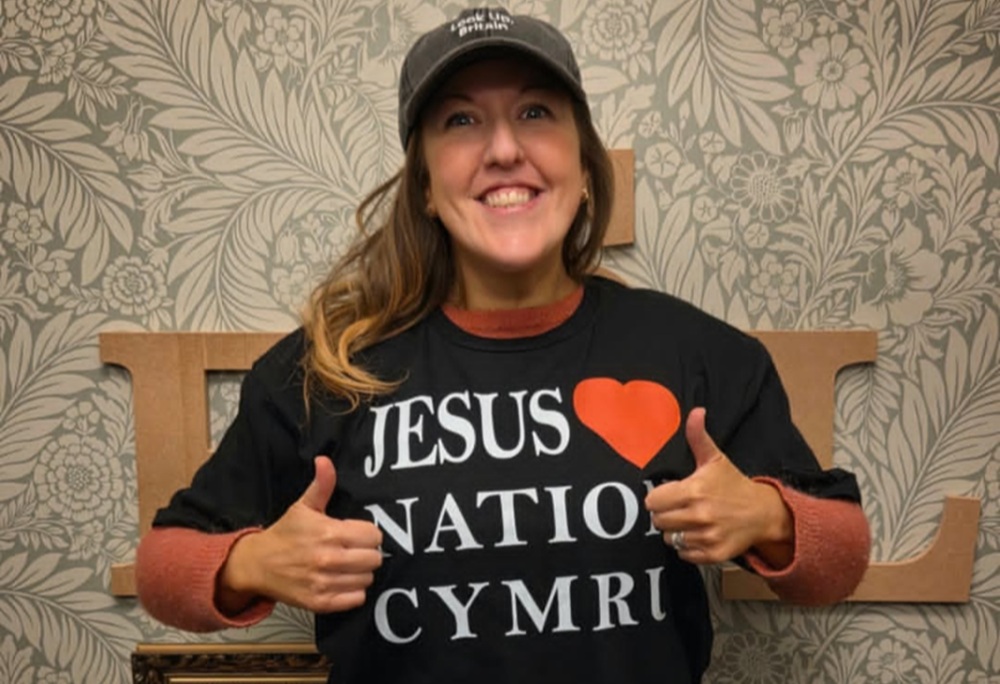
This phenomenon has long been visible in the United States, where elements of evangelical Christianity aligned themselves with Donald Trump and the far right. But it is no longer confined to America. It is now appearing in Wales too — influenced by figures such as Tommy Robinson, and amplified by Christian voices closer to home, including Faith Jarvis, who has offered social-media platforms to far-right figures despite her ministry being sponsored by her church in Neath.
This essay is not an academic intervention. It is a pastoral and personal one: a reflection shaped by memory, tradition and concern for the church and society we inhabit today.
Faith and nation: a Welsh inheritance
I was raised in a household where Christianity and Welsh nationalism belonged together naturally.
Chapel on Sunday and Plaid Cymru posters at election time were simply part of the rhythm of life. I remember chapel activities with affection, and delivering leaflets with my father with equal pride. For us, faith and Welshness were not in competition.
That coherence began to fracture in my teenage years. I encountered Christians who dismissed the Welsh language with the phrase, “the gospel matters more than language.” It sounded pious, but it rang hollow.
By university, the tension became explicit: Christian Union meetings clashed with Cymdeithas yr Iaith gatherings. I was told I had to choose — was I one of God’s people, or merely a “nashi”?
It was during that period of dislocation that I was introduced to the work of R. Tudur Jones. Through him, I discovered that my upbringing was not a private anomaly, but part of a wider Welsh tradition: a nonconformist Christian nationalism that saw faith not as a servant of power, but as its critic; not as a weapon of exclusion, but as a source of moral imagination.
Even today, long after the chapels have emptied, this inheritance still shapes Welsh political life. As historian Tom Holland has argued, the moral grammar of the modern West remains deeply Christian, even when faith itself is denied. Ideas of human dignity, suspicion of empire, solidarity with the weak, and hope for a better future did not emerge from nowhere. They were formed by the story of a crucified God.
The same is true of Welsh nationalism. Plaid Cymru, even in its contemporary secular form, remains profoundly shaped by nonconformist values. To ignore this is not to achieve neutrality; it is to create a vacuum — one that can be filled by far darker forces.
Nationalism needs an ethic
Nationalism is not, in itself, a complete ideology. It always borrows from elsewhere. That is why it can be dangerous. Untethered from a moral vision, it easily becomes an idol.
Welsh nonconformity understood this. Its contribution was not blind nationalism, but a chastened one — a nationalism that existed to serve justice, protect minority culture, and resist domination. It was suspicious of power, including its own.
That insight remains urgent today. Movements such as YesCymru have deliberately sought to be ideologically broad, focusing on independence rather than articulating a detailed vision of what an independent Wales should become.
That strategy may have tactical value, but it also carries risk. When a cause becomes an end in itself, it drifts towards idolatry.
The nonconformist church, historically sympathetic to Welsh nationalism, must therefore resist the temptation to become an apologist for any political party — especially if Plaid Cymru were to find itself in government.
The prophetic task of the church is not to sanctify power, but to speak truth to it, even when that power feels familiar or friendly.
This is precisely where contemporary Christian Nationalism goes wrong: faith loses its critical edge and becomes a tool for justifying authority rather than challenging it.
A dangerous turn
What distinguishes today’s Christian Nationalism is not its concern for identity or belonging, but the way it constructs those concerns around fear. It thrives in an environment shaped by conspiracy theories, social-media echo chambers and the erosion of trust in shared truth.
What we are witnessing is not simply disagreement over facts, but what might be called epistemological capture: a distortion of the very ways people decide what is true. When fear governs perception, discernment collapses.
This has been exacerbated by cultural upheaval, the decline of Christendom, and long-term economic insecurity.
For some Christians, the loss of cultural privilege feels like persecution. In that climate, movements that promise certainty, strength and restored status become deeply attractive.
It is here that far-right actors have found Christian language useful. By framing themselves as defenders of “true Christianity,” they delegitimise churches that speak about justice, hospitality or truth — dismissing them as “woke” or compromised.
The tragic irony is that this reverses the Christian tradition itself, which insists that it is the church, not the state, that defines the scope of Christian faith.
What now?
The task for Christians in Wales in this election year is neither retreat nor accommodation. It is fidelity.
The Welsh tradition of Christian nationalism, at its best, reminds us that love of nation is never absolute, that the church exists to challenge power, not baptise it, and that fear is never a fruit of the Gospel.
Christian Nationalism today offers belonging without truth, identity without humility, and power without sacrifice. Against that, the church is called to remember that its centre is not a flag or a party, but a crucified Christ.
Tudur Jones once wrote that a Christian nationalism worthy of the name “asks nothing for itself that it does not wish for others.” In a moment when louder voices are driven by fear, that vision remains not only relevant, but necessary — for Wales, and for the church within it
Dr. Rhys Llwyd is a minister with the Baptist Union of Wales in Caernarfon and Dyffryn Nantlle. He holds a degree in Welsh Politics and Political Philosophy and a doctorate in Public Theology. An adaptation of his doctoral thesis was published in 2019 under the title Tynged Cenedl: Cenedlaetholdeb Gristnogol R. Tudur Jones.
Support our Nation today
For the price of a cup of coffee a month you can help us create an independent, not-for-profit, national news service for the people of Wales, by the people of Wales.



The people I grew up with Welsh speaking,chapel going,small n ationalists if asked who Jesus would vote for would have answered ‘lebor’.
I think that this is an excellent article. We must never conflate faith, whether Christian or other, with nationality – even in a country such as Britain with its rich Christian tradition. At the end of the day, a Christian’s loyalty to God and their fellow-believers over-rides loyalty to their nation, since the explicit goal of the Church is to be a community composed of people from all nations and ethnicities, living in harmony. Incidentally I write this as an Englishman of German ancestry now living in Wales!
In the past, those with extremely low intelligence who became disruptive were made to sit in a far corner of the class with a pointed D cap, overentitlement now sees them demand to sit in front of a camera with a KKK cap. Very strange people in very strange times.
..the moral grammar of the modern West remains deeply Christian, even when faith itself is denied. Ideas of human dignity, suspicion of empire, solidarity with the weak, and hope for a better future did not emerge from nowhere. They were formed by the story of a crucified God. I totally disagree with this assertion. The ‘moral grammar’ derives from several philosophical currents and has nothing to do with religion, Christian or otherwise.
Thank you for the article CN is probably coming to Wales with Reform. Farage is dangerously popular in US government circles. What he has discovered there he will bring here – Trumpist politics from Magaland. J.D. Vance is a good friend of James Orr, a senior adviser to Nigel Farage. Danny Kruger, another recent Tory jumper and Christian nationalist, was soon in the Farage play-book replacing the language of tolerance with the rhetoric of exclusion in a Parliamentary speech. It’s coming here and it’s ugly. Former Archbishop of Canterbury, Rowan Williams, has recently called for a Christian language that embraces the… Read more »