


Cool it with the tram-trains
Cai ap Gwilym
At a time when scepticism about the benefits of devolution is rife, it is a shame that so few are talking up Trafnidiaeth Cymru (TC).
The South Wales Metro is shaping up to be a genuinely transformative project, with electrification continuing apace, along with station upgrades, frequency improvements, and contactless payment.
Outside of South Wales, trains are increasingly new and clean, featuring the only Wi-Fi network on any rail service in the UK that, in my experience, actually works. Wales’s management of its railways makes a clear case in favour of further devolution, especially considering that the valley lines are the only part of the network that is fully devolved to Wales.
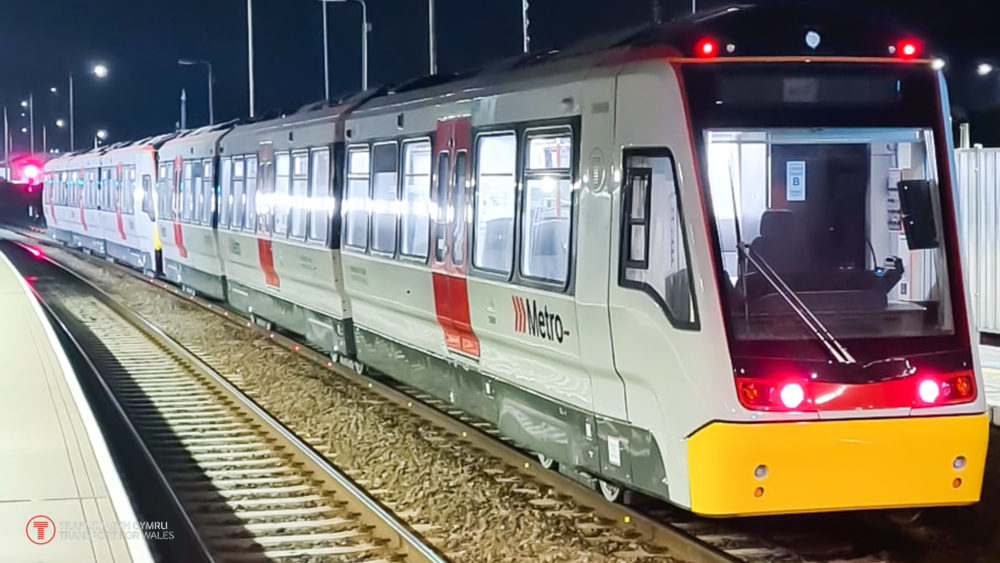
That said, TC is not immune to chasing a misguided fad. Tram-trains have been having something of a moment in transit planning circles, inspired by the success of Germany’s Karlsruhe Stadtbahn.
In short, tram-trains tend to run along conventional railways (known as heavy-rail) in the outskirts, before diverting onto tramways (light-rail) to reach the city centre. This is in contrast to more conventional German ‘S-Bahn’ systems, in which trains stick entirely to the heavy-rail network.
In Karlsruhe, the concept was a roaring success, and owing to some of the similarities between Karlsruhe and the Cardiff metropolitan region, it made sense that TC planners would consider the Karlsruhe model for south Wales. However, there are a number of key differences which suggest we ought to be looking elsewhere for inspiration.
Karlsruhe’s main problem was the 1.8km distance between its main railway station and its CBD. A conventional S-Bahn would not have made sense here, as it would have dropped passengers too far away from their destinations to be of any use.
Karlsruhe’s solution was therefore to use its already-existing tram network, a solution which required very little new infrastructure. Additionally, both the trams and the heavy rail network use low-floor trains, meaning that tram stops in the CBD could remain low-key and unobtrusive, while remaining interoperable with the mainline rail network.
Cardiff Central
By contrast, Cardiff Central is right in the middle of the CBD, thus making the city a perfect candidate for a more conventional S-Bahn-style system. Cardiff also does not have an existing tram network. This means a higher infrastructure cost, for a smaller connectivity gain. And because Welsh railways use high-floor trains, tram stops will also need high platforms, thus making them intrusive, less accessible, and taking up valuable space.
A key asset of the valley lines has also been overlooked. Whereas the heavy railways around Karlsruhe were fully integrated into the rest of the national rail network, the valley lines are almost entirely separate.
There is only one place where the valley lines and the rest of the network share track, which is for a single kilometer through Bridgend station. The infrastructure cost of fully separating the valley lines would be small, especially compared to the potential benefits of separation.
These include increased reliability and service frequency, as well as the potential for some degree of automation in the years ahead, as seen on the excellent Copenhagen S-Tog (The Danish equivalent of S-Bahn).
Tram-trains achieve the opposite. Mixing with road traffic vastly increases the potential for service disruptions, as trams have to contend with traffic signals, pedestrians, cyclists, and bad drivers.
Integrating street-running trams into the heavy rail network means that the whole system now has to make allowance for these potential disruptions, reducing service frequency. It also increases the potential for delays within Cardiff to cascade further up the line, affecting commuters who are not even travelling on the same route.
Downgrade
Tram-trains therefore force a downgrade of the entire system. So why are we doing this? It all comes down to Cardiff Bay. While Cardiff’s CBD doesn’t suffer from a last-mile problem, Cardiff Bay does.
To solve this, we are building a new tram line directly linking the bay to Cardiff Central, before integrating into the valley lines network to allow direct services along a new rail branch up towards Llantrisant.
A tram is a perfectly good solution for linking Central to the bay, but it doesn’t need to be integrated into the valley lines. One-seat rides are overrated; you don’t need them as long as the tram connection is frequent enough.
And as the new branch to Llantrisant is mostly greenfield along a former railway alignment, there is no need for this to be constructed to light-rail standards either. Additionally, a separate tramway could use low-floor platforms, thus facilitating further expansion along space-constrained city streets.
Toilets
So to make this clear: We are limiting the potential of the entire valley lines network, all for the sake of a few hundred meters of street-running in Cardiff Bay. Cardiff Bay is not even the city’s main centre of employment, so why prioritise it over the needs and comfort of commuters travelling from 38 kilometres upriver? Not to mention the lack of toilets…
The South Wales Metro is a truly fantastic project, so it is a shame to see it undermined by the present fad for penny-pinching downgrades.
Amid a sea of bureaucratic mediocrity, railways are one area where Wales is unabashedly aiming high. Let’s not get in our own way by compromising on quality. If devolution is to succeed, it should deliver the very best.
Cai ap Gwilym is a PhD candidate in anthropology at the LSE
Support our Nation today
For the price of a cup of coffee a month you can help us create an independent, not-for-profit, national news service for the people of Wales, by the people of Wales.
Get more trusted Welsh news
Choose Nation.Cymru as a preferred source in Google News to see more of our journalism.



I don’t agree – the main benefit of tram-trains is their reduced weight. As a result they are very quick to accelerate which will either a) significantly reduce journey times from the top of the Valleys into Cardiff to around 50 minutes, or b) allow for more communities along the route to have stations without vastly increasing the journey time for everyone else (e.g. Glyncoch, North of Pontypridd, currently doesn’t have a rail station but probably fits the population criteria to have one). The street running also gives options to, for example, convert to street running in the Valleys in… Read more »
The class398 tram-trains are 73tonnes for a three-car set so average 24 tonnes per carriage whilst the same class in ‘normal’ mode is 67tonnes for a three-car set so average 22 tonnes per carriage. The tram-trains are actually heavier and less efficient due to the additional battery sets and AC/DC rectifiers needed to run in tram mode.
The Class 150 trains they’re replacing are about 35 tonnes per carriage.
Diesel trains are lighter but cannot accelerate anywhere near as fast as an electric unit – the weight saving is compared to other battery electric trains such as the Class 756 which is currently running on the Valley Lines.
Having ridden both, the acceleration difference is noticeable, and will lead to significant time savings between stations even though they have a lower top speed than the other units.
According to TFW they can get to 50mph a mile sooner than the old Class 150s.
As for PCH in Merthyr, that’s located up on the hill in Gurnos and these tram-trains would not be able to run up such steep hills, at least without rack and pinion assist. As for the Treforest Ind Est that lies on the east of the river Taf while the railway line is on the west bank. Two new briges would still be needed to operate such a service.
Tram-trains can handle much steeper gradients than heavy rail.
Up to about 8-9% gradient… As well as tighter radius curves.
Originally, the Coryton line ran on to Tongwynlais then on through what is now the Treforest Industrial Estate. Then the line (now buried under the A470) ran via what would become the housing estates of Dynea, Hawthorn and Rhydfelen and was supposed to join the Taff Vale Railway at Trefforest. That would have been the better route as trains runs through open countryside between Trefforest and Taffs Well and the station for Treforest Industrial Estate is poorly located for passengers. But as Brychan states, re-routing the line through Treforest Industrial Estate now would face obstacles and costs.
This misses the point. Tram-trains open up new route options across the network such as a loop through Merthyr town centre or reconnecting towns and villages which lost their old heavy rail trackbeds to bypasses. And there’s no reason for on street running to impact reliability if the traffic signalling gives priority to tram-trains on shared sections of road.
Street-running still runs an increased risk of disruption from traffic congestion and accidents caused by other road users. Signalling tech for street-running trams has improved a lot, but it will never be as reliable as a system with fully protected rights of way (even with level crossings). And the more routes you have sharing track, the more the problems can compound. This is something to watch for as the Valley Lines are already quite heavily interlined, with some reverse-branching as well. If you want a tram loop around Merthyr town centre, there’s nothing stopping you from just building a tram,… Read more »
This is solved by building buffers into the timetable and operational resilience planning. Any on-street sections will be at the end of a route so an extended dwell time can be timetabled at the turnaround point and at the point before the service re-enters the heavy rail section. If both scheduled dwell times are 12 minutes the service can absorb 20 minutes of delays in the on-street section without affecting the wider network. In the event of more serious disruption in the on-street section inbound services can be turned around before they enter the on-street section ensuring outbound services enter… Read more »
I don’t envy anyone who is on the last train to Merthyr on a Saturday night on a train without toilets.
Last train doesn’t need to be a tram-train but this obsession with toilets is usually from folks who never travel by train because those who do know very well you can’t rely on train toilets which regularly fill up and go out of service, or are impossible to reach on busy services.
The Metropolitan Line in London has never had toilets (in fact no Tube train does). Even today the trains take 50 minutes from Amersham to Baker Street – longer if they’re going to Aldgate. In steam days they started way back at Aylesbury and were slower, including an engine change at Rickmansworth. The diesels on the London-Bedford line I used when I was at school did have toilets … but only in one carriage out of four!
How often do you travel that route?
If you want the full history of the South Wales Metro….and why we got tram-trains, etc. I wrote it all down in “How to build a Metro”…..
https://cardiffmetro.wales/
I know, and I didn’t agree, including for reasons this article does not fully encompass (such as system expansion further up the valleys, which I think comes with its own set of issues). But my main aim is to provoke more public discussion about this project, from an angle that I don’t think has made much of an appearance outside of government/engineering circles. This means asking deeper questions than whether or not there will be toilets on board (though I concede that toilets would be quite nice). So hopefully this can help achieve that.
When Cardiff gets its Garden Suburb it can have a garden railway…
An Urban Tommy Tank story for big boys…
Cardiff gets a new train set we’re still in the pony and cart!
While tram trains do have _some_ drawbacks, the fact that they enable Cardiff and the Valleys to start developing tram networks is a huge benefit that cannot be understated. Of course it would be ideal to build a great tram network, with low-floor trams, there’s no way to get that approved by the hands holding the purse strings, especially while also paying for much needed upgrades to the infrastructure and rolling stock of the valley lines. Tram trains and a short stretch of street-running across Callaghan Square are the foot-in-the-door needed to get towns and cities in South Wales the… Read more »