
Cymraeg in decline: Welsh language education is the only solution
Stephen Price
In what felt like a very hush hush release this week, we discovered that, for the second year running, the number of Welsh speakers in Wales has declined, according to the latest Welsh language data from the Annual Population Survey.
It was only through reading a news item on BBC Cymru Fyw that I found out – with little fanfare otherwise, the news would have just gone unnoticed by me and many others.
The survey on people’s ability in Welsh and how often they speak the language covers the period from October 2024 to September 2025.
Despite the recent fall, the overall trend since March 2010 has been one of growth (25.2%, 731,000), following a gradual decline between 2001 and 2007.
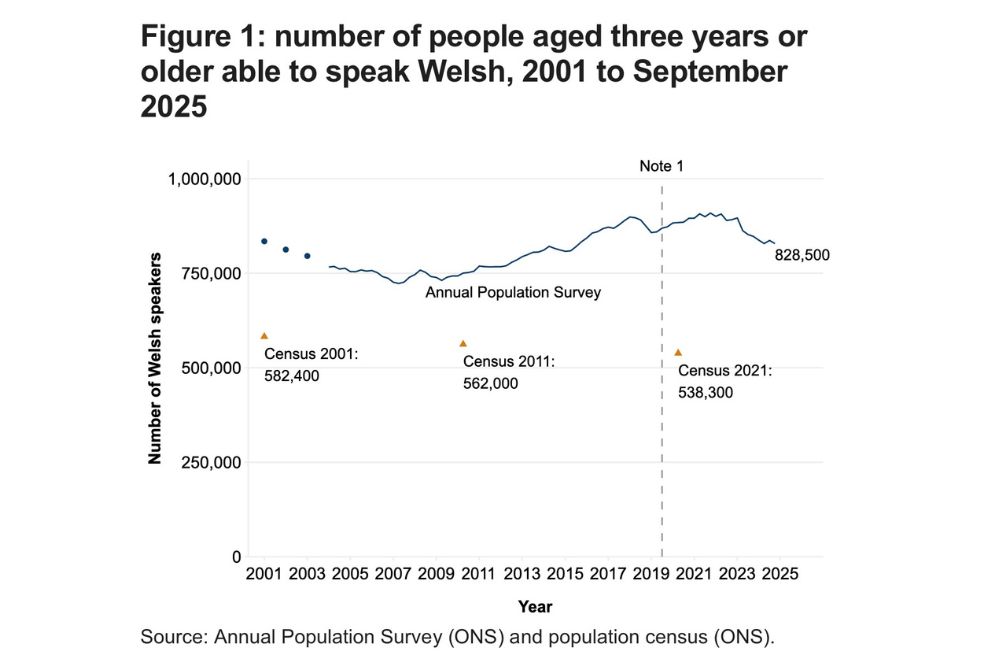
According to the APS, there were an estimated 828,500 Welsh speakers living in Wales in the year ending 30 September 2025. The number of Welsh speakers recorded in the 2001, 2011 and 2021 Census are plotted on the same chart, labelled 582,400, 562,000 and 538,300 respectively.
For the year ending 30 September 2025, the Annual Population Survey estimated that 26.9% of people aged three years or older were able to speak Welsh. This figure equates to around 828,500 people.
Children and young people aged 3 to 15 years were more likely to report that they could speak Welsh (46.5%, 227,300) than any other age group. This is consistent over time, but the percentage of children and young people aged 3 to 15 years who can speak Welsh has been decreasing in general since the beginning of 2019.
The Welsh Government said: “We’re working on a wide range of actions to achieve our aim of a million Welsh speakers by 2050, and to increase opportunities for people to use their Cymraeg.
“This includes introducing the Welsh Language and Education Act, our response to the report of the Commission for Welsh-speaking Communities, the second phase of the Commission which is looking at the Welsh language in areas with fewer Welsh speakers, free Welsh lessons for 16-25 year olds, and increasing the amount of Welsh language technology that’s available.”
Owain Meirion, Chair of Cymdeithas yr Iaith said: “We often hear from politicians that the Welsh language belongs to everyone, but this rhetoric is not realised. The result of that is the continuous decline in the number who can speak Welsh.
“The current Government has run out of time but we recently published a document with measures that we challenge the politicians to implement in the next Senedd so that it can be a turning point for the language to become a community language.
“Among the calls are to improve the regulation of the housing market and legislate to treat houses as homes, implement the recommendations of the Commission for Welsh-speaking Communities, set a target for the number of children in Welsh-medium education, restore and increase the amount of Welsh content in the media and expand and strengthen the legal rights of the people of Wales to use the language.”
What to believe
Whilst showing decline over the past two years, many people pointed out how small the survey was and that they personally weren’t asked. Like the complainants, neither was I or anyone else I know with or without any Welsh language skills. Therefore, naturally, any survey or data such as this needs seasoning with a barrel-load of Halen Môn.
Whilst ‘disappointing’, however, I’ve got a nagging feeling that the figures are actually telling too positive a story, or too positive a spin, I should say.
Having lived and worked in Wales my entire life, in various roles in various locations (supposed Welsh language heartlands where I met more English folk than Welsh), the idea that a quarter of the nation speaks Welsh just doesn’t ring as true as I’d like it to.
Looking back to my A-Level studies in Brynmawr Comprehensive or whatever silly name it had given itself at the time (Grant Maintained? Foundation?), there were (get ready to sing along) just the two of us. An entire year of very capable students, and only two chose Welsh.
Moving into adulthood, looking at my friends from across Wales, despite many being learners or speakers themselves, only my sister currently has her child in a Welsh language school. Others have left Wales altogether, or have chosen the default option of English-medium schooling.
The only exception to those is a friend whose child is in an English medium school simply because Monmouthshire has no Welsh language high school of its own. Neither does the smaller county next door, Blaenau Gwent. Neither, perhaps more shockingly to me, does Merthyr Tydfil.
Currently, children who attend Welsh medium primary schools in Monmouthshire and Blaenau Gwent are forced to commute to Torfaen to continue their education in Welsh at Ysgol Gymraeg Gwynllyw in Pontypool.
The 400 or so children from Merthyr travel to Ysgol Rhydywaun in Hirwaun, Rhondda Cynon Taf or Ysgol Cwm Rhymni in Caerphilly.
The situation in Powys is no less damning. For those in the south of the county, it’s a case of attending the dual-stream Brecon High or heading as far north as Builth Wells, or hopping a county or two to head to one of the aforementioned schools or Ysgol Gymraeg Ystalyfera in Neath Port Talbot.
Only, as many families in each of those counties will attest, many parents make the difficult decision to switch to a nearby English medium high school for reasons ranging from unfamiliarity, too long a commute or tagging along with close friends.
Parents console themselves that their children’s Welsh skills are in the bag, but any Welsh learner would agree that it really is a case of use it or lose it.
What a complete waste.
What is overlooked in this educational switch is the loss of community, and the loss of culture – often intangible or abstract, but as potent and important as any other detail of our identities and experiences – and indeed the loss of future prospects.
A million Welsh speakers? We can fudge the data, include the DuoLingo app-downloaders, but no one is buying it.
Y presenol / The present
I bumped into the (sole) school friend whose children attended the same primary school as my nephew last year and happened on the subject of my his schooling, eager to find out about her children’s experience in the same school.
Her teenage children are both thriving, but I was saddened to hear that she’d made the difficult decision to send her youngest to a local English medium comprehensive after the experience of her first born.
Ahead of starting this piece, she agreed to share some thoughts in confidence, writing: “After having two children go through Ysgol Gymraeg Y Fenni, I am extremely disappointed and frustrated that there is no Welsh medium secondary provision in Monmouthshire.
“My eldest child had to spend an hour on the bus each morning, leaving at 7.15am to attend the Welsh Medium in Torfaen and then struggled with her social development as most of her friends she’d made from the same school lived in Caerleon and Caerwent.
“It seriously impacted upon her wellbeing as she did not have the freedom to go out with friends after school due mostly to the distance between her and her peers.
“Because of this, the decision was made for my younger son to attend a local secondary in Abergavenny.
“Even though the Welsh language is extremely important to us as a family, we felt we had to sacrifice this for him as we did not want a repeat of him feeling isolated socially.
“Now, my son is in a nearby English medium high school and although we’re very happy with the level of education there, we are very sad that my son has since mostly forgotten a lot of the Welsh language and finds it difficult to converse now compared to his fluency at Primary.
“As non-Welsh speaking parents, he has sadly struggled to maintain the absolute need to speak our national language regularly enough to hold on to it.
“As a family, we feel that we have been denied the opportunity for our son to be offered his right to a local Welsh secondary education in his treasured national language.”
Digon yw digon
Leading the fight against Welsh language decline and decay is Cyngor Gwynedd, which should be used an example among all other councils across Wales if we are to reverse the current statistics, or more to the point, the reality behind the current statistics – the day-in-day-out, lived, meaningful use of Welsh in Wales, not just as a language of the home or school.
Cyngor Gwynedd is planning the first major review of its Welsh language education policy in more than four decades.
The shake-up will see Welsh becoming the significant language used to teach children in the county’s schools.
Ysgol Friars, Bangor, Ysgol Uwchradd Tywyn, Tywyn and Our Lady’s School, a Catholic primary, in Bangor are categorised as “Category 3T schools” or schools “schools in transition” which are moving towards full Welsh medium provision.
Welsh is already the predominant medium in the rest of the county’s 90 plus educational establishments. They are considered to be in the Welsh Government’s Category 3 – schools that already offer a significant amount of Welsh medium provision, with Welsh being the main language of internal communication.
Children who move to the county from non-Welsh-speaking areas will be referred to attend Gwynedd’s Immersion Education System.
The main changes are:
- All pre-school education settings will be provided through the medium of Welsh.
- All pupils in the Foundation Phase until the end of Year 2 will be taught and assessed through the medium of Welsh.
- Schools will provide opportunities for pupils to use the Welsh language regularly, inside and outside the classroom, in a curricular and extra-curricular manner.
- From Year 3 onwards, at least 80% of pupils’ educational activities (both curricular and extra-curricular) will be in Welsh.
- Pupils’ grasp of Welsh will continue to be developed, giving attention to the development of their skills in both languages. From Year 3 onwards, English will be introduced as a subject and cross-curricular learning medium.
In secondary schools, Welsh will be the main language of education for all pupils up to 16 years old.
Pupils’ grasp of Welsh will continue to be developed, giving attention to the development of their skills in both languages. English will continue to be introduced as a subject and learning medium of some cross-curricular elements.
Schools are expected to ensure that all pupils (Years 2-9) who are latecomers and new Welsh speakers are referred to attend Gwynedd’s Immersion Education System.
Children and young people with additional learning needs (ALN) will receive equal linguistic opportunities in accordance with the policy.
The council says the new policy is in line with Welsh Government’s Welsh 2050: A Million Welsh Speakers’ strategy.
The council, in its report stated: “This policy is an attempt to set Gwynedd’s ambition to ensure that the county’s children and young people grow up to be proficient users of the Welsh language and develop bilingual or multilingual skills within our education system.”
Breaking point
The reasons why we should speak Welsh are endless, and yet we continue to look the other way and expect the beautiful, native language of our forefathers and mothers to somehow keep surviving against all odds. At some point, if you stretch anything enough, there comes a breaking point.
Thankfully, a sea-change is occurring across our nation, whereby we are all realising our status as custodians, and waking up not only to the economic and social benefits of Welsh, but also responding to something a little more abstract, a little more personal, in that we want to right the wrongs of the past, and we want our language to not only live, but to thrive.
But in order to do so, we all have a part to play.
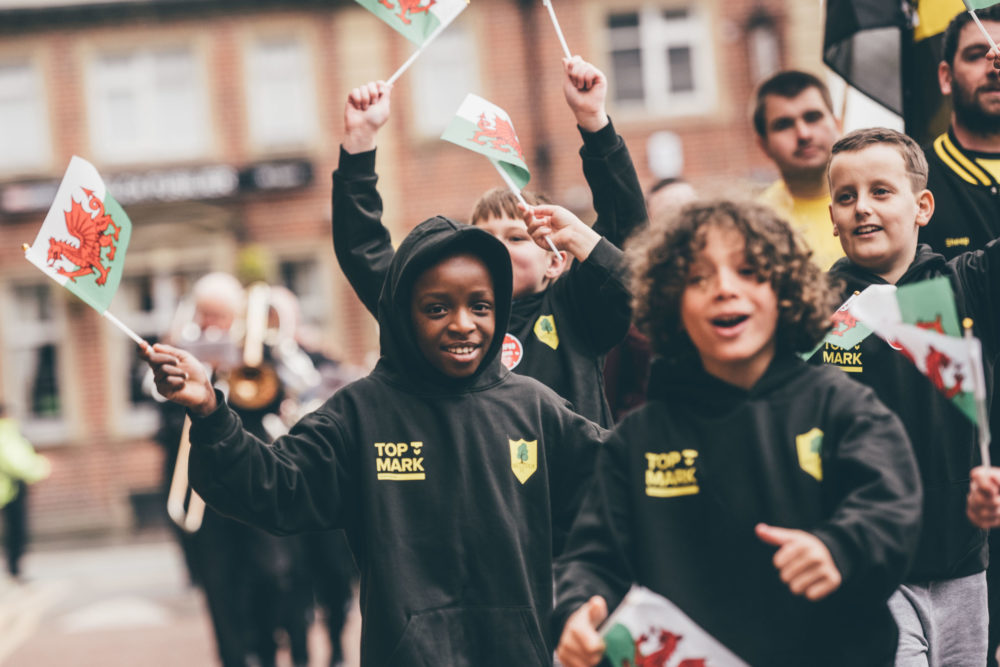
Learning a language isn’t the provision of just the young at school, or pensioners with perhaps more time on their hands at at a night class. We can all, whatever our ages, start a language learning journey right now from the comfort of our own homes.
Apps such as DuoLingo and SaySomethingInWelsh are a great place to start – and each of those has corresponding Facebook learning groups where you can meet other learners and practice together.
You can also search for courses via Learn Welsh, and in the process find new friends and new communities to practice and learn with in the real world.
From there, using your Welsh in the wild, it’s incredibly surprising how many people speak Welsh that you pass by or interact with in shops etc. – and all it takes is a ‘shwmae’, ‘bore da’, or ‘prynhawn da’ to test the water.
Perhaps more importantly than that, we have to recognise that for our nation to be truly and meaningfully bilingual, our children – Wales’ future workers, thinkers, movers and shakers – need to be given the chance to speak Welsh.
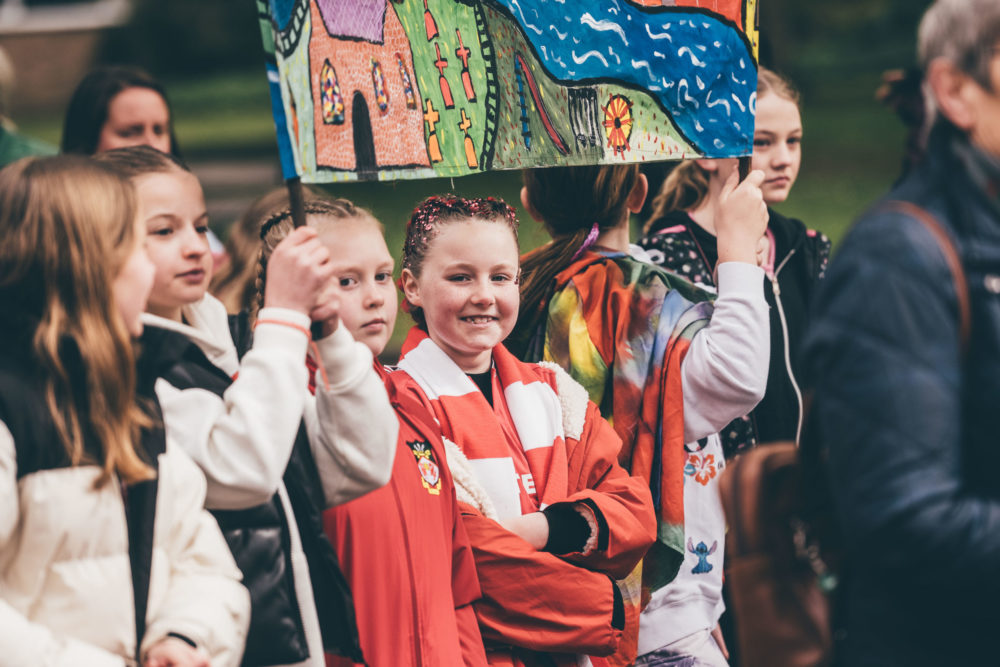
Like me, Heini Gruffudd, chair of Welsh language lobbying group Dyfodol i’r Iaith (A Future for the Language) believes that the most effective way of learning a language is through total immersion.
“You don’t get natural Welsh speakers from English-speaking schools except with some brilliant exceptions,” he said.
“You only get Welsh speakers from Welsh medium schools where pupils start learning the language in playgroups.
“If you learn a language after that you’ve lost the best opportunity.”
To either provide our children with, or deprive our children of, their very language, the ancestral language of Wales is on us now.
A spreadsheet fudging a million Welsh speakers isn’t enough, if you ask me – and 800,000 certainly isn’t – Wales, and those in power in Wales, should be aiming for all its citizens to live their lives in Welsh, and our nation to be fully bilingual.
We must demand wider provision of Welsh language schooling for all ages, and we should all consider Welsh medium education a must for our nation’s children so that Wales’ beating and vital heart, its language, can be restored.
Ymlaen!
Fight Welsh language decline
Find your nearest Welsh language school here.
Click here to find out more about SaySomethingInWelsh.
Click here for more info on DuoLingo.
Click here for information on local Wales-based Welsh classes or London classes (Not exhaustive so please check social media and search engines for what’s on in your area)
Click here to find out more about Lingo Newydd.
Support our Nation today
For the price of a cup of coffee a month you can help us create an independent, not-for-profit, national news service for the people of Wales, by the people of Wales.



The picture in Powys stems from a long-term avoidance of Welsh language issues. The last administration made a start with Ysgol Bro Hyddgen in Machynlleth, and when I became portfolio holder in 2022, the Lib Dem-led administration made it a priority with a process to move Ysgol Bro Caereinion to Welsh medium, completed in 2024, and the current legal process to create an all-through school in Builth Wells is now in its final stages. This will lead to 3 fully Welsh medium schools in the county by 2031, with all pupils within 30 mins drive by car of a school.… Read more »
As if swansea would ever return to Welsh.
More Welsh medium schools is the solid way forward. Perhaps a good idea would be to implement a small charge for English language schools to provide funding.
Yes, the education system is key; but what this article barely mentions is the lack of economic opportunity for youngsters in most parts of Wales. Unless and until that issue is addressed, it will always be an uphill struggle towards 2050.