


Don’t Look Back in Anger
Ben Wildsmith
In the confusion of our hyper-connected, yet isolating, society, anger has become a totem of authenticity.
Ranged against AI slop, media-trained soundbite merchants, and homogenised apologists for endemic decline, we have manipulative opportunists whose schtick is to provoke rage and then shrug in front of podiums asking, ‘What did you expect?’ when it boils over into disorder.
That the latest venue for this depressing routine is the loyalist communities of Belfast is hardly surprising.
The journalist Peter Taylor, whose BBC documentary series on the Troubles gave voice to all sides of that tragedy, described his experiences in the homes of those involved.
On the Republican side, he found bookcases full of volumes on Irish history, language, and culture, alongside works on political struggles around the world. In the loyalist homes that he visited, there were seldom any books and, if there were, they were manuals on body building.
The emptiness at the heart of British culture was always most clearly expressed in Northern Ireland, where fealty to flag and monarch historically privileged working-class communities with better housing, education, and employment prospects than their neighbours.
In such a set-up, pride is handed down as a birth right, rather than something earned. It is a bauble, handed out by the powerful to those who are useful to them. Defence of that illusory pride becomes an end in itself; a closed system that requires only grievance to self-perpetuate.
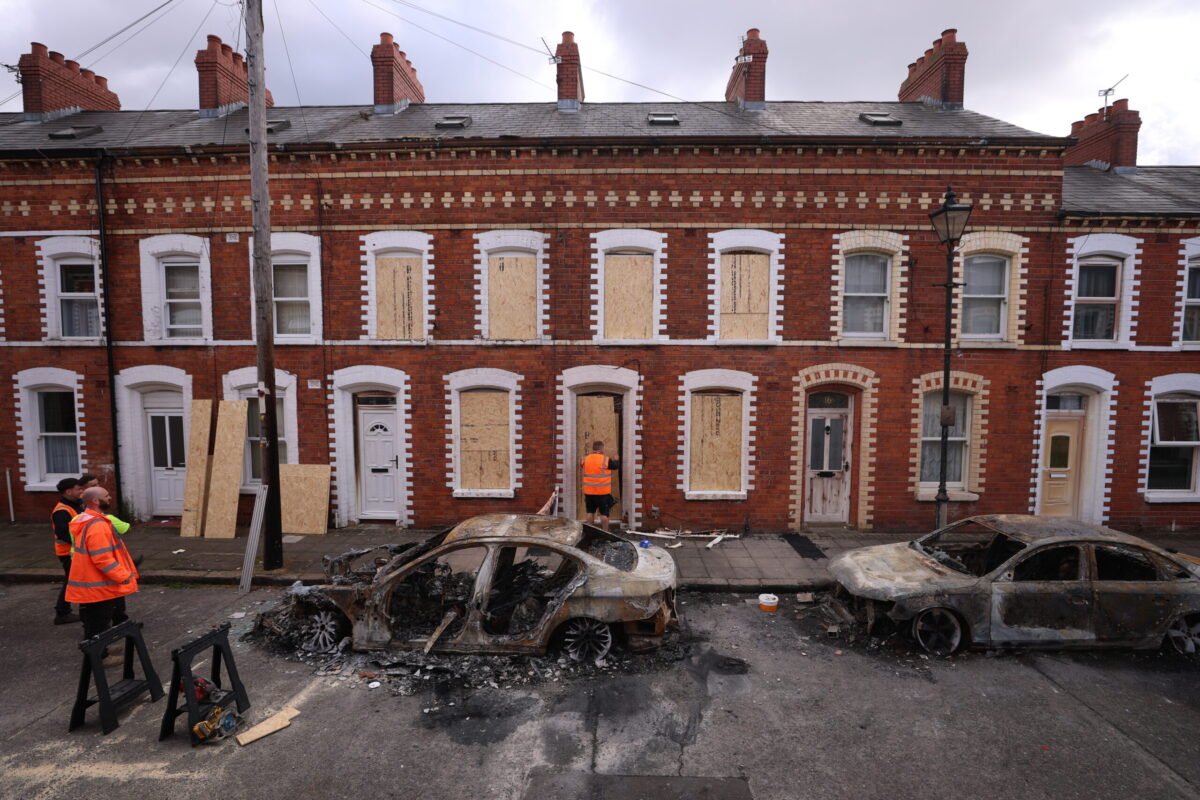
As Belfast burns once again, and the circus moves on from last week’s performance in Southampton, the ‘anger’ of the rioters is being advanced as the tip of an iceberg that supposedly has most ‘ordinary’ Brits frozen in Nigel Farage’s ‘cold rage’.
Of course, nobody condones the violence, heaven forfend, but the anger is understandable. It is the sacred, authentic expression of decent people, who know that their only salvation is governance by a lavishly funded, part-time gold salesman with a cheeky line in deniable racism.
Or, at least, it used to be. The danger in hawking disruption as an end in itself is that someone will come along and disrupt you. Whilst Reform UK is not short of a few quid, Elon Musk finds Farage’s nod-and-a-wink ‘civic’ nationalism to be weak sauce.
Murderous migrants beheading innocent people in their home town is what’s making people angry, not “social media”!
— Elon Musk (@elonmusk) June 10, 2026
Consequently, his algorithmic heft is increasingly being thrown behind the nakedly ethno-nat Restore Party, led by Farage nemesis Rupert Lowe.
For the first time, these two parties are in direct opposition in the Makerfield by election and Farage’s recent pivot away from a strategy of appealing tom the centre ground reflects the potency of Restore’s appeal to his core support. The fracturing of Reform’s Tory/UKIP coalition is underscored by Martin Shipton’s report on predicted defections to Restore amongst the recent Senedd intake.
It may well be that the financiers behind right-wing politics in the UK have given up on parliamentary democracy as a means of advancing their agenda.
Instead of building a coalition of voters through policies like Reform’s abandoned pledge to increase the income tax threshold to 20%, they now see more benefit in paralysing democratic governance altogether.
In meaningful elections, Reform have struggled to push past 30% of the vote share and, whilst that might see them home in Westminster, it wouldn’t be mandate enough for radical changes to the social contract.
The magnitude of disruption touted by Rupert Lowe, encompassing the reintroduction of capital punishment and mass deportations for reasons as flimsy as occupying social housing, could only come about in the aftermath of political and social collapse. For that, you need a mob.
So, it is no shock to read that the much-travelled Stephen Yaxley-Lennon is in, er, Moscow this week meeting Elon Musk’s father.
‘Patriot’
The Tenerife-based professional patriot was a guest of the Israeli government last year and it is a matter of some curiosity as to why he generates so much international interest.
After this week’s stabbing attack in Belfast, Yaxley-Lennon immediately released a list of towns where demonstrations would be held that very evening.
The ‘anger’ of the people was provided with organised venues for expression before most people had even read the news to discover what they were supposed to be angry about.
The whole of the United Kingdom is hitting the streets tonight at 7pm following yet another invader attack on our people.
It’s time 🇬🇧 pic.twitter.com/tscckc9ceK
— Tommy Robinson 🇬🇧 (@TRobinsonNewEra) June 9, 2026
Amidst all the international manipulation and pseudo-cultural posturing, our strength as citizens is our humanity.
The interview with two Ugandan care workers, Sumayah Nakazibwe and Stella Ariokot, who had been trapped in a smoke-filled house on Tuesday night, whilst rioters burned out their neighbours, was harrowing viewing.
Outrages
So, of course were the horrifying images of the attack on poor Stephen Ogilvie. These events are outrages against decency that would illicit an emotional response from any functioning human being.
Let us not be fooled, though, that the only valid expression of that is anger. We have a range of responses available to us – sadness, indignation, determination – that can empower our responses to events.
Amongst us, those whose imagination has not been hijacked by the malevolent megalomania of the new oligarchy, we must insist that anger is the badge of powerlessness.
At work, in the pub, at home, we must object and reason when people are captured by manufactured outrage and threaten to become contagious.
The exploitation of human suffering is a contemptible tactic that serves only to dehumanise victims and perpetrators alike. It makes tools of living people and grotesques of those we have lost. Don’t stand for it.
Support our Nation today
For the price of a cup of coffee a month you can help us create an independent, not-for-profit, national news service for the people of Wales, by the people of Wales.
Get more trusted Welsh news
Choose Nation.Cymru as a preferred source in Google News to see more of our journalism.




The current crop of neo-fascists are well placed to exploit the fears of a population under stress. Recent UK governments of all stripes have neglected to address their concerns as being of no consequence, leaving the door open to the far right to perpetuate their poisonous ideology.
This is what happens when a government doesn’t deal with th elites of musk and Lennon disinformation and remain on the platform that spreads the hate.
Last year the PM said he likes flags as well and run out the island of strangers gaffe. And large marches around the edges calling for the rage he never calls for when a woman is murdered.
This was a Modern Day Krystalnacht on the Streets of Belfast.
Anyway there is positive news as 20,000 people turned out in a Rally in Belfast City Centre to stand in solidarity with the victims of the violence and to tell the Fascist Terrorists they are not wanted in Belfast.
Massive Respect to the family of Stephen Ogilvie and a speedy recovery for Stephen from that horrific ordeal.