


Ecological collapse: Polanski and ‘the left’ are wrong about individual responsibility
Stephen Price
Three news reports hit the headlines this week highlighting the earth’s descent into ecological collapse in no uncertain terms.
Clicks are king in the media, however, and despite their importance, few actually bother to read anything about nature or animals.
A piece about a closing down pub or an appearance on a top ten list, that’s where the clicks lie. Articles on war, extinction, the climate? A handful of readers at best.
Firstly, some seasonal ‘good news’ in the lifting of mandatory avian influenza housing measures across England and Wales amid “receding” threat levels, following a Defra announcement.
Defra said the latest risk assessment, epidemiological and scientific evidence shows bird flu risk levels in wild birds and poultry has reduced, although avian influenza prevention zone mandatory biosecurity measures will remain in place until the wild bird risk falls further.
Welsh CVO Richard Irvine added: “It’s important to get ready for lifting the Housing Order on 9 April, including to check and prepare ranges and outdoor areas.
“Whilst we are seeing risk levels reducing, bird flu has not gone away. Please continue to practice scrupulous hygiene and biosecurity to protect your birds.”
The second piece: the emperor penguin and Antarctic fur seal were singled out among a host of countless others species which are facing the threat of extinction because of climate change, a new conservation assessment has warned.
The loss of sea ice and shrinking food availability have caused both populations to plummet in recent years, according to the latest assessment for the International Union for Conservation of Nature’s (IUCN) red list of threatened species.
The findings have prompted calls for urgent action to reduce planet-heating greenhouse gas emissions as well as supporting Antarctica’s role in stabilising the planet’s climate and providing refuge to unique wildlife.
Elsewhere, the southern elephant seal has moved from “least concern” to “vulnerable” on the red list following declines caused by (welcome back to the conversation) bird flu.
The disease has affected four of the five major subpopulations, killing more than 90% of newborn pups in some colonies and seriously impacting adult females.
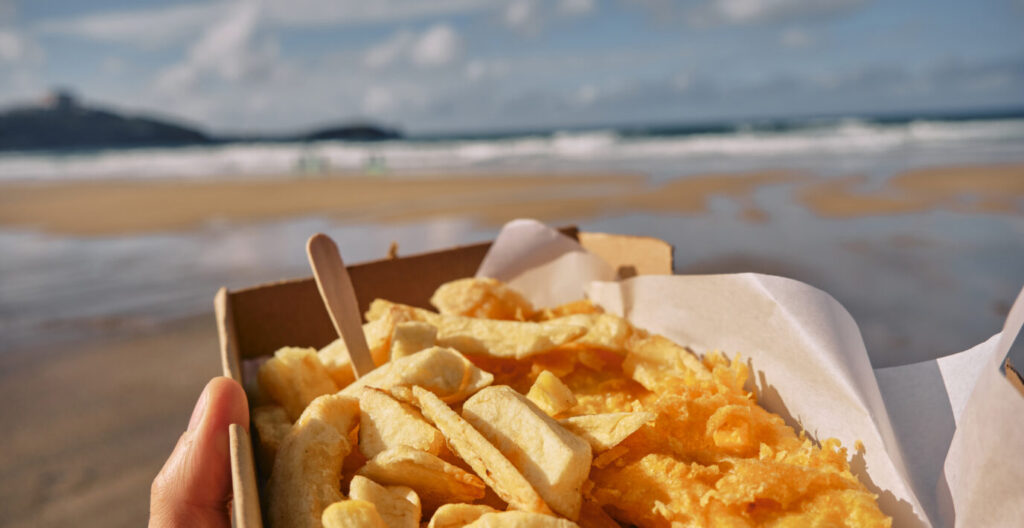
The third story to hit the lower reaches of news sites was the warning that ‘Brits’ should “completely avoid” buying UK-caught cod, according to the Marine Conservation Society (MCS), as it warned that populations have reached a dangerous point of decline despite zero-catch recommendations.
The MCS, a supposed environmental charity (that pushes eating sea life – make it make sense), publishes a Good Fish Guide to help consumers and businesses make sustainable seafood choices.
On Thursday it downgraded all UK-caught cod to the worst possible rating, recommending consumers choose European hake as a flaky white fish alternative.
Kerry Lyne, Good Fish Guide manager, called the downgrade a “warning signal”, and said the UK government needed to “address these concerns to allow stocks to recover”.
The Guardian shared: “Concerns about cod fishing echo those expressed over mackerel this time last year. When persistent overfishing caused by quota disagreements between the UK and its coastal neighbours depleted fish stocks, mackerel was removed from the Good Fish Guide recommended list.
“More recently, Waitrose announced that it will stop selling mackerel by 29 April, saying fishing must be kept within ‘sustainable limits'”
Chris Graham, head of sustainable seafood at the MCS, said: “It’s deeply concerning seeing so many of our iconic fisheries – from cod to mackerel – under increasing pressure.”
The Guardian article continues: “The MCS has asked consumers to consider more sustainable alternatives to UK cod, such as Icelandic cod, which is abundant and not subject to overfishing. More locally, European hake is recommended as a sustainable choice, as is haddock, particularly if caught in the North Sea or west of Scotland.
“Other options for shoppers wanting to make sustainable choices include seabass or plaice from the North Sea, and UK-farmed seafood such as blue mussels and freshwater trout.
“The MCS updates its Good Fish Guide advice twice a year, depending on the latest scientific advice. In particular it looks at stock levels and plans for management.”
Where to start…
Starting with the bird flu restrictions..
Avian Influenza or Avian Flu continues to spread through our captive and wild bird populations in the UK. The scale of Avian Flu outbreaks across the UK and Europe have been unprecedented with over 330 cases confirmed across the country between late October 2021 and April 2023 alone according to a UK Wildlife Trust.
And the origin? For the handful of meat eaters that will actually read this.. drum roll: poultry farms and other captive birds. The virus then spreads to our wild bird populations particularly affecting sea and wetland species.
According to PETA: “Bird flu, also known as avian flu, is a type of influenza that spreads among birds and one of numerous diseases caused by keeping animals for food. The H5N1 strain of bird flu – the outbreak of which we are now seeing around the world – originated in farmed geese before infecting chickens raised for their flesh and eggs.”
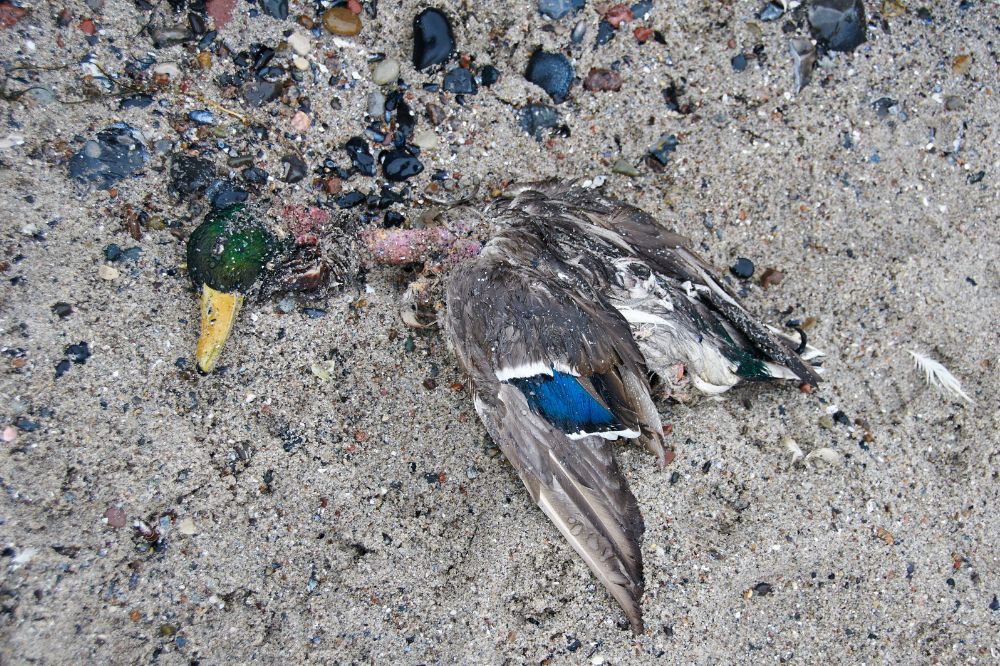
Bird flu has killed millions of wild birds worldwide, including tens of thousands from 78 wild bird species in the UK. Seabirds, waterfowl, and birds of prey are most affected, including barnacle geese, swans, peregrine falcons, hen harriers, buzzards, white-tailed eagles, golden eagles, gannets, roseate terns, black-headed gulls, guillemots, kittiwakes, and herring gulls. Three-quarters of the UK’s pairs of great skua, a protected species whose main population lives in the UK, have been killed off.
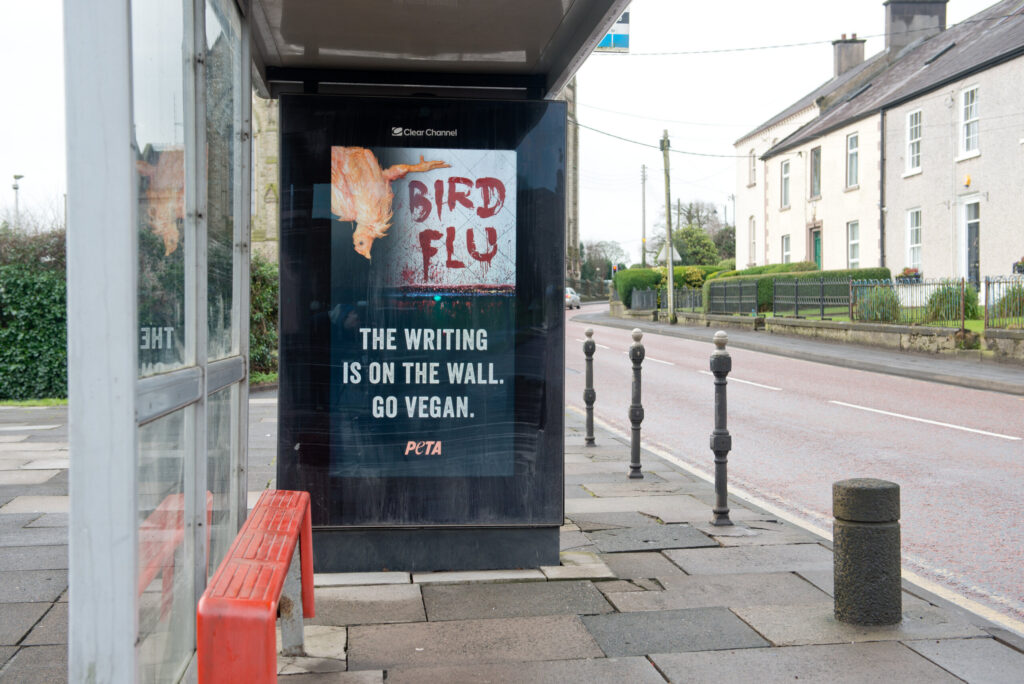
PETA continue: “At least half a billion birds on farms have also been killed due to the H5 strain of avian influenza and its variants since the strain was first identified. H5N1 is especially deadly for chickens – their heads swell, they struggle to breathe, and they experience extreme diarrhoea. But it is not only a devastating pandemic for birds.”
Rest assured – the restrictions will return, and our puffins and other supposed-beloved birds will reach breaking point. The writing is on the wall.
The answer? Simple. All of us, each and every one of us, addressing the root cause – the food on our plates.
The same answer lies, in part, with the global catastrophe facing our wildlife.
Study after study shows that a vegan diet can lessen your carbon footprint.
Feeding massive amounts of grain and water to farmed animals and then killing them and processing, transporting, and storing their flesh is extremely energy-intensive. And forests—which absorb greenhouse gases—are cut down in order to supply pastureland and grow crops for farmed animals. Roughly 80% of deforestation in the Amazon rainforest has been caused by cattle ranchers, who destroy the land in order to raise animals for their skin and flesh. Finally, the animals themselves and all the manure that they produce release even more greenhouse gases into our atmosphere.
An Oxford University study, published in the journal Climatic Change, shows that meat-eaters are responsible for almost twice as many dietary greenhouse-gas emissions per day as vegetarians and about two and a half times as many as vegans.
The U.N. says that raising animals for food is “one of the top two or three most significant contributors to the most serious environmental problems, at every scale from local to global.”
One recent study showed that a vegan diet reduced carbon emissions by 46%, water use by 7%, and land use by 33%, while the two vegetarian diets cut carbon emissions by up to 35%.
Then to the Marine Conservation Society.. How about not fishing at all?
Seriously? Why are they not promoting leaving the ocean alone?
Our oceans are being decimated – cod ‘supplies’ are the canary in the mine. The interdependent ecosystems around them are all failing too.
And it’s not just cod that’s suffering: “Up to 40% of all marine life caught gets thrown right back overboard if it’s ‘bycatch,’ and most of them die before they even hit the water,” according to Seaspiracy director Ali Tabrizi.
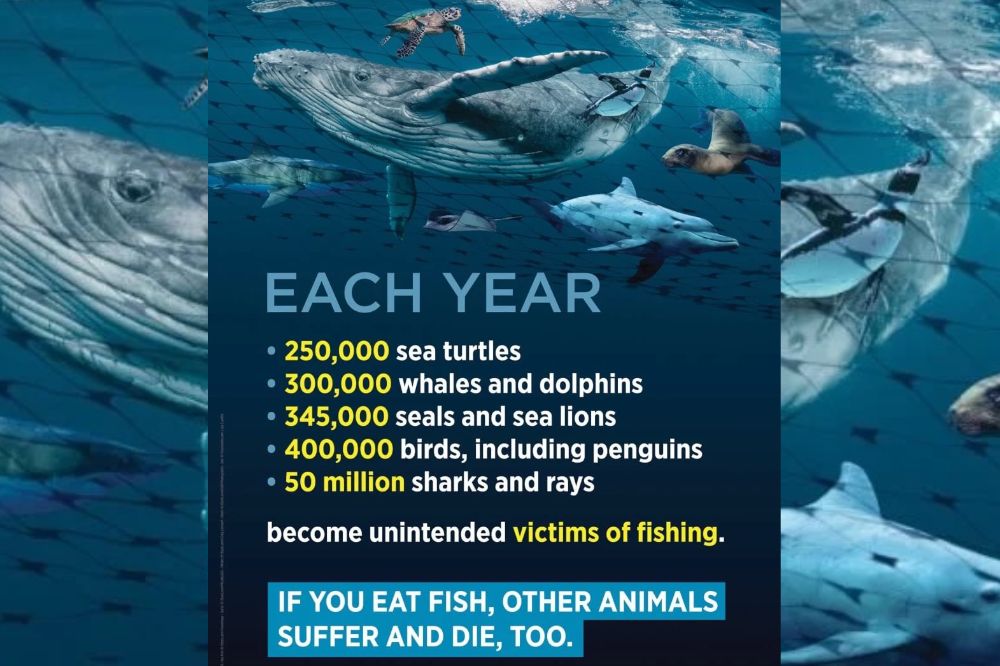
PETA write: “It’s simple – stop eating fish and seafood. You will save the lives of many animals and diminish the profits of a global industry that harms millions of sentient beings a day and is responsible for wrecking our environment.”
The biggest source of plastic in the ocean? Fishing nets. But let’s all drink with a paper straw while we eat seafood shall we..
That we’re debating which fish to kill off next when we can all eat nutritious delicious vegan food right now, and minimise our land use and feed more people in the bargain is one of life’s cruelest absurdities.
Where do we turn?
A while ago, on Facebook, I made the mistake of commenting below a disappointing piece from Zack Polanski titled ‘Zack Polanski: You can fly, drive, eat meat and still be green’ where the Greens leader boldly claimed that individual responsibility isn’t an issue, that we’re all absolved and it’s all on the big corporate bogeyman. The onslaught of commenters (mostly Green supporting ‘lefties’) telling me they agreed with Polanski (and not my one liner about us all having a part to play) was telling.
The Greens have some good green credentials, and are better than most parties out there, but they are very silent about them at the moment. A few lines on the site and in their manifestos but these are largely overlooked and unimportant at the minute. Green but not quite. And just like important news stories, green policies don’t get the clicks.
In his appeal to the mass KFC-visiting Argentinian steak-loving populace, he said: “There is far too much focus on individual responsibility,” he said. “Shell and BP in the Seventies and Eighties knew what they were doing to the planet through their actions, so they created the idea of the carbon footprint to move the focus away from systemic change from governments and businesses and focus on individual responsibility.”
Apologetic vegan, Polanski, does not fly or drive. “I have the privilege and the time to be able to make those choices,” he told The Times. “Someone can be an environmentalist and still not be able to make those choices.”
Most of us in the west are privileged. A tin of beans or lentils costs a fraction of meat. And that’s even without the subsidies we’re all paying in other ways.
Anyone can pick up a pack of vegan ready made sandwiches or sushi that costs the same as its secretion or flesh filled counterparts. It’s 2026. It really is very easy.
The Times report from Adam Vaughan continues: “There is unease among some in his party about environmental issues being less prominent in his public comments, but Polanski rejected the idea that he was not talking about green issues.”
Polanski counters: “Nothing matters more than the environment,” he said. “So it’s nonsensical to ever suggest that the Green Party doesn’t care about the environment or it’s not one of our number one priorities.
“What has changed is the way that we talk about it. If people listen to me for more than 30 seconds, the environment is there. It’s just [that] the first thing that comes out of my mouth is always about bills and cost of living.”
Sadly, however, he’s not really talking about it, is he… And when he is challenged about how green his party is, this is what he has to say?
Of course, we must go for the big guys. But said big guys are often simply listening to us, the buyers.
I won’t be voting Greens in the Senedd elections in May – I think they’ve forgotten who they are, ‘why’ they are even – and Polanski’s statements on individual responsibility are ludicrous.
If I buy a steak to eat for my supper tonight, a cow – an individual with thoughts and feelings – had to die.. depending on where the poor thing was raised, a rainforest may have had to fall.
If I buy a kebab after a drinking session or chicken nuggets for my child, an animal most often had a ritualistic slaughter.
If I buy a Greggs sausage roll over a vegan sausage roll then I’ve condemned pigs to being killed in gas chambers.
If I was to get off on catapulting swans or lighting mountainsides on fire in the name of fun, the fallout is plain to see. And so on and so forth.
We, as individuals, collectively add up to millions in Wales alone.. what we do matters. And the natural world and the very few wild animals teetering on the brink also matter. A lot.
So where do we turn, if we want the world to look better for everyone and every thing on the planet?
We turn to the mirror.
Support our Nation today
For the price of a cup of coffee a month you can help us create an independent, not-for-profit, national news service for the people of Wales, by the people of Wales.
Get more trusted Welsh news
Choose Nation.Cymru as a preferred source in Google News to see more of our journalism.



I think you might have missed his broader point about the need for systemic changes here, Stephen… Yes, we all have a part to play (I’m a vegan myself) but it’s about creating good conditions for people to be able to make those choices. An example from my life would be my continued use of an ICE vehicle (a modest petrol car but still a petrol car). When I bought my first car I promised myself that my next one would be an electric vehicle, but when that old banger kicked it, I examined my finances and found that it… Read more »
A vegan diet is much cheaper than a meat and dairy diet, so the idea that you are priced out of making the change is wrong.
I don’t think the complaint about the Greens here is fair. Everyone knows and understands that the Green Party is fundamentally pro-nature and wants to take care of the environment. Thus the party doesn’t need to stress that at election time when bandwidth is limited. The WGP manifesto has 7 key pledges – the first 5 are to do with social justice and wellbeing and then there is water and the environment. I think that’s because everyone knows the Greens have positive policies towards the environment, so it doesn’t need to be emphasised
At least we are talking about this, or some of us are? But most won’t. We know this. Just looking around you at the ordinary Joe? Its the most depressing thing you can do ! As George Carlin said, “when you see how stupid the average person is & realise 50% of the world is even more stupid”! We are in some much trouble if we can’t win the marketing war!
Polanski doesn’t address food security. Large areas of Wales are only suitable for livestock farming. Importing cheap beef and soya from the US is not the way to go. He would be better turning his attention to the huge industrial chicken farms here. The high cost of housing means we spend less on our food compared to the rest of Europe. Rather than just thinking vegan, he needs to think sustainability and security.
Large areas of Cymru are suitable for arable crops, fruit growing and forest farming. They always were, but in case you hadn’t noticed, the climate is warming, which makes such crops more viable than formerly. Before the government, aided and abetted by short-sighted farmers, decided that sheep were the way to go. Look at how many place names include “perllan”, if you want evidence that there were, and are, alternatives to the devastation of animal agriculture. And all that is before we consider vertical farming and lab-grown meat; these are the future of food production..
Yes, no question there were far too many sheep, but a mixed agriculture of livestock and arable has a better chance of preserving soil health and lessen dependency on imported fertilisers. Really not sure about lab grown meat, maybe on Mars?
You are entirely wrong, but this is not the place to write a lengthy essay on why “mixed agriculture” is little better than conventional animal agriculture for soil and the environment generally, let alone animal suffering. If you think lab -grown meat is a science fiction idea, then you are really out of touch with recent developments. Time to do some reading?
This is a misunderstanding of what the Green Party are saying (and I’m not one of their voters, I just don’t like misinformation). ZP does show through his actions that individuals must take some responsibility through their choices, but he’s also right that that is meaningless if we let big polluters ignore their responsibilities. As he points out, convincing us that it is only about individuals has been the aim of the multinationals since the 1980s – any climate crisis is about you, not us. He’s also right that a lot of environmentalism is middle class preaching and in Wales… Read more »
This.
Well said Stephen – I am totally in agreement with your righteous anger, especially considering the barbaric cruelty meted out to sentient creatures, so that already obese humans can increase their risk of diabetes and heart disease. I have been vegetarian for most of my life, eating only eggs and an occasional tin of sardines, but in the last two years I have gone fully vegan. I could no longer be complicit in the cruelty involved in even that minor consumption of animal foods. I have also stopped eating fish and shellfish – the problem with a list of “ok… Read more »
The Oxford University Study (follow link) was on emissions from cattle ranching in the United States a form of husbandry not found in Wales nor any other part of Europe. It relates to grain crops grown on the prairie and then feeding it to cattle in arid areas like Texas. For PETA to claim this as a reason not to eat meat in Wales is perverse. Good pasture fed livestock in Wales is a net carbon sink, in line with the natural eco-system, on land type unsuitable for any other form of agriculture.
A net carbon sink greater than forest? I don’t think so. You are not even taking into account the CO2 spent in transporting, slaughtering and processing the dead animals, or the cost of disposing of the unusable bits of the carcasses. And no cattle in Cymry exist only on grass, so where do you think cattle feed comes from? Here is a clue – it’s a long way away.
There’s nothing automatically environmental about a vegan diet, if you next day air freight your soya beans from Bolivia. We need the environmental conversation to be more sophisticated.
Yes, buy locally grown and seasonal produce. Say goodbye to strawberries in December and asparagus from Peru. Biodiversity depends on a rejection of intensive farming based on pesticides, herbicides, chemical fertilisers and the ripping up of hedgerows.
What makes you think soya beans travel by air? You are taking an imaginary worst-case scenario to make a very poor argument. And what makes you think vegans eat soya beans exclusively? They are imported in vast quantities to feed cattle mainly, and also used to make anabolic steroids, which is amusing when you consider the meatheads who take them to artificially inflate their muscles while whining about “soy boys”.
It was a fictitious example of how a vegan diet could be unenvironmental. Sweeping statements about good or bad aren’t helpful, just as they are about healthy diets when store bought vegan burgers are ultra processed and full of salt.
We need the environmental (and health) conversation to be more sophisticated.
Thanks Stephen for an informative and thought-provoking article. There is always a place for both collective and individual responsibility and action. Looking in the mirror, I ask myself, can I do better? The answer is emphatically yes. Being informed however helps me make better decisions. It also allows me, with less hypocrisy, to challenge those who are collectively responsible, whether those directly responsible or indirectly responsible such as our political leaders. Turning to our politicians, I attended a Nature and Climate hustings this week. The six main parties in Cymru were all invited. Reform declined the invitation, reflecting a depressing… Read more »