


Food security in Wales: we must act now
Professor Tim Lang, Professor Terry Marsden, Duncan Fisher, Our Food Trust
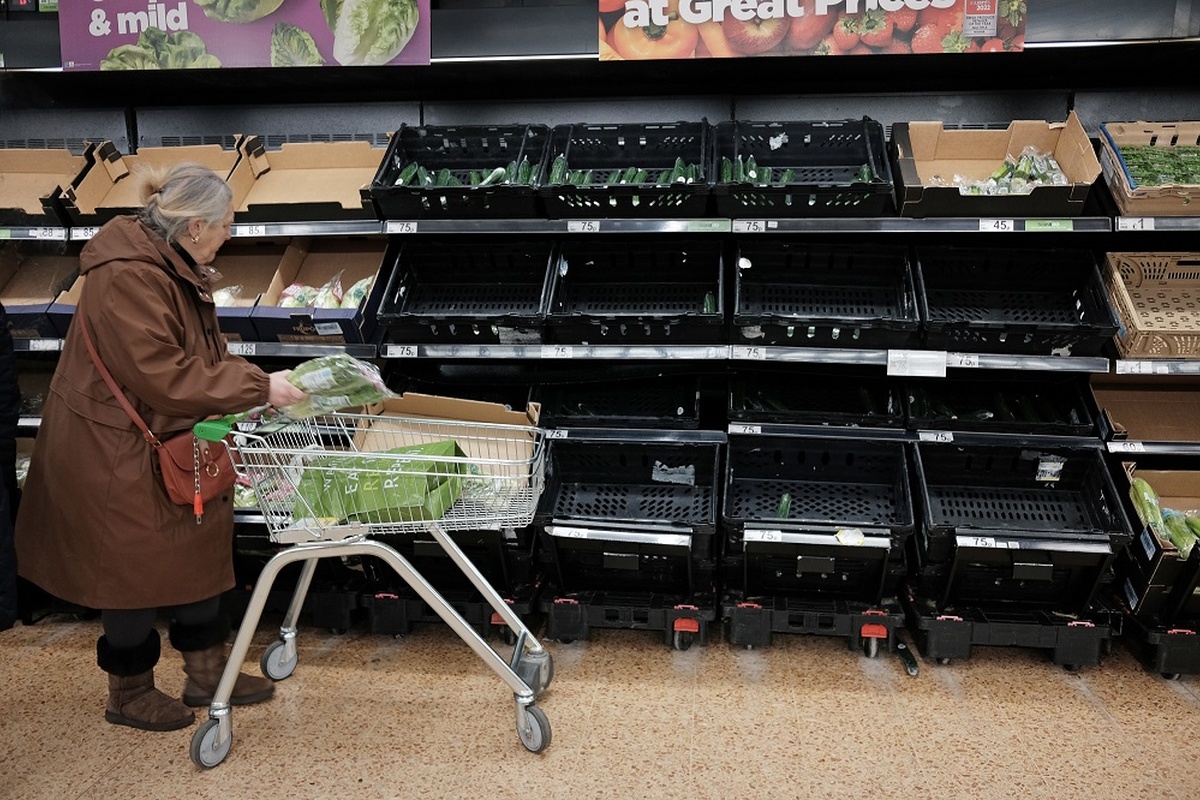
The UK has been experiencing food shortages and high food prices. And it’s going to get worse, much worse. An open letter to the Prime Minister this week, signed by 180 food and farming advocates, described the situation thus:
“The UK (along with the West) is entering a new era in which food supplies will be disrupted, public expectations may not be met and food can be weaponised. The food system is exposed to shocks and threats from geopolitics, climate heating, ransomware, energy outages, software malfunction and disinformation. These shocks will fall upon a system that is highly wasteful, import-dependent, environmentally unsustainable, and driven by the pursuit of private profit rather than resilience, with millions of people unable to afford a decent, healthy diet.
“The ‘just-in-time’ model means little or no stock is held along the supply chain, and the UK has no national food storage, as stores were wound up in the 1990s…..The food system built over recent decades is not fit for today’s or tomorrow’s challenges. The UK’s home production is woefully inadequate.”
We signed the open letter and supported its call for urgent action. The Welsh Government must also take a lead in dealing with these issues given its devolved powers for Wales.
The impact we are all feeling already is the price of food. Since 2021 the price has risen by 50%. It’s going to get worse. Food price inflation in 2025 was 4.2% a year. Then came the current war, then came the drought. Now food price inflation is predicted to rise to 6%, which is a doubling in 12 years. But there is more to come. The wars go on and we are receiving the most severe weather warnings for the coming year that we have ever seen. The UK, and therefore Wales, is explicitly vulnerable to the current and future turbulence. There is a complacent assumption that this will die down. We should plan on the confident assumption that it won’t.
So far, we are not ready. The current strategy is to rely on market forces, on ‘Tesco et al’. As the letter says, “for too long, the UK has been complacent about food as a national security matter, even as the urgency of the matter has become irrefutable.”
Let’s be frank about food security action in the Welsh context
Public awareness that food security has a hard edge is rising in the UK and in Wales as it hits pockets, purses and household incomes. People are getting the fact that our so-called ‘efficient’ just-in-time global supply systems are actually highly vulnerable.
But so far Wales has not developed an overview of what we need to do about it. We therefore welcome the creation of a new food security strategy group preparing thoughts for the new Government. Until that process delivers, it must be stated that so far, Wales has too often been stuck in discussions about whether there’s even a problem.
The key question — how are we going to make sure the 3.2 million people of Wales have access to decent, affordable food? — remains unasked and unanswered. And this challenge comes with multiple underlying problems, such as water pollution, biodiversity loss, sustainable farming, dietary declines, public sector procurement, labour shortage problems.
The key sectors that would need to work together fully to tackle the hard-edged food security threat – economic development, farming, sustainable food, poverty – have not been addressed or assembled in ways to address strategic challenges.
Despite this shortfall, there are a large number of projects in Wales testing a different approach to food. But even taken together, they do not come anywhere near to addressing the needs of 3.2 million people.
Minette Batters, former President of the NFU, said on Radio 4 that the UK is an island with 70 million people with absolutely no plan to feed ourselves in the face of circumstances we know are going to happen. She said we need the biggest agricultural revolution in our history. Wales has to agree what it wants to do about food security.
There are things that can be done from Cardiff, others that require UK-wide agreement, and others on which more local and community actions can begin to make a difference.
How can we make sure 3.2 million people in Wales have access to decent, affordable food?
This question is not just about today – conditions are changing rapidly, and crises, both short-term and long-term, are coming in waves.
The Just in Case report in 2025 (written by one of us) sets out what food security action requires. First, we must diversify our food supplies, so that our food comes from multiple sources, with much more from local and regional farms. Second, we must build community food resilience: the capacity of communities to look after their people, particularly those most vulnerable to lack of access to food.
Another fundamental feature of building food security is an “all-of-society” approach, where national Government, local authorities, communities and households are all working with common purpose.
A foundation for action
The good news is that there is much to build on in Wales. The open letter refers to “the creativity of farmers and growers; the improvement of British food availability and cultures since the mid-20th century; the awareness that food systems rely on natural ecosystems; the recognition that food is one of the UK’s largest employers; and much more.”
Wales itself is home to a wide variety of initiatives that, if fostered and scaled up, would create a new foundation for food security in Wales. And, encouragingly, the new Government of Wales is commissioning a new food strategy, with early signs that it might take a more radical approach than anything we have seen to date.
So what do we need to do?
It would be easy to say more research is needed. Actually, the UK and West, let alone Wales, are awash with serious and detailed work on what needs to be done to address the complex, interconnected nature of the food challenge. The good news is that much thinking and discussion has gone on. The bad news is that there has not been enough common agreement to get going.
Our Food Trust has summarised for Wales at least some of the ideas online at FoodSecurityAction.org, based on the Just in Case report. We think there could be agreement for action at four levels: national government, local government, community and household. Taking a multi-level approach would allow people to get on with changes such as the following:
- Communities could aspire to grow more food for their community, share food skills and plan for shocks. See Community food security: eight actions.
- County and city councils could support the growing of more food for their region, rebuild urban-to-rural trade, build a skills base, plan for shocks and support community action. See City/County Council food security: seven actions.
- The Welsh Government could establish strategies and laws, empower local government, diversify domestic food production, support urban-rural food trade, and enable food growing through the planning system and plan for shocks. See National food security: ten actions.
- Households could aim to have local food stores if they can, to learn/share growing and food skills, to grow food if they can, and to be ready to help out in a crisis. See Household food security: five actions.
What next? Food security leadership and food security flagship programmes
Wales needs two things right now. First, national leadership of the food security issue. We welcome the new food strategy focus as a serious opportunity to address food security. Second, the urgent launch of flagship programmes that will catalyse wide system change.
Wales needs a body that oversees food security action and brings together the silos of economic development, farming, sustainable food, and poverty. It needs to connect with state-of-the-art action across the world, define what action is needed in Wales, communicate the agenda across all of Wales, make proposals for the new Wales food strategy, and, above all, propose flagship programmes and then work out how to implement and finance them. This entity must report to the Welsh Government.
Flagship programmes need to deliver clear outcomes that resonate strongly with the public. This will not be hard: building food security is an extremely popular thing to do. Flagships need clear timeframes to maintain momentum.
They need to trigger changes that cascade across the food system, helping widespread transformation. Flagships need partnership between government at all levels, the private sector and civil society. Finally, they need well-managed innovation to enable the actors to take risks and experiment to deliver things that are impossible right now.
Here are four suggestions for flagship food security programmes in Wales.
Growing more food for local and regional markets
This will require a massive programme of farm diversification and building affordable farms for a new generation of farmers. It will mean protecting farmland from being sold out of farming (where it fetches a much higher price), building access to local and regional markets, building skills, and adapting our growing methods and technologies for the changing climate.
Feeding the towns and cities.
This will require stimulating demand within the cities (retail, catering, procurement, regional food hubs…), organising collective supply in rural areas, and investing in food supply chains with the required infrastructure. Farmer ownership of the supply chains should be maximised, through cooperatives or not-for-profit intermediaries, so that more value stays on the farm.
Addressing food poverty and the culture of poor diets
Many households already don’t have access to decent food, and the number is going to grow inexorably as food prices rise and disposable incomes decrease. We need to build an alternative to food banks and fast.
Community food resilience
Every community in Wales needs a local food action plan. The 22 Food Partnerships in Wales can have a pivotal role in supporting this, themselves supported in this role by the Welsh Government.
One might say this is all very well, but can’t we just leave the food system to sort itself out? Those days are over. The truth is that the promise of cheap food is now meeting the reality of rising food prices and shortages. We cannot ignore the environment and simply grow more, when the environment is the infrastructure on which food security depends.
We cannot ignore how our current food supply is disruptible, when industry insiders and the government’s own expert reports say so. Other countries are ahead of us. But as a small nation, Wales can be honest with its people and can draw on the strengths that exist.
Support our Nation today
For the price of a cup of coffee a month you can help us create an independent, not-for-profit, national news service for the people of Wales, by the people of Wales.
Get more trusted Welsh news
Choose Nation.Cymru as a preferred source in Google News to see more of our journalism.


