


Go home and prepare for coalition
Desmond Clifford
The recent ITV Wales opinion poll has generated something suspiciously like excitement in our normally dour politics.
If an election were held tomorrow Plaid Cymru would be the largest party. Reform UK would come second – even without a leader, candidates, policies or track record. Labour and Conservatives, in the current Senedd one and two, would be third and fourth. The once mighty Welsh Liberals have gone dodo. This poll measures on the Richter Scale.
Of course, the election will not be held tomorrow. It will be held a year from now and lots – everything in fact – can change in that time. For mostly the wrong reasons, the world has never felt less predictable.
We are living through the last days of the first phase of devolution. Eluned Morgan is, I suspect, the last First Minister of a single-party Welsh Government. Whoever succeeds her, or if she herself continues, it will likely be as head of a coalition government.
The new voting system, and the pattern of Welsh politics, makes other outcomes very unlikely.
The experience of single-party minority government in Wales has not been glorious. Alun Michael’s few months of minority rule right at the start of devolution was painful. There was initial Labour euphoria when Rhodri Morgan won half the seats in 2003 but, in practice, government became a grim attrition without a functioning majority.
Devolution was designed with coalition in mind. When Labour got serious about devolution in the 1990s, it won support for its proposals from Plaid Cymru and Liberal Democrats on condition of using proportional representation in the election system.
Radical
We take this for granted now but it was a radical move in the mid 1990s when first-past-the-post was all anybody knew.
In the 1997 referendum, the three pro-devolution parties campaigned alongside each other in the expectation that they would, over time, get to share power.
So it came to pass. The first coalition, a slightly tentative affair, was Labour-Liberal Democrat from 2000-03.
Devolution’s most successful government to date was the Labour-Plaid Cymru coalition of 2007-11. The quality of ministers was sound because they were chosen from a bigger pool. They represented the geography of Wales more fully and so embedded a sense of legitimacy and inclusion.
Coalition required an agreed government programme – the One Wales agreement – which provided strategic sense and a secure reference point when things got tricky, as they sometimes did. Above all, Senedd (Assembly) majorities were secure, and Ministers commanded the institution rather than being held hostage by it.
After the 2016 election the Labour administration relied on support from Liberal Democrat Kirsty Williams, embedded into government as Education Minister (a very good one, too) and, later, newly independent Dafydd Elis Thomas, holding the Culture portfolio (the most credible person ever to do so).
These arrangements enhanced the quality of government and sustained reliable majorities for Carwyn Jones and Mark Drakeford.
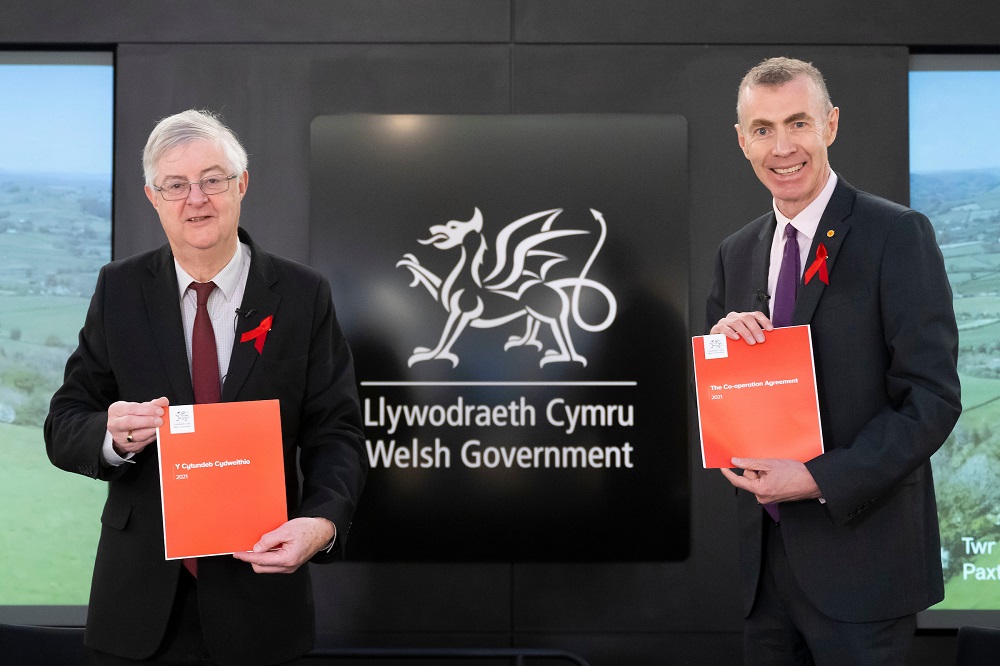
Most recently, the Co-operation Agreement brokered by Drakeford and Plaid’s Adam Price, an informal coalition effectively, delivered three budgets, Senedd Reform and a crop of other agreed measures. Labour’s current difficulties began when Drakeford stood down and Plaid Cymru ended the deal.
In the late 1990s the spirit of devolution promised cross-party co-operation freed from Westminster’s leaden hand. I’d score the card perhaps C+/B-.
There’s a legacy of partisanship which activists struggle to relinquish.
Rhodri Morgan was given a very hard time (vicious, actually) from Labour grandees when he took the bold decision to enter coalition with Plaid in 2007.
The various coalitions and co-operation arrangements described above weren’t always easy-peasy; there were sometimes tantrums and tiaras, much of it pointless and performative, but business generally got done eventually.
The voters will decide, of course, but it looks very unlikely they’ll give any party a full majority from now on. The new voting system militates against it and, unless a party’s vote mimics the Workers’ Party of Korea, the prospects for a single party majority appear slim.
Up until now, the Senedd’s politics over 25 years have been heavily weighted towards the crowded centre-left. As we saw at the EU Referendum in 2016, this can mask a gap between the liberal instincts of the Senedd and the wider Welsh public.
If we put square brackets around the question of independence, you could hold a policy postage stamp between Labour, Plaid Cymru and the Liberal Democrats. They contest largely the same spaces, even when they pretend otherwise. There are Plaid Members more left wing than Labour, there are Labour Members not much less nationalistic than Plaid. Jane Dodds is largely inoffensive to either Plaid or Labour.
The Senedd’s centre of gravity is a social democratic, soft-nationalist melange. The right has had little purchase in the Senedd so far – but perhaps their day is coming?
Posturing
Reform UK and the Tories look like they’ll have things to talk about when they get past the posturing. The current opinion poll doesn’t offer them a route to power but it puts them in the ballpark. For the first time, it’s not impossible to imagine a right-leaning outcome to a Welsh election.
We don’t yet know what policies Reform UK will develop for Wales, or whether they’ll take the Senedd seriously enough, but Conservatives should be giving serious thought now to a governing agenda. Even if they’re not on the winning side next time, they can be part of a proper opposition and, for the first time, a real government-in-waiting.
Flirting with Senedd abolition is a dead-end and will alienate them from Welsh voters for a whole new generation. Instead, if they take the chance, they have opportunity to show voters what a right-leaning Wales might look like.
Only a couple of years back, in 2022, Welsh Labour celebrated a century of winning elections in Wales.By any measure, that’s some record. Even at the time, though, I wondered if there wasn’t an element of hubris abroad.
As Gibbon notes, empires start to crumble at their point of greatest power and successive election wins have obscured an underlying erosion of Labour’s traditional base of support.
Next year is Plaid Cymru’s centenary which they may celebrate by winning an election, their first at the national level. If they pull it off, it’ll be a huge achievement after a century of defeats. And a heck of a gestation – has any other party waited so long before winning power?
Voting system
The eccentric voting system chosen for Senedd Reform makes life harder for smaller parties. Presumably both Labour and Plaid thought that would include Reform in 2026 so there’s some irony in the current polling position. If support for Labour drops much further, it risks a downward spiral; the modelling looks tricky when support falls to mid/lower teens. Unless fortunes shift markedly, the Lib Dems and Greens will struggle for seats.
My best guess is that the new Senedd will split, for the first time, into two clearly identifiable blocks. There’ll be a left-centre/ soft-hard nationalist/ progressive group consisting of Plaid Cymru, Labour plus any Lib Dems and Greens who make it through. And there’ll be a right-leaning, explicitly unionist block of Conservative/ Reform. My guess is the first group will form the government and the second group the opposition.
It could just conceivably be the other way round.
Wales can learn from Ireland’s recent experience. Fianna Fail governed Ireland for most of the twentieth century, yielding to Fine Gael and its partners for only short periods.
The banking crisis changed politics for good. When, in 2020, Fianna Fail and Fine Gael adapted to reality and formed a coalition, it was an infinitely greater leap than any Welsh parties have to contemplate.
A hundred years ago, these guys were literally killing each other and attending the Dail (Senedd) with guns in their pockets just in case.
The Irish have made coalition in a PR system work effectively. The Taoiseach has been shared on rotation; Michael Martin (FF) holds office until 2027 when Simon Harris (FG) will resume the post. The rotating Taoiseach is not offered as a good will gesture, it reflects the reality that neither party can command a majority in the Dail without support from the other.
If similar circumstances apply in Cardiff, the parties should consider a similar bargain.
Coalition-building
My unsolicited (and possibly unwelcome) advice to the political parties is to think seriously about coalition-building as the norm. It’s what Welsh voters want and will very likely mandate. Of course, no one will campaign for coalition, and nor should they. The election is a choice, and each party should look to win or to maximise its support.
But if they’re clear-sighted, party strategists should be thinking through what issues really matter, how support can be built and where red lines might be drawn.
There needs to be a new seriousness about drawing up manifestos with this in mind, a shift in gear from past amateurishness.
European countries sometimes take months over post-election wrangling. The expectation here is for sharper action and voters won’t be impressed by Senedd Reform if it results months of handwringing, especially where the range of outcomes seems largely predictable.
Coalition shouldn’t be a lowest common denominator; it should stretch up, not bend down. Set sights with ambition and draw on double the talent, the very best from each party or parties. But don’t let the Welsh people down by sitting on your hands and opting out.
If you want Welsh democracy to work and thrive, be ready to follow instructions from the voters.
Go home and prepare for coalition.
Support our Nation today
For the price of a cup of coffee a month you can help us create an independent, not-for-profit, national news service for the people of Wales, by the people of Wales.



The One Wales Agreement between Labour and Plaid did produce stability and the recent Co-operation agreement had a similar effect. In my opinion the construction of an agreed platform between coalition partners ensures that policy that is developed has the broadest support from the electorate and ensures a democratic mandate.
Anything that keeps Reform out of the equation can only benefit Wales.
Circumstances have changed.After Starmers Island of Strangers it’s imperative that Reform along with Labour should be kept out.
The only credible option is for Plaid to have a coalition pact with the Lib Dems and The Green Party even if it means a minority government.
By the way this would be nowhere near the same scenario as the Voting pact in the 2019 General Election.
It’s not really up to you. It’s up to the voters. Whatever alliance can command the strongest combined vote share should be in government.
Best not to expect a man from County Cork to be too familiar with the nuances of English history…