


Helen Jenner: can she be any good?
Desmond Clifford
Reform’s new leader, Helen Jenner: will she be any good? What does good even mean in this context?
She’s a better pick than Dan Thomas who she replaces, though this is not an extravagant endorsement. There was something of the wet blanket about him.
Former Tories make the worst Reformers. They are invariably career politician types who made a self-interested calculation to jump ship. Look at shameless Robert Jenrick, the champion among turncoats. Ten years ago, he was a Cameroon Remainer, then he angled for the Tory leadership until Kemi Badenoch nailed it down, and only then discovered his inner Reform instinct. Now he’s practically Genghis Khan and will stay that way for as long as it serves him. When it’s all over, you can see him running a Buddhist retreat in Herefordshire insisting this was his karma all along.
James Evans, another former Tory, didn’t exactly help Reform’s cause last week. He called a press conference to announce that, in spite of colleagues pleading with him, he wasn’t standing for the leadership, but could if he wanted to, and if he did, he’d win. Even in a party used to strangeness, this was at the far frontier. To paraphrase Scott Fitzgerald: “Let me tell you about politicians. They’re different from you and me.”
I imagine Helen Jenner will get over it. She’s a Farage True Believer. She belongs to that part of Reform which represents an inchoate howl, a people affronted by change over which they feel little control. The world has changed dramatically – immigration, automation, stagnation – BUT NOBODY ASKED ME! Boo-hoo.
Reform is partly a response to the dreary managerialism of the traditional parties and the gap between rhetoric and action. Brexit was merely the catalyst. In Farage they found the man who says it like it is, who laughs at consensus; the man who, in following his own way, found a tribe which had been waiting for him.
In Welsh politics the Labour Party embodied that sense of dulling stagnation. Labour’s dreary conservatism, delivered with a “we’re-better-than-you” self-righteous drone, became harder to take as the country got stuck in the mud.
Plaid Cymru was the beneficiary with a fresh prospectus, dynamic leadership and a belief in Wales in place of Labour’s defeatism. Among those for whom “Wales first” doesn’t work, Reform picked up the slack.
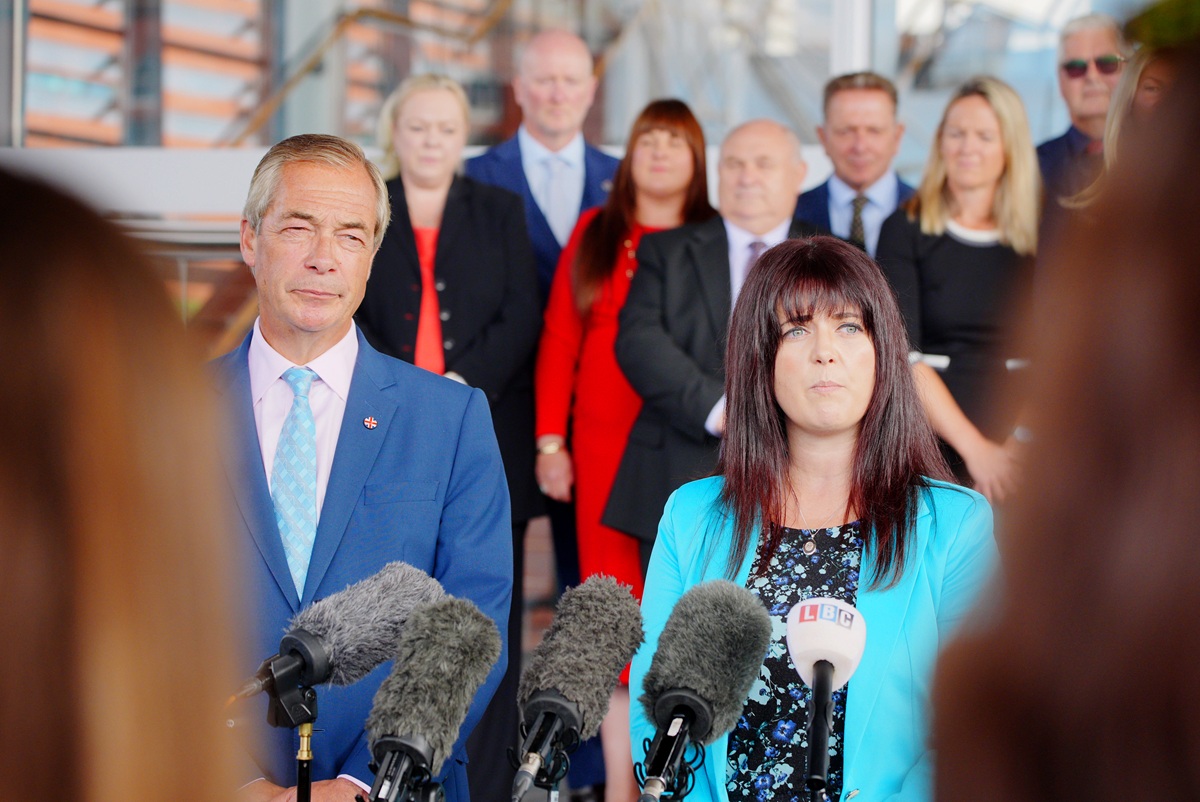
Reform’s problem is that it has no leader, truthfully, other than Nigel Farage. The party was built in his image and makes no sense without him. The millions of pounds from crypto-traders flow in because of him. Farage anointed Helen Jenner on the steps of the Senedd, implying he saw something in her all along.
Let’s see if the rest of us do. She was Reform’s best asset in the Welsh election. She represented better than any Tory-turncoat ever could the swell of anger and rejection which propelled Reform from post-Brexit turmoil to a political mass movement.
Occasionally she was tongue-tied and lacked the polish of practised political operators, but this was mitigated by a seemingly authentic persona – the ordinary person disillusioned by traditional politics and looking for change.
Her speaking Welsh (Farage noted, in his interviews, “so many young people speak Welsh these days”!) emphasises that, contrary to some opinions, the Welsh-speaking population doesn’t conform to a single political outlook.
Will she be any good? As leader of the opposition, she needs to present herself as an alternative First Minister and Reform as an alternative government. While she can reasonably be allowed a little while to bed in, she can’t spend her entire time in haranguing mode.
She needs to develop as a viable alternative First Minister and demonstrate her credentials to the country at large.
Party activists
The great mistake of most leaders in the Senedd is that they address their party activists, not the wider Wales. That was one reason for Labour’s catastrophe; they became obsessed with each other and forgot the country beyond the Senedd door. Helen Jenner will need to shape a distinctive Reform agenda and persuade voters that she and her party have some distinctive ideas for governing Wales better than Plaid Cymru.
They can bang on all they like about immigration and the culture wars but ultimately voters want to know about health and education, and how to use the Senedd’s actual powers.
If Reform’s performance to date is any guide, this won’t happen. The likelihood is that Helen Jenner will sit atop Reform as an inert fixture offering no variation on prognostications coming from Farage and his leadership clique. She will defend what she has to defend and otherwise roll with the punches. The chances of a meaningful agenda for Wales emerging are very low. That was the main reason why, apparently, Sarah Cooper-Lesadd left for Plaid.
At the election Helen Jenner personified the estrangement many voters feel with the political system, but she is now part of that system. In return for her fat Senedd salary, an amount most of her constituents can only dream about, she needs to come up with some solutions.
Cardiff-centric
For years the Senedd suffered from being Cardiff-centric. All six of Labour’s First Ministers were from the Cardiff Labour Party with the exception of Carwyn Jones who lived all of twenty miles away in Bridgend. It was perverse really since Cardiff rejected devolution at the referendum in 1997. There was, inevitably, a certain insularity of outlook and policy which probably didn’t help the party in the long run.
Suddenly, North Wales is dominant. Rhun ap Iorwerth and Helen Jenner actually went to the same school, Ysgol David Hughes, on Ynys Môn.
Along the coast in Kinmel Bay is Darren Millar, leader of the Conservatives. Further east again is Ken Skates, Labour’s leader. It’s a major re-mapping of political geography but, in principle, a positive development. Welsh democracy should reach all parts of the country.
Helen Jenner has an English Literature degree and was a teacher. I wonder if she finds repose with Keats, Shelley and the like? Is she moved by the desperation of RS Thomas at the state of Wales, and his own state with God? Maybe she finds wisdom and philosophy in George Eliot? Does Shakespeare work for her? Is she thrilled by Glendower in Henry IV Part 2, or does she prefer Macbeth with its politics raw and bloody?
At any rate, she has something in common with Andy Burnham: amazingly, he is Britain’s first Prime Minister with a degree in English Literature – and a welcome change from all those PPE (Politics, Philosophy and Economics) bores.
Spitting
Helen Jenner was spitting about Sarah Cooper-Lesadd’s defection from Reform to Plaid, saying she must have lied to one party or the other about her beliefs. And yet she has appointed Laura Anne Jones as her deputy, barely a year after she defected from the Tories, for whom she was elected to the Senedd twice, in 2003 and 2021 – ending an association with the party stretching back more than 20 years.
The Dan Thomas resignation and the defection of Sarah Cooper-Lesadd have been Reform’s first big bumps in the road. I suspect they won’t be the last.
A new party with so many members previously untested in elected politics is inherently unstable. I’ll be surprised if there aren’t further splits, resignations or expulsions to come.
Will Helen Jenner hold it together? Will Reform still be a force at the next election or will the crazy kaleidoscope have moved again?
Support our Nation today
For the price of a cup of coffee a month you can help us create an independent, not-for-profit, national news service for the people of Wales, by the people of Wales.
Get more trusted Welsh news
Choose Nation.Cymru as a preferred source in Google News to see more of our journalism.



Jenner. Ych a fi!
Great piece, She has kicked off all guns blazing .Her head down reading from a script with a few hand gestures You had the sense she felt pressured to be snappy and snipey Full on Reform mode. Having already had a reshuffle today some might think Reform are already on the back foot Luck seems to bypass Chief Whip Powell His motion tonight ” Should Wales be part of the UK lost by 1 vote ( Staggering the Casting vote Llywydd) The loss of Sarah from Reform to PC looks significant The motion really has opened up a can of… Read more »
“In Farage they found the man who says it like it is” He says what serves him best in the moment, regardless of any resemblance to reality, and will turn around later and say the complete opposite if that’s what best suits him in the new moment. He makes it up as he goes along. Right or wrong, true or false it doesn’t matter. The only test is what best suits him right now. He has no embarrassment at being caught telling falsehoods. The lack of embarrassment and shame and the complete satisfaction with his own actions gets called authenticity… Read more »
Like all reform Lieutenants to farage, they will do what Herr Leader says.
Is she calling out het boss’s attack on a woman at the conference yet? Or is that sort of abuse OK because the victim was not in Reform.
If Helen Jenner were any good, she would have been made Reform leader. Instead, Nigel Farage chose Dan Thomas, a thug for hire. Jenner was not an afterthought: even her Senedd group was divided and not wholly convinced by her leadership qualities.
Well that aged well…
Reform UK’s Welsh leader works for firm that helps foreign workers migrate to the UK