


HMRC’s Kafkaesque correspondence: what it says about the agency
Dr Huw Evans
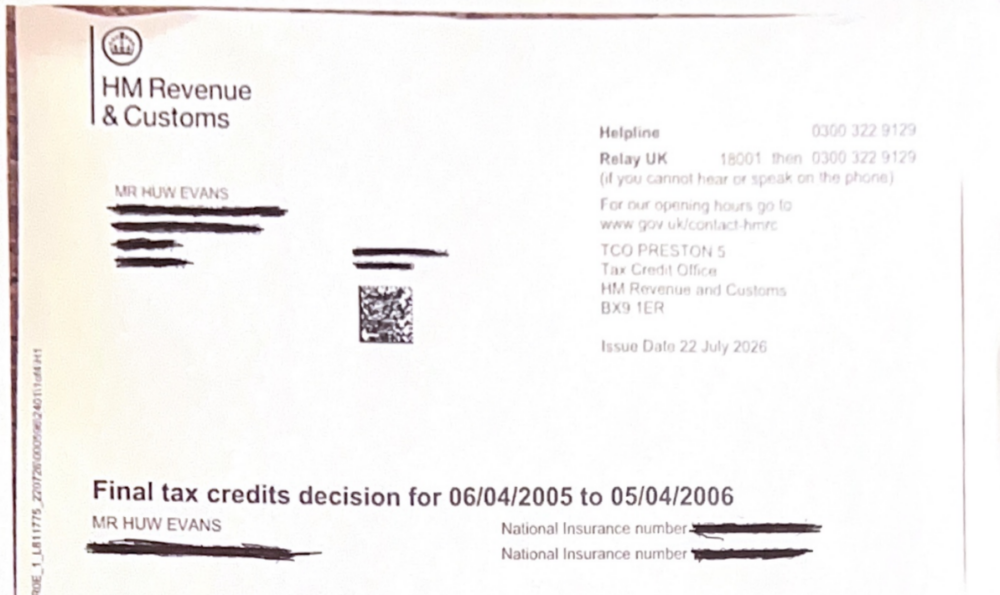
On 30 July 2026, I received a letter from HM Revenue and Customs addressed to my wife and me. It was headed ‘Final tax credits decision for 06/04/2005 to 05/04/2006’.
The letter had not been lost in the post for 20 years: it was dated 22 July 2026. Receiving correspondence of this kind, about a tax year two decades earlier, felt almost otherworldly.
The letter confirmed the total amount of child tax credit paid for 2005–06 and stated that nothing further was payable to us. It also invited us to check the decision and the circumstances on which it was based. That invitation came with a warning: we ‘could be charged a penalty of up to £300’ if we did not report any change in circumstances within one month.
The letter prompted a sequence of reactions: amusement, incomprehension, irritation and, finally, reflection. I consider each in turn below.
Amusement
The absurdity of the situation made me laugh. I felt it surreal. A decision notified 20 years after the event, combined with a warning that I might be penalised if I failed to report a change in circumstances within one month, had an unavoidable comic quality.
The premise was also difficult to take seriously. I could not realistically be expected to know, with any precision, whether our circumstances had changed during that period. The relevant records are long gone, and my memory is not sufficiently detailed 20 years later.
Incomprehension
I could not understand how such a routine and apparently uncomplicated matter had taken so long to conclude. The delay was so unexpected that it left me, to borrow Frankie Howerd’s line from Carry On Up the Jungle: ‘…flabbergasted: my gast had never been so flabbered’
Irritation
I was irritated. I might, in theory, have had grounds to challenge the assessment or claim further child tax credit for the period. In practice, however, the absence of evidence after so many years means I have no realistic basis on which to review the decision.
I suspect the decision is probably right. We generally manage our financial affairs carefully and would have been alert to our entitlement at the time. But there is an important distinction between believing a decision is likely to be right and being able to verify that it is correct.
I was also irritated by the threat of a financial penalty for failing to report any change in our circumstances within one month, despite HMRC having taken two decades to issue the decision.
I do not think there was any relevant change during 2005–06, but I cannot now be certain. That leaves a theoretical possibility that some change occurred which I no longer remember and cannot verify. In principle, I could therefore face a penalty, although any alleged change would still have to be proved. The result is Kafkaesque.
Reflection
My thoughts then moved beyond the personal inconvenience, which was relatively minor, to the broader implications of the letter.
Government must pay for the services it provides. Borrowing can meet some costs, but debt must ultimately be serviced and repaid. In the end, public services depend on revenue, and taxation is the central part of that revenue stream. It follows that tax collection authorities, like HMRC, should operate as efficiently as possible.
In this context, efficiency means collecting the correct amount of tax from everyone. That is an ideal rather than an easily attainable state, but it should still be a clear objective. Broadly, it depends on two things: effective enforcement and collection processes that are adequate, accessible and timely.
As to enforcement, tax evasion remains a significant challenge. A 2024 National Audit Office report stated that £5.5 billion was lost to tax evasion in 2022-23. On a related point, the HMRC Chief Executive stated in 2022 that every £1 spent on enforcement work generated an additional £9 in tax revenue. Enforcement work is therefore an investment activity which more than pays for itself.
Before its election, Labour published Close the Tax Gap, a plan focused on reducing the difference between tax owed and tax actually paid. That gap was calculated at £39.8 billion in 2022-23. It includes tax lost through evasion, but also tax that is simply not collected, so it spans both enforcement failures and weaknesses in collection processes.
The HMRC letter does not inspire confidence that the agency is even moving towards that ideal. Nor do I believe the letter was an isolated, one-off error: realistically, it cannot simply have sat in someone’s in-tray for 20 years.
It was most likely generated by a system. If so, that makes the absence of effective oversight more troubling. Systems should be reviewed, and safeguards should prevent correspondence of this kind from being sent, even if it is generated automatically.
It also seems likely that other people received similar correspondence. That raises further questions: why did the process take so long; how reliable are assessments made or finalised after such a delay; and how can taxpayers meaningfully challenge decisions when the evidence needed to do so may no longer exist? Those questions point to wider concerns about HMRC’s efficiency and effectiveness.
Questions can also be asked about the quality of HMRC’s customer service.
Where does this leave us?
This piece may read, at least in part, like a rant — and perhaps it is. But the broader point matters. The subject matter is relatively trivial, yet the letter was so plainly anomalous that it raises legitimate questions about HMRC’s systems and oversight.
HMRC is not the only public body whose performance merits scrutiny. Similar questions can and should be asked of other agencies.
Publicising examples of this kind helps bring those questions into view and may, in a small way, contribute to them being answered.
Support our Nation today
For the price of a cup of coffee a month you can help us create an independent, not-for-profit, national news service for the people of Wales, by the people of Wales.
Get more trusted Welsh news
Choose Nation.Cymru as a preferred source in Google News to see more of our journalism.


