


Hostage Nation. How Plaid saves Wales

Richard Morgan
In 1840, French political commentator Alexis de Tocqueville wrote about emerging democracy in America. He identified a form of power that he called “Soft Despotism”… so subtle and potent that its subjects wouldn’t even notice they were being oppressed.
Wales faces an evolving disaster, in which the writings of De Tocqueville have an awful resonance. If he were writing about Wales, the following could have been written yesterday.
“Above this race of men stands an immense and tutelary power, which takes upon itself alone to secure their gratifications and to watch over their fate. That power is absolute, minute, regular, provident, and mild. It would be like the authority of a parent if, like that authority, its object was to prepare men for manhood; but it seeks, on the contrary, to keep them in perpetual childhood: it is well content that the people should rejoice, provided they think of nothing but rejoicing.
“For their happiness such a government willingly labours, but it chooses to be the sole agent and the only arbiter of that happiness; it provides for their security, foresees and supplies their necessities, facilitates their pleasures, manages their principal concerns, directs their industry, regulates the descent of property, and subdivides their inheritances: what remains, but to spare them all the care of thinking and all the trouble of living?
Thus every day it renders the exercise of the free agency of man less useful and less frequent; it circumscribes the will within a narrower range and gradually robs a man of all the uses of himself. The principle of equality has prepared men for these things; it has predisposed men to endure them and often to look on them as benefits.”
The passage above is not a metaphor. Wales is a nation. It has a language, a distinct literary, musical and poetic tradition. It has a vibrant sporting identity and a set of values rooted in socialism, chapel and community. It has also, for the best part of five hundred years, been administered and governed as a region of England.
Living with the tension created by trying to reconcile this conflicting state of affairs causes a condition of constant low grade psychological distress. This in turn leads to exhaustion and a feeling that no matter what is done, no matter which way a vote is cast, that nothing will change.
A state of affairs has developed where the Welsh have been bullied and coerced to such an extent they have started to willingly accommodate a power they cannot escape. They have, as a result of trying to reconcile the unreconcilable, and its attendant fatigue, come to believe that the Welsh government is to blame for services and national infrastructure that are inexorably descending into crisis.
Welsh Labour
The Welsh Labour Party shares some considerable responsibility for this. Its performance on devolved policy areas such as Education has been nothing short of catastrophic. However, there is no question that Wales should and could have more funds at its disposal.
Wales is a net contributor of energy to the UK, at a time when energy has never been more valuable. Currently all the money from Wales Crown Estate holdings flows to Westminster directly. Severn Trent and United Utilities extract in the region of 1,100 million litres of water a day from Welsh reservoirs and rivers, the profit from which the Welsh never see.
The devolutionary constitutional settlement imposed on Wales by Westminster is devastating in its simplicity. Wales is permitted to control all the things that generate costs while Westminster controls almost all the things that generate income. To compound matters further, Wales occasionally has extraordinary costs thrust upon it, such as a £4 billion charge for HS2. A project that does not serve a single Welsh station, in a country that has no mainline railway connecting North to South.
UK Government then pays Wales back barely enough to keep public services and infrastructure sliding, from permanent crisis, into total collapse.
It is like being in an abusive relationship in which the stronger partner imposes its will, controls the finances, demonstrates deeply immoral and hypocritical behaviour while the weaker partner works round the clock and hands over their unopened pay packet every week. Thus the dominant partner gives back barely enough for the other to pay the bills and feed themselves, while constantly bombarding them with the message that they will never make it on their own. You’re too weak. You’ll never earn enough. You can barely run this household even with my support; how will you possibly survive without me?
This experience of being coerced and abused is lived in every bus replacement service, in every water bill that arrives on the day the river at the bottom of the garden runs brown, or every time a school closes. It results in chronically low expectations. Rather than hoping for the best, hoping for excellence, people just want the bus to arrive on time, for the school or library to stay open, for the rivers not to be full of human shit. A population that has been failed often enough will eventually stop asking for anything more than the minimum.
De Tocqueville continues his essay:
“After having thus successively taken each member of the community in its powerful grasp and fashioned him at will, the supreme power then extends its arm over the whole community. It covers the surface of society with a network of small complicated rules, minute and uniform, through which the most original minds and the most energetic characters cannot penetrate, to rise above the crowd.
“The will of man is not shattered, but softened, bent, and guided; men are seldom forced by it to act, but they are constantly restrained from acting. Such a power does not destroy, but it prevents existence; it does not tyrannize, but it compresses, enervates, extinguishes, and stupefies a people, till each nation is reduced to nothing better than a flock of timid and industrious animals, of which the government is the shepherd.”
He describes a state of being in which the Welsh electorate now finds itself. Timid and stupefied. A population that has, through a combination of gaslighting, abuse and excessive control of the minutiae of life, arrived at the conclusion that it can never make it on its own as an independent country, and that whether they vote or not, or who they vote for, nothing will ever change.
Into this dynamic struts Reform UK. They are selling the notion of being listened to, and the recognition that things are genuinely broken. It feeds off people’s frustration and resentment, and it is directing it, with considerable skill, at immigrants, at the civil service, at ‘woke’ organisations and institutions, at existing traditional systems of government, at experts.
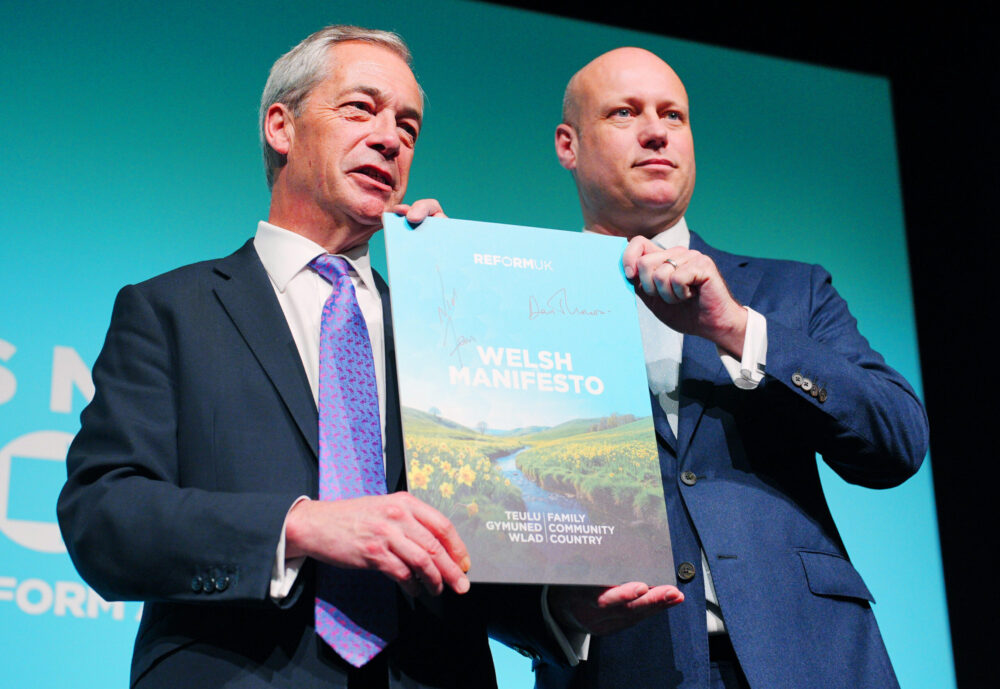
Reform will blame anyone and anything except the prevailing structural economic arrangements responsible for producing the conditions that have so broken the will of the population, while simultaneously campaigning for policies that would make those arrangements worse.
Reform UK poses an existential threat to Wales and the Welsh language. It is a rising force because the anger and frustration it feeds upon is legitimate. Wales has been failed by a combination of starvation of funds from England, and episodes of staggering incompetence from Welsh Labour, and the people who feel it most acutely: the post-industrial communities that once formed the industrial powerhouse, not just of Wales, but of the entire British Empire, are right to be angry.
In a letter to his illustrator, Ralph Steadman, regarding Steadman’s “savage, glue-sniffing” son, Hunter S. Thompson wrote,
“England is the wrong place for a boy who wants to smash windows. Because he’s right, of course. He should smash windows. Anybody growing up in England today without a serious urge to smash windows is probably too dumb to help.”
Ditto Wales in the twenty-first century.
Anger
Farage is adept at identifying this anger and using it for his own ends. He depicts himself as a man of the people raging against the broken machine. He is however a millionaire former City of London investment trader who has campaigned tirelessly for financial deregulation, weakening of workers’ employment rights, tax cuts and slashing spending in areas which are very likely to impact the growth of the Welsh Language.
He is in reality, very much a fan of the machine he rails against, and like some nasty predatory insect, is very careful to cultivate an image that lets him fit in with the demographic he is targeting. The flat cap, gamekeeper shirt and pint of warm frothy beer are very specifically chosen affectations, designed to allow him to blend in and look like one of you.
However, Farage as predator and his policies aside, the real existential threat that Reform UK poses to Wales is so pernicious that it needs to be understood urgently and acted on as if the very existence of the country depended on it; which in many senses, it does.
“Soft Despotism” is the context in which the danger lies. Any future Reform victory in Wales would mean two distinct things:
First, that the Welsh Nation had become so bludgeoned into a state of quiet, frustrated apathy that it would vote for its own destruction. And second, that by voting for a right-wing party led from England, a majority of Welsh voters would abandon the idea of Wales being self governed. It would be the most tragic thing to happen to Wales since the Acts of Union were signed in 1536 and 1543.
Listening to conversations in canteens and buses, it is not uncommon to hear people express a willingness to vote Reform, and in the same sentence express sufficient frustration with the Senedd that they would happily endorse its abolition.
Given Welsh Labour’s record, had they won the recent election, it would have opened the door to a Reform landslide in 2030. Happily for everyone concerned there is one way of stopping that happening, and one way only. Wales right now needs the spirit of Bevan and ap Gruffudd more than ever. Plaid have got one shot at this and they need to get it right, first time.
What won’t work is the following: Trying to win arguments, calling members or supporters racists, or Nazis, or trying to prove them wrong, or calling them anti Islamic, or stupid, or economically illiterate. Don’t accuse them of identifying all the problems but offering no solutions. Don’t call them anti Welsh. In fact don’t call them anything.
There is almost no point in engaging with them on any level because all they have to do is point out how broken everything is and they’ve won. Every single person watching or listening to a broadcast in which Reform are given the opportunity to reiterate, for the umpteenth time that everything is broken, and they are going to fix it is going to say to themselves ”Well… they’ve got a point, and to be honest I’ve had enough of being told things are going to get better, so what the hell. I’m voting reform”.
Not one of the things listed above are going to work. There is one thing, and one thing only that will stop Reform UK.
Results.
Progressive policies
With the rise of Reform, Wales is in a fight for its life, and it is a fight that Plaid Cymru must win. It will only be won if Plaid adopts truly innovative and progressive policies, and crucially, new and more effective methods of enacting those policies. Some difficult discussions need to be had about some long standing assumptions. Welsh Language policy for instance needs to be reviewed urgently. If they fail to do this, they will fail to deliver results and at the next election the Welsh population will abandon the idea of self governance.
The very best case scenario if that happens is that any chance of Welsh Independence will be lost for a generation. The worst case scenario hardly bears thinking about but includes the winding up of the Senedd and a return to being ruled as a region of England by a Reform Government.
Among the challenges Plaid must overcome is that over the last forty years the UK economy has transitioned into one which values profit and GDP over human outcomes. If anyone doubts this they need look no further than our privatised national rail system which manages not only to be the worst, but also the most expensive in Europe, or the UKs National Water infrastructure which features widespread illegal pollution as part of its business plan. It is more profitable to pollute and pay the fine, than to spend money repairing and updating infrastructure.
Not so Welsh Water you might think. You would be wrong. Despite its proud claim that it is “For Wales, not for profit” it is neither owned by the Welsh people, or controlled and regulated by the Welsh Government. Welsh water is debt funded, and between March 2024 and August 2025 alone Welsh Water paid £200 million in debt interest to overseas creditors.
Investment has fallen by over 20% over the last thirty years and the CEO was awarded £91,364 in 2024, the same year that Welsh Water pleaded guilty to eight hundred environmental breaches. It is also haemorrhaging profit to England: For every £1 that Severn Trent Water pays Welsh water for the water abstracted from the Elan Valley, it makes £21.
In the United Kingdom, national infrastructure is now largely run for profit, not for the benefit or welfare of the population. And estimates from the High Pay Centre suggest that in 1980 a CEO in the UK would earn twenty times the median pay of their workers. In 2025 CEO pay had risen to one hundred and thirteen times the median pay of a worker.
These few examples stand here solely to illustrate the enormity of the structural problems that stand in the way of Plaid Cymru delivering results to the Welsh electorate, and that is before they get anywhere near policy areas like Education and Health.
It would be absurd to think that there might be any quick fixes that would even begin to circumvent these titanic structural problems. Or would it?
The Preston Model
2011, Preston, Lancashire. A £700 million city centre regeneration project collapsed when the main developer pulled out. The ensuing crisis required Preston City Council to innovate.
Matthew Brown, a councillor, had been researching worker-owned cooperatives in America. He approached the Centre for Local Economic Strategies (CLES) and together they started looking at how much Preston’s institutions were spending, and where that money was being spent. It turned out that most of the money was going to national and multi national suppliers, and not staying in the local area.
Together they designed a scheme in which procurement was redirected. Local institutions were required to identify whether local suppliers could meet their needs before considering options outside the area. Between 2012 and 2017 the amount spent by those institutions in the local area rose from £38 million to £111 million. Spending by the same institutions inside Lancashire rose from £292 million to £486 million. No permission from Westminster was required nor was any new legislation needed.
In 2018 Preston was named the most improved city in the UK for resident wellbeing, and the model was being adopted as far and wide as Cleveland and Barcelona.
Institutions
Wales has the institutions: The Hospitals, the Universities colleges and schools, the Councils, the Police. What it needs now is the vision to get this process moving, and to do it fast.
Plaid have four years. If they move fast there is a strong chance that the Preston Model will deliver the very results that will get them re-elected. Getting re-elected is the goal. Failure would almost certainly mean the end for Wales.
What has been historically lacking is a combination of things: There has been an institutional reluctance to look outside Wales for solutions; most notably to England (for obvious historical and cultural reasons) and a lack of political will to demand that its own institutions behave differently.
The levers are there, but for twenty seven years the Labour Government didn’t even see them, let alone pull them. Procurement, planning, public sector employment, housing, all utilised for community wealth building rather than meeting targets. Welsh Civil society in all its forms needs to be mobilised as a force for economic growth, not just for target setting, gatekeeping and lobbying. Which brings us neatly to the elephant in the room. The Welsh language.
Having established that the existential threat to Wales lies in what a Reform win would mean; the Welsh electorate giving up on self governance… rather than any specific appalling policy, it is worth noting what Reform say about the Welsh language, and how, rather than trying to win an argument against them in this respect, they can be disarmed.
Reform claim that they are not anti Welsh, nor do they object to its use. They have however said that they are in favour of the Welsh language growing as a result of a desire to learn it rather than compulsion.
There is a compelling argument for Plaid to adopt the same position. At least for the moment.
Pragmatic re-evaluation
Call it a temporary pragmatic re-evaluation of language targets. The aim being to unshackle some policy areas. Areas which would significantly benefit from drawing from a talent pipeline which is currently constricted as a result of language policy.
To give only one example. Recruitment of Welsh language teachers of core subjects is in crisis. Recruitment of Maths through the medium of Welsh is at 28% of target. Science is at 27% of target and Welsh itself is at 15%. With the current number of Welsh Schools, Plaid will need to train 1000 welsh speaking teachers a year. The number qualifying annually currently stands at 369. This is for no other reason than less than 18% of the population of Wales speaks Welsh sufficiently well to be considered for employment as a teacher.

In practical terms it means that when assessed, Welsh speaking children, taught in Welsh speaking schools have lower attainment levels than English speaking Welsh children taught in English medium Welsh schools[1].
In a sentence. There is such a shortage of Welsh speaking teachers of core subjects, that the quality of education being delivered to Welsh speaking children through the medium of Welsh is measurably poorer than that being delivered in English to English speaking children.
In the world of a temporary pragmatic re-evaluation of Welsh language targets, teachers would be selected on the basis of their core subject skills first, and then supported in their journey to become fluent Welsh speakers while on the job.
The same recruitment policy could easily be implemented across all areas where Welsh language requirements constrict the recruitment pipeline. The goal is excellence first. The language will follow.
A targeted, temporary relaxation of Welsh language requirements for core subject areas costs nothing in long term ambition. It immediately opens up the talent pool and sends the unambiguous message that Plaid is putting educational excellence front and centre, within a system in which Welsh can flourish. The goal becomes educational attainment not a compliance driven framework in which the children are taught by teachers underqualified in the subject they are delivering.
The other challenge for Plaid, which is tied directly to the Preston Model, is this: A Wales built by the Preston Model is a Wales that would be built with prosperity flowing from the bottom to the top, not as it currently is, with prosperity dribbling down from above.
If Plaid can build that, they can build a country with economic and social confidence, with communities that are proud of their achievements, who believe strongly that they have the power to change their futures for the better. This is a Wales in which the Welsh language will thrive. It will grow and thrive not because of 2050 targets, or mandatory frameworks or being taught compulsorily in schools. The language will follow prosperity.
Plaid needs urgently to focus on delivering results, and those results need to be, first and foremost, economic. Recalibrating its Welsh language aspirations to fit with the urgent prerogative to deliver real improvements to the electorate is not a retreat or surrender.
It sends the message they can make difficult pragmatic decisions, and an acknowledgement that a thriving Welsh language will be the product of a thriving nation, not a precondition for one.
[1] Lancaster University, using 2015 PISA data. Maths, Reading, Science. Significantly this gap exists despite Welsh speaking children coming from more advantaged backgrounds. More books at home, more time studying outside school.
Support our Nation today
For the price of a cup of coffee a month you can help us create an independent, not-for-profit, national news service for the people of Wales, by the people of Wales.
Get more trusted Welsh news
Choose Nation.Cymru as a preferred source in Google News to see more of our journalism.



Interesting article. Good to see the start of serious policy discussion.
Terrifying stuff. Really hope he’s nowhere near government. Not one mention of the private sector, Welsh businesses, attracting businesses to Wales, entrepreneurs etc etc. The part of the economy that creates money, jobs etc that fund public services. Extraordinary.
By paying their employees next to nothing,recruiting foreign workers to deliberately keep wages at a pittance and when profits are low relocating to the sweat shop economies of the Third World.Thats how global capitalism really operates.
Odd stuff. Most companies pay their workers good wages and have been responsible for the extraordinary technological advances we have seen in the last 200 years. Wales needs those companies so we can have skilled, well paid jobs that lead to the tax receipts that fund the NHS, education etc. 70% of UK tax receipts come from the private sector…
Jess, you are correct to point out that the article fails to directly address the private sector and, if I interpret your comment correctly, the notion that the private sector creates wealth and the public sector spends it. The Preston/CWB Model though does implicitly reference private sector growth. Public sector funds flowing directly to the local private sector, rather than to larger national or multi national concerns. Whether the CWB model will work for Wales is the debate we should be having, and urgently. The Wales Centre for Public Policy has looked at it but the results weren’t researched for… Read more »
“…attracting businesses to Wales…”. While there’s nothing wrong with that, shouldn’t our priority be to build our own businesses here in Wales? We’ve seen far too much of the branch factory syndrome over the years, where a company from outside sets up an operation here – frequently after having been induced to do so by expensive financial incentives – only to pull out later when it faces difficulties at home.
Remarkable article. How do we get people to read it? Spread it far & wide because this is the issue in a nutshell. This appraisal of our current stock is precise & pertinent. The urgent situation regarding Welsh language teachers is shocking & asks us why can’t good subject qualified teachers learn Welsh on the job? Perhaps pupils could be encouraged to become the teachers? A two way street? Can respect be maintained? Why not? Diolch Richard Morgan! Great piece!
I agree; in fact, I was one of those teachers! Unfortunately, I started teaching a few months after Margaret Thatcher came to power and after seven years working in underfunded schools I left the profession, never to return. This was 40 years ago and nothing I’ve seen since leads me to believe that the situation has improved. Teachers need to be valued and supported.
The article is dead right – there is no point in arguing with Reform supporters. During the Brexit campaign I set up a pro-europe Facebook page. The arguments were similar to Reform’s current argument – which is currently just swapping the EU for the British establishment. I only managed to pursuade one person – the rest just doubled down and eventually threw abuse when the evidence was stacked against them. A pointless exercise. Results that substantially show an improvment to people’s standard of living is the only thing that will starve Reform of it’s oxygen. Plaid must look everywhere for… Read more »
A very good article. This reminds me how important the 1997 devolution referendum was, which stopped Wales from continuing to be a vassal state. Equality important was in 2011, when voters again acted decisively, enabling the then National Assembly of Wales to become a legislature, leading to the establishment of Senedd Cymru on 2020. Devolution has made it possible for the election of Plaid Cymru, which has now halted the subservience shown by Welsh Labour, and has also neutralised the threat of Reform both in Caerphilly and nationally. People do not realise how important 7 May was and is -but… Read more »