


Inequality in Public Service
Ben Wildsmith
With UK finances looking even more precarious than usual, an uneasy conversation is ongoing as to where savings can be found.
Now that virtually all state activity outside of the NHS and the armed forces is outsourced to private companies, room for manoeuvre is limited and the politics of coercion has been evident from the outset of Labour’s term in office.
Take, for instance, public sector pay. This has never recovered its value since the 2008 crash, and recent inflationary pressures have meant that staff retention is a serious issue in all areas of the public sphere.
You might expect that Labour, reliant as the party is on voters who are employed in the public sector, would seek to redress this as a matter of priority. However, Post-Covid, post-Brexit, and post- election, the government is not trading in hope but, rather, damage limitation.
This has meant that its offer to the public sector has been based less on fairness than on what it can get away with in the face of imminent catastrophe.
So, train drivers and junior doctors saw their long-running disputes settled with awards of 15% over three years and 22% over two years respectively. Other areas of public provision, such as local government, have been handed pay increases that are either cancelled out by inflation, or rendered de facto pay cuts by it.
In Labour’s Britain, some public sector workers are more equal than others.
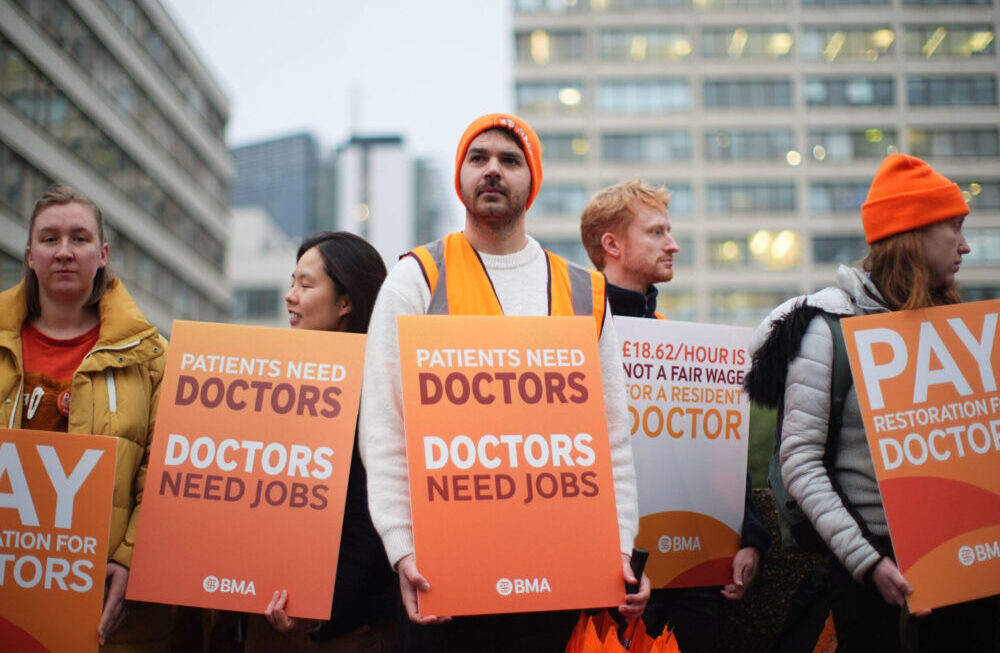
Wes Streeting won a deal of public support last week for his forthright attack on junior (now resident) doctors who plan on striking again in part for a further pay increase.
People who have not received 22% pay increases tend to be less than understanding about the ongoing complaints of those who have. That is not to undermine the justness of the doctors’ case. Pay erosion since austerity means that their role remains less rewarded than it was prior to George Osborne’s measures as Chancellor in David Cameron’s government.
Market forces
There is an international market for qualified doctors so the risk of losing expensively trained staff overseas is real. Doctors can justifiably point to market forces and stand on their value when negotiating for more pay.
They have a second advantage over other workers here, though, and one that also applies to train drivers. Both roles already attract a wage that allows industrial action to be viable.
Further down the public sector pecking order, support workers, cleaners, teaching assistants etc. have similarly urgent cases for a redress of austerity-era cuts to pay. These workers, however, are often living so close to the bone that losing a day’s pay to industrial action simply isn’t viable.
Wes Streeting’s irritation at junior doctors reappearing like Oliver Twist is distorted by the absence of similar demands from those workers under his remit whose bargaining power is hobbled by poverty itself.
Balkanisation
The balkanisation of public service jobs, now often fulfilled by a patchwork of private companies, charities and agencies, has caused a hierarchy of employment rights.
Across the country, people are working side-by-side in identical jobs but with different conditions and pay depending upon how they arrived in their roles. This confusion has created tiers in society that a ‘labour’ movement should never tolerate.
It’s perfectly possible for a local authority-employed support worker to be partnered with an agency worker who is paid differently, has less employment rights, and a less generous pension.
These two workers might go home to identical houses, but the agency worker will likely be renting as lenders insist on permanent contracts. So, here at the ‘less equal’ end of public service work, people are existing in a sort of caste system.
Those at the top can leverage advantages time and again, and these are funded at the expense of those with no levers to pull. If the government is serious about transforming the employment experience, it should start with transparency and fairness towards those it employs itself.
Support our Nation today
For the price of a cup of coffee a month you can help us create an independent, not-for-profit, national news service for the people of Wales, by the people of Wales.



Undoubtedly true, but public sector staff are still by and large better off than those in the private sector, usually in terms of pay and certainly in terms of job security.
potentially job security, that’s because they have unions to help them. You’re welcome to join one! People in unions tend to find they have better pay, better conditions and better security. Pay, no dice. People in the civil service can almost always find a better paying job in the private sector. Better pension too. Oh yeah, the myth of gold plated civil service pensions… it’s true the civil service used to get fairly decent pensions, it was considered pay back after decades of working in the comparatively underpaid Civil Service. That was however abolished. Pensions are no better and in… Read more »
Using agency staff shouldn’t ever be about cost saving for employers. The lack of pensions should translate into a higher effective hourly rate than the permanent colleague doing the same work. This should make it a good option for a younger person saving for a deposit. There should be a right to convert to a permanent role after six months which will stop employers exploiting flexible staff who are effectively permanent.