


Is Wales under polled?

Dr Andy Cotter-Roberts and Craig Lawton of Grasshopper Communications
As the Senedd election approaches, it can feel as though we have been inundated with opinion polls, with another coming each week.
On some occasions we have seen two a week, each from different polling companies with their own methodologies and sample sizes.
However, despite all of these, it appears that Wales could in fact still be “under” polled.
Firstly, we must look at different nations and regions across Europe to help us understand how others are polled in the build-up to their elections.
Staying close to home, looking first to Scotland, we can see that in the run-up to the 2021 Senedd and Holyrood elections, the population of Scotland was polled more than three times as much as the population of Wales.
However, as Scotland has a larger population and a higher GDP, it may not be all that simple.
There are also other nations and regions which are much larger and richer than Wales that get polled less. Examples of these include Veneto and Piedmont in Italy, and French regions such as Occitanie and Nouvelle-Aquitaine.
Therefore, it is not simply the case that bigger or richer nations get polled more often.
Similarly, some comparably sized Spanish autonomous regions- like Catalonia, Galicia, and the Basque Country – also saw a much larger number of opinion polls carried out on their populations.
This was despite their GDP per capita being similar to that of Wales.
Therefore, if neither population size nor GDP are direct factors, this suggests there is another factor that is driving Cymru’s relatively low number of opinion polls.
It could be argued very simply that the greater the levels of interest there are in an election, the more a nation gets polled. If this were true, it would mean everywhere is polled appropriately based on the actual number of polls that take place.
Interest
However, if we consider change to be a key driver of interest, then- conversely- a lack of change would also explain a lack of interest.
Until now, there has been very little change in which party has a hold of the reins of power in Wales.
Not only has Welsh Labour won the most seats in every Senedd election since devolution began, the party has also topped the poll in Wales at every General Election since 1922.
Could it therefore be that the reason for Wales receiving so much less polling than other European nations is due to the lack of political volatility to date?
Until very recently, we were seeing Cymru being polled in 2026 at similar rates to that of 2021.
This is despite a significantly different political landscape now presenting itself with both Plaid Cymru and Reform looking likely to beat Welsh Labour.
Between the 2016 and 2021 Senedd elections, Cymru experienced some significant changes. Not only did we see the referendum on the UK’s membership of the EU take place, we also saw the rise and subsequent fall of UKIP in the Senedd.
Despite all this volatility, polling levels in Wales again stayed reasonably stationary.
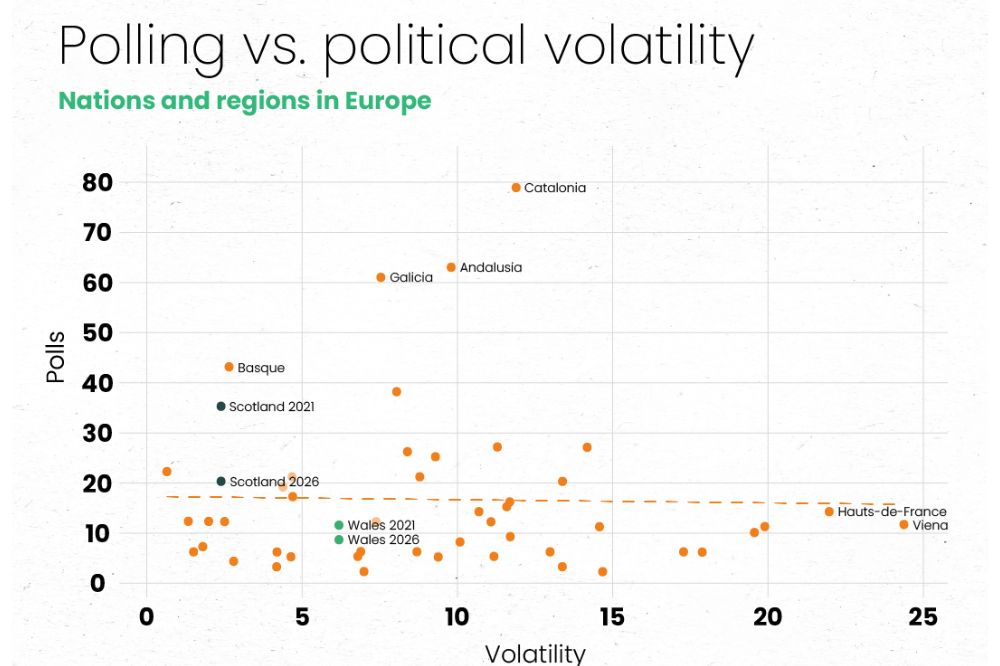
Other European nations back this up, with there being no direct relationship between the number of polls and the volatility between elections.
Places like Scotland and the Basque Country, where there is very little overall political change at each election, were polled over twice as much as Cymru. Similarly, Galicia, Andalucia, and Catalonia are all also relatively low on the validity scale, yet they are all polled over three times as often as Wales.
In comparison, elections in Sicily and for Vienna’s state parliament both see much higher levels of volatility. Despite this, both are polled about the same as Wales.
What sets Scotland and Catalonia apart in recent years from Cymru is the continued political interest driven by their respective independence referendums in 2014 and 2017.
Narrative
The Spanish regions generally comprise smaller, region-specific parties, with local political dynamics distinct from those at the national level. In these cases, a key driving factor has been either independence or greater autonomy.
This is where we start to see similarities with both Cymru and Scotland. Both have seen parties prioritising independence- Plaid Cymru and the SNP- playing significant roles in elections.
However, whilst independence as both a narrative and as a movement has been growing across Wales in recent years, what we have not yet seen is a full-blown independence referendum. This appears to be one trigger for greater polling of the population.
Therefore, the main determining factor on the levels of polling a nation experiences appears to be the distinctiveness of its political dynamics, particularly the difference between the national level and the presence of regionalist or independence movements.
Dynamics
For example, whilst France has a lot of regions with distinctive political dynamics, there is no real separate national identity within these regions to drive any independence movement.
So is Wales actually “under” polled, and could we see more after May 2026?
As Cymru receives UK-wide media and news coverage- and takes part in Westminster elections in addition to Senedd elections- it can often feel as though we are being polled a lot.
This has been further heightened by Wales- up until recently- also taking part in EU elections and of course also being asked to vote in the referendum on the UK’s membership of the EU in 2016.
Despite all of this, Wales does in fact get under polled compared to Scotland, even despite their independence referendum taking place a full 12 years ago.
However, with four polls dropping in Cymru across seven days, it does feel like we are starting to see some change.
As we enter an age of multi-polar populism, we are also going to see an increase in the distinctive nature of Welsh politics. As we have seen from other European models, this is likely to result in an increased frequency of polling.
Despite this, for Wales to really see a notable increase in polling, a nation defining issue or cause must first grab hold of the Cymru’s attention. Looking to the regions of Spain as well as Scotland once more, independence could well be that cause.
If the opinion that have been carried out are to be believed, that nation defining moment may be a lot closer on Friday 8th May.
Support our Nation today
For the price of a cup of coffee a month you can help us create an independent, not-for-profit, national news service for the people of Wales, by the people of Wales.
Get more trusted Welsh news
Choose Nation.Cymru as a preferred source in Google News to see more of our journalism.



Madness. This has been one of the worst elections since 99, no mention or debate or discussion of policy. Just poll after poll.
Has there actually been any change in the last two months? Basically reform and plaid similar, labour down at 14 or 15 percent etc. polling for each party is in the range of error.
We’ve known for 3 months what the outcome will roughly be. At least FPTP adds some intrigue!
The problem for me is that opinion polling skews the result. If we all “know”, for instance, that Reform is on the rise, that may lead us to vote tactically for (say) Plaid – not so much because we like Plaid, but because we want to keep Reform out. If, on the other hand, none of us had any idea of the parties’ popularities, we might simply cast our vote for our preferred one.
What purpose do they serve? It skews narrative and policy of political parties to “chase” the popular vote indicated by polls. It skews voter voting intension. The media obsess over them and dramatise them. Sample sizes are always small. They are increaxingly inaccuarte. Waste of time and money.