


Is Welsh Rugby ignoring the emerging talents coming from our universities?
Dewi Williams
Among the plethora of issues facing the Welsh Rugby Union at the moment, we are constantly reminded of the lack of depth and quality of players within our regions, and this translates to the men’s national team.
We are all aware of the dire financial situation that faces Welsh Rugby by now however, with the Ospreys announcing a loss of almost £2m over the last year just this week for example. The regions simply do not possess the money to make huge signings like the Saracens or the Leinster’s of the English and Irish systems.
Therefore identifying, developing and utilising young talent would seemingly be the best way forward?
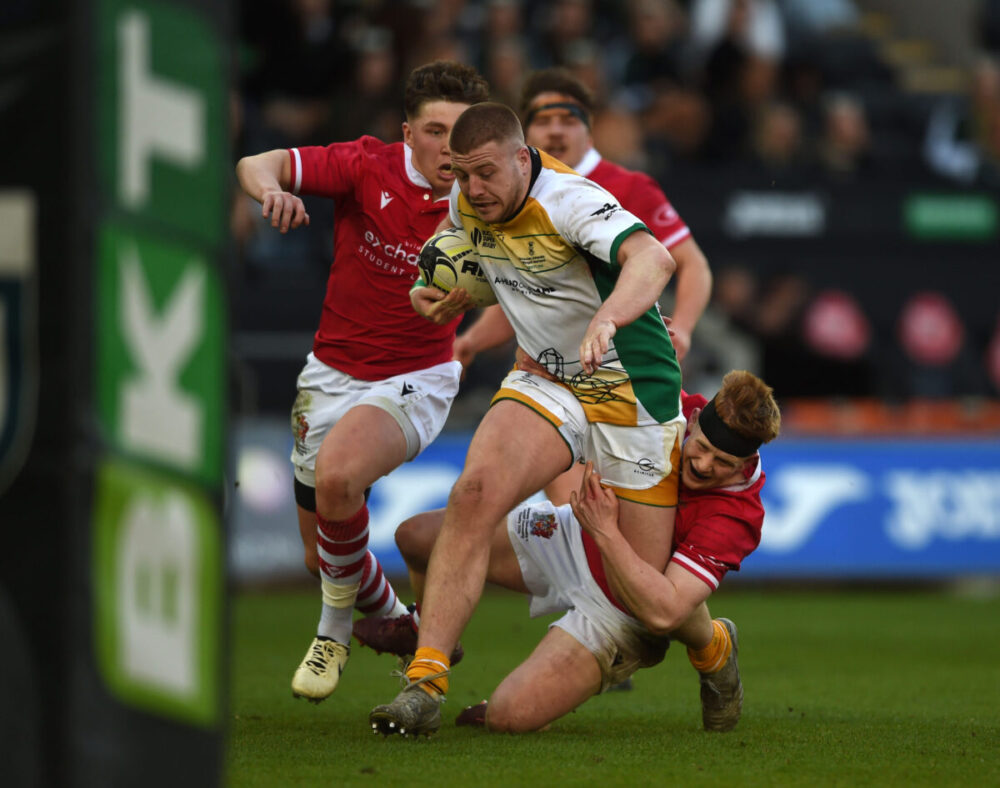
Enter University Rugby, and in particular the BUCS Super Rugby competition, the highest standard of rugby in Britain outside semi-professional and professional competitions.
The league consists of 10 universities around the UK, and since 2019 Wales have been lucky enough to have three of its universities competing – Cardiff Uni, Swansea Uni and Cardiff Met.
That was, until this year where Swansea found themselves relegated from the league after a prolonged period of finishing at the bottom of the table.
Cardiff have also faced a sustained period of finishing near the bottom, and whilst Cardiff Met has historically been the most successful of the three Welsh universities, even they have been finishing mid-table at best over recent seasons.
Perhaps the lack of success for Welsh Universities in BSR reflects the wider state of the game in Wales currently, epitomised by the abandonment of a game between Swansea and Cardiff Uni that made national headlines in January this year. But the talent that these institutions help develop, in Wales and across the bridge in England, should not be overlooked.
Cardiff Met helped produce Dragons and Wales no.8 Aaron Wainwright, Cardiff Uni aided the development of Cardiff and Wales centre Ben Thomas, and even Welsh great Alun Wyn Jones represented Swansea University too, but some of the other names that have represented our universities seemed to have been missed by Welsh scouts.
Harlequins and England’s Alex Dombrandt famously donned the Cardiff Met yellow and burgundy and even played for Wales U20’s in 2017, and Harlequins centre Luke Northmore who won his first cap for England last summer came through the Archers’ ranks too.
At a lower level, Met winger Roma Zheng was swept up by the Harlequins back in the summer of 2023, and fullback Joshua Carrington, originally from Swansea, was signed by Bristol Bears last summer after a successful season with the Archers. Cardiff Uni and Newport RFC’s Harrison James has also featured for Gloucester in the PREM Cup this season.
Whilst I am no fan of Dombrandt and not arguing that these players would have waltzed into our regions’ starting lineups, there’s an argument to be made that players of this quality should at least be tried and tested within a professional environment here in Wales rather than over the bridge.
The lack of strength and depth too often mentioned would surely be bolstered if we had a handful of elite University players entering the Welsh system every year.

Despite these missed opportunities we’ve seen some effective examples of this type of recruitment over recent years. The Ospreys’ Max Nagy is perhaps the best example of an Englishman who was swept up by the Welsh system after impressing at Swansea Uni, and players such as ex Hartpury man Keillen Cullen (who is originally from Bonymaen) as well as ex Cardiff Uni flanker Gwilym Evans are now under the Ospreys’ watchful eye.
Ex Cardiff Uni scrum-half George Macdonald is also one to watch, training with the Scarlets during pre-season last year and representing Llandovery in the SRC, and previous Welsh U20’s captain Harry Beddall was brought back over the bridge from Hartpury to represent the Dragons this season.
University rugby is evidently not completely ignored in Wales then, but why do we see more and more promising students ending up at English clubs rather than Welsh regions?
Perhaps this has more to do with the pull of English Universities rather than Welsh scouts. Many of the Universities in England who compete in BSR have direct partnerships with professional Premiership Clubs. This allows players to develop within a competitive university environment whilst also being eligible to play for professional clubs in competitions such as the PREM Cup. Wales U20’s Fullback Jack Woods finds himself contracted with Bath and playing for the Uni of Bath in BSR for example.
The English Schools and Colleges system also has a direct link with Premiership clubs and their age grade academies, with players that are contracted from school then encouraged to go on to play BSR at University. Up and coming fly half Math Jones of Penybanc RFC followed this pathway. Contracted with Harlequins, he attended Gordons School in Surrey before Quins asked him to go and play BSR with Hartpury. He said in an interview with S4C that “Wales should put more emphasis on BSR”.
Restricting young talent from studying and playing in English Universities is not something that would be beneficial however, but it is vitally important that the WRU make it clear to players like Woods and Jones that they want to see them in a red shirt rather than a white one.
But herein lies another problem.
On the radar
It seems that those Welsh players that leave Wales for University without senior or academy contracts, who subsequently make their mark playing in BSR and pique the interest of English clubs, aren’t on the radar of Welsh rugby.
Look at the Final of this season’s BSR Championship – Bath vs Loughborough. Loughborough’s captain, Owain Evans, and player of the match, Bath’s Iwan Coyle, are both Welshmen who have made their mark in BSR.
Evans of Llangefni Rugby Club played for RGC and Wales U20’s before making the move to Loughborough to captain the side, whilst Coyle of Builth Wells RFC played for Christ College Brecon, and made the move to Bath, progressing from their 5th team to a key player in their BSR squad. As a result, both donned the red rose of the England Students side last month against France Universities, with Evans also signing with English Championship side Worcester Warriors. There’s no doubt that Coyle is being watched carefully by Bath Rugby also.
It could well be that these players are future internationals, destined to play on the ground of the national stadium, and to let them slip away into the English system, or worse, the English international setup would be disappointing to say the least.
Funnily enough I remember watching Iwan Coyle play in the Principality Stadium a few years ago.
It was the Welsh Schools Cup Final with Coyle playing for Christ College Brecon against an Ysgol Gymraeg Ystalyfera side that included current Ospreys and Wales no.8 Morgan Morse. It was obvious that both were men playing amongst boys, and whilst Morse has had the opportunity to develop into a promising young international with the Ospreys, Coyle has taken a different route.
Where Morse represents the conventional pathway to the professional game, it is important that Welsh Rugby begins to recognise the alternate routes to the top of the game that players like Coyle embrace.
Elite university setups
An argument could be made that Welsh rugby should start to adopt an American system, where the primary pathway for players in leagues such as the NBA and the NFL is through elite university setups. The RFU has already began to lean into this idea with the professional partnerships I have discussed, as well as an investment of £1.4m into university rugby over four years.
Whilst the money that the WRU invests in Welsh universities isn’t publicly available, I highly doubt it is anywhere near that figure.
With Welsh universities struggling financially, I wonder how willing these institutions would be to taking on a large cohort of 18 stone rugby boys, acting as a stepping stone for these aspiring professionals. Probably quite willing if it meant saving their colleagues’ jobs.
It’s funny to think that Immanuel Feyi-Waboso would probably be playing on the wing for Cardiff and Wales right now if Cardiff Uni accepted him onto their medicine course.
Nevertheless, whilst paying close attention to these talented students won’t solve all the on-field issues that face Welsh Rugby, I feel the recognition of developing players within our own Welsh Universities, as well as those who leave Wales to study, would play a major role in increasing the strength and depth of the player pool in Wales.
Support our Nation today
For the price of a cup of coffee a month you can help us create an independent, not-for-profit, national news service for the people of Wales, by the people of Wales.
Get more trusted Welsh news
Choose Nation.Cymru as a preferred source in Google News to see more of our journalism.



Diolch Dewi, a very good insight on current university rugby. University rugby may seem disconnected from the larger rugby picture for a generation or two, but knowing some history can explain this. There was once a very well known coach of ‘Cyncoed’, who was even shortlisted for head coach of our senior national team. Focussed on the individual players, he forged very close links to the next level, which were then deemed first class clubs. He would make sure these clubs played his college, even if it meant their squad XVs in midweek. Any impressive college player would then be… Read more »
The loss of IFW was probably the biggest howler of the decade or more. It proved the lack of proactivity. Access to the Cardiff Med School would have met his longer term needs and ensured that he played in Cardiff. A simple example of something that remains uncorrected.
What element remains uncorrected that would have solved IFW not being offered a confirmed space on the medicine course at Cardiff University?
The absence of formal links between Union, regions and educational establishments. I’m not for one minute suggesting that academic underachievers should be favoured due to sporting prowess but something is amiss when a young man living in Wales possessing quality grades at A level gets declined by a local Welsh university.
You seriously think that if there was a formal link then the university would discard their entry requirements on a medicine course just for rugby players?
Their entry requirements would not have to be discarded. That is my point – read again “I’m not for one minute suggesting that academic underachievers should be favoured due to sporting prowess…..”. Indeed knowing that a channel for progressing both sporting and long term career objectives exists here in Wales might motivate young people to work even harder to attain their academic goals.
So you agree your initial comment is incorrect then and a “formal link” would have done nothing for IFW who simply was not successful in gaining a place?
Comment sent in error