


James Joyce, Caravaggio, Dublin: Welsh Envy
Desmond Clifford
To Dublin for Bloomsday, a long-standing ambition. For readers unfamiliar with James Joyce, his massive novel “Ulysses” follows the progress of two characters wandering around Dublin on a single day, 16 June 1904.
One of the two is Leopold Bloom, hence “Bloomsday”. The other character is a younger man, loosely based on Joyce himself. They are cast in a kind of father-son relationship, although they are not related.
The action roughly follows the story of Homer’s Odyssey, mimicking the journey home from the Trojan War, substituting Dublin for the Aegean Sea.
In Joyce’s novel, a series of Odyssey-inspired episodes take place across Dublin stretching from the early morning till late into the night.
The novel ends next morning with Molly Bloom, Leopold’s unfaithful wife, half asleep and half awake, agitated as she thinks of her lover…”and his heart was going like mad and yes I said yes I will Yes.”
This style of writing, the “interior monologue”, was among the fundamental innovations of modern literature.
Ireland banned Joyce’s book for obscenity for years (so did Britain and America) but made up for it later. The Joyce industry is substantial, especially now he’s out of copyright.
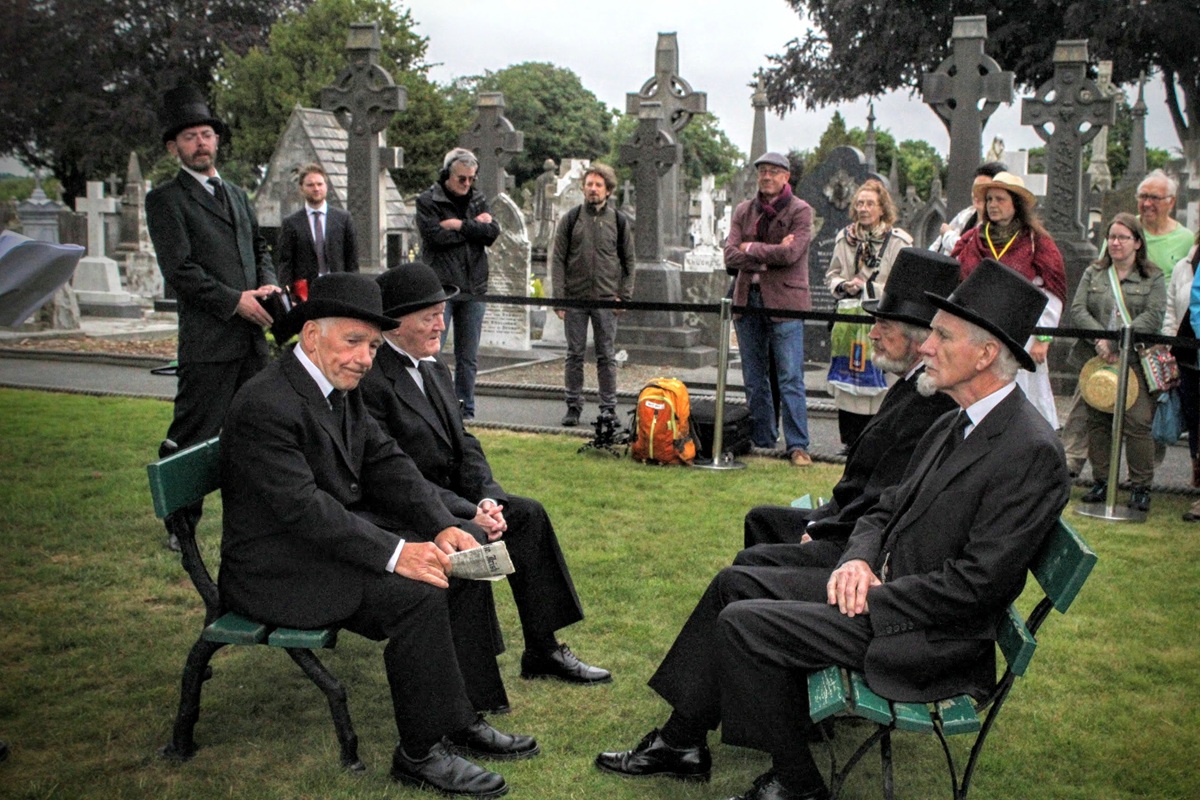
Bloomsday is celebrated at the many locations across Dublin associated with the novel. Actors read excerpts, drama troops perform pieces, music associated with Joyce is performed and chefs even produce recipes from the book. Enthusiasts dress in clothes approximating to Edwardian Dublin. It’s all very good fun, if you like that sort of thing. Even if you don’t, it’s still good fun.
It’s also good for business. It draws visitors to Dublin from around the world. I went with a couple of mates from Cardiff and between us, over a few days in Dublin, not a cheap city, we injected a good few hundreds of euros into the Irish economy. That’s just us three, so multiply that by X – the total number of Bloomsday visitors, some hundreds I would guess – and the Irish economy benefits handsomely from its investment in its errant son.
Similarly, there are significant industries built around Yeats and Oscar Wilde and cottage industries on
other writers (fun fact: Wilde and Bram Stoker competed for the attentions of the same girlfriend, a tale for another day!).
Envy
As a visitor from Wales motivated primarily by culture, it’s hard not to drip with green envy in Dublin.
Even from touchdown at Dublin Airport, Ireland owns its culture. On the transit walk in the airport there’s a giant poster of the Beatles visit to Dublin in 1963. They played two shows in what was their only visit. McCartney and Lennon had Irish ancestry, obviously, but that’s not the point. The point is that the Beatles visit to Ireland, connecting the country to wider cultural currents, is owned by Ireland and celebrated by it alongside its own creations.
There is just no equivalent of this mentality in Wales. What happens here is noted passively, for the most part, not “owned” or celebrated.
Through the airport, through the shops, through the streets of Dublin, Ireland is Ireland at every turn. I ventured into a bookshop. There are more books on James Joyce than there are books about Wales, or by Welsh writers, in any bookshop in Wales. The shelves of Irish history and fiction are bigger than most entire Welsh bookshops. Then there’s all the other English, American and other Anglo books, piles of them.
Why is Wales so meagre in this way? Why does our publishing industry struggle to sustain an identifiable corpus of Welsh writing in the way Ireland does? There are plenty good writers in Wales. I know because I review their books in this publication.
In a couple of weeks there will be the Welsh Book of the Year ceremony. I suspect most will be read by
small numbers of people, but they will deserve better.
There’s discussion to be had about stimulating Welsh writers and how to help publish and promote their work, but there’s almost no discussion about the paucity of Welsh readers. Why so few? Why is there so little interest in Welsh books and books about Wales while Ireland teems with them? Why are bookshops so bad, in many cases, at curating Welsh books? Do they employ people who care about Welsh literature? Does the Welsh Books Council have a role here? It should, shouldn’t it?
The Taking of Christ
In between my James Joyce activities I nipped into my favourite building in Dublin, the National Gallery of Ireland. I headed straight for my favourite picture, Caravaggio’s The Taking of Christ. Thrilling.
The face of Christ is taut with betrayal and resignation; this is his fate, he knows it can be no other way. Judas, that conniving, compromising Everyman, looks sheepish into the middle-distance, embracing Christ but unable to meet his eye.
Armed police, their eyes shielded from view, already have hands on Jesus – orders must be obeyed. The light is photographic; we have full clarity on the action. It’s worth visiting Dublin just for this.
Ireland, unlike Wales, actually has a National Gallery. It’s down the road from its equally excellent National Museum. They’re not all lumped together like Cardiff.
My Joycean mates and I passed an agreeable evening round the corner at the excellent Museum of Literature Ireland. Could anyone imagine a Welsh Museum of Literature? Granted, you can’t conjure
literary acquisition out of thin air and Ireland’s literary tradition grew out of circumstances which can’t be replicated on demand. That’s not really my point. My point is that Ireland values its literature, past and present, takes pride in it and invests in it.
For culture to flourish fully there needs to be a society which embraces it, believes in it, values and sustains it.
To be very clear, I’m not saying Wales isn’t cultured. On the contrary, Wales is surely among the most cultured small countries on Earth and it’s precisely because of this that I feel so sore about our under-resourced culture infra-structure.
With imagination and investment Wales could genuinely be a world-leader. There is so much to work with.
Mediocrity
If this article has the characteristics of a rant, then I’ll plead guilty and take the rap. I’m just fed up with the endless acceptance of second best and mediocrity in our political, cultural and commercial life. I just don’t accept that Wales can’t do better. We have a government which says it believes that too, so let’s see.
The previous government had 27 years to make its mark on culture. It did some useful and purposeful things, but the fact is, Wales is a country whose National Museum has a leaky roof. Does the Welsh Government building have a leaky roof? I thought not.
Perhaps the Government could sell its mostly empty property portfolio and use the money to secure the
nation’s decaying cultural infrastructure?
Heledd Fychan, the new Culture Minister, has begun mapping a new vision. The rhetoric is encouraging, and culture is an area where the Welsh Government has the tools to transform the field if it chooses to act boldly. At the end of four years the landscape could look markedly different – or it could look largely the same.
The Minister has made the connection with Health and Education and those fields command substantial budgets which can be marshalled in complement with Culture. The Government should also understand Culture as an industry which repays investment.
I began this piece describing how old duffers like me and my mates wandered around Dublin this week spending our honestly earned Welsh shillings on Ireland’s culture. That money goes directly onto Ireland’s GDP (where it will be scored as service export earnings) and a chunk will be sliced off in tax revenue by the government to add yet more to Ireland’s budget surplus.
Tough choices
The Finance Minister Elin Jones warned last week about tough choices facing the Welsh Government. She was right to do so. The new Government has stated priorities and the financial position is tight and not about to get much better.
As Plaid Cymru sets about delivery, someone will have to be disappointed.
The Government must be selective while driving change in a Wales which begins to look and feel different to what they inherited.
If their legacy includes leaky roofs at the Museum, cultural institutions gasping for breath and lurching from crisis to crisis, and a national culture which is no further forward, then they will have failed to bring the difference promised and expected.
Support our Nation today
For the price of a cup of coffee a month you can help us create an independent, not-for-profit, national news service for the people of Wales, by the people of Wales.
Get more trusted Welsh news
Choose Nation.Cymru as a preferred source in Google News to see more of our journalism.



Ireland is in Europe, and it wants to be. Does that help?
I completely agree. This new government should use the opportunity to revamp our attitude to culture and the way we support it, building on the good work being done by individuals and small groups outside the Cardiff bubble.
It’s because James Joyce was into flatulence.
Enjoyed this writing from Des Clifford, a useful reminder of what can be achieved as we have a new Culture and Sports Minister in Heledd Fychan. Is Mr Clifford asking the question did the Labour Party ever take the importance of Welsh culture seriously? Dafydd Elis Thomas as a Minister in a Labour Cabinet tried to bring it the surface in his work on books and other fine initiatives, but he was always progressive. Plaid Cymru will change this these failures, and answer the points made. It is a political party more at home with culture as with the Irish whose praise… Read more »
Sorry to put a downer on things but there’s literally nothing we can do about it. Welsh people don’t control the levers of power in Wales – even if we became independent, thigs would jmprove but the people in charge here would be English. Look at the way ‘YesCymru’ types fawn over the likes of Will Hayward, the way our football team recruits England’s cast offs and the way young people adopt Anglicised accents. It is depressing and I don’t know what can realistically be done.
I’d like to give an Irish perspective. My introduction to Welsh culture was through reading The Black Cauldron and hosting reciprocal school rugby teams. I later got to read the Mabinogion in translation. I was a teenager when Cerys Matthews and Super Furry Animals were in the charts. When I finally got to visit Wales, it was everything I expected; seaside towns, neolithic mines and Norman castles. Port Meirion and Llandudno. The only dissonant notes were the plaques, captions and pamphlets at all the tourist sites. In Ireland they are written for an Irish audience first and then an international… Read more »
To be fair the castles were built by Anglo-Norman invaders. About as ‘they’ as it gets!
Ulysses was not banned in Ireland. It was banned in other countries.
Ireland did not consider Joyce an “errant son”, even if he was not perfect.
Joyce is Emperor’s New Clothes dreck, but what Wales needs is to be an independent state sat at the top table. That is what (most) of Ireland has that we don’t.