


Jenrick on judges: another baseless attack
Dr Huw Evans
Wannabee Tory leader, shadow justice minister and Lord Chancellor, Robert Jenrick, has recently made claims about judges and their appointment which do not stand up. This article explains why.
Flawed claims by people that go unchallenged is a curse of our age. Robert Jenrick is a repeat offender.
I’ve written about him before.
‘Activism’
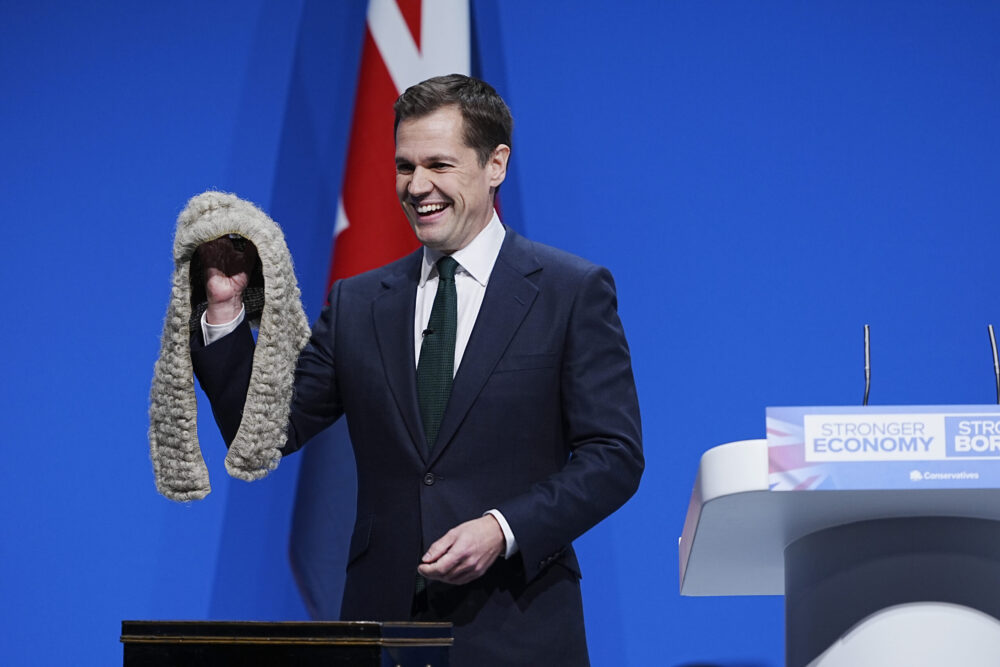
Jenrick’s claims were made on 7 October 2025 at the Tory Party conference. He claimed to have ‘uncovered dozens of judges’ who ‘blur the line between adjudication and activism [and who] can have no place in our justice system’. These judges have ‘ties to open-borders charities, who take to social media to broadcast their open-border views, who’ve spent their careers fighting to keep illegal migrants in this country.’ And: ‘Some even continue to do so while… serving as judges’.
He also claimed that there had been ‘constitutional vandalism [by] Tony Blair and New Labour’ and that the Tories would ‘reverse’ this allowing the Lord chancellor ‘once again [to] appoint the judges’ and ‘restore the Office of the Lord Chancellor to its former glory’.
Jenrick’s allegation of judicial activism and partiality do not stand up. He accuses judges of activism but then says some continue to do so while ‘serving as judges’. By implication, some judges were ‘active’ before their appointment but are not anymore. Judicial appointments should come from as wide a range of candidates as possible, and that will include lawyers who have regularly worked in defending peoples’ human rights.
There will also be lawyers who are appointed as judges (and to adapt his language) ‘who’ve spent their careers fighting to keep illegal migrants [out of] this country’; Is Jenrick saying, that lawyers who routinely represent asylum seekers should not be judges? It sounds like that.
Partial
And Jenrick’s criticism implies that once appointed, a judge is free to be partial. That isn’t right. If a judge gets things wrong a decision might be appealed or a case reopened. Judges can also be subject to disciplinary proceedings for misconduct.
He says he has ‘discovered dozens of judges’ who have shown partiality. So, it is as least 24 but it could be 144. We don’t know names or what it is they are supposed to have done.
Jenrick’s sloganising is a baseless attack on judicial independence.
The constitutional vandalism refers to the effect of the Constitutional Reform Act 2005. The CRA changed the UK constitutional architecture, guided by Montesquieu’s doctrine of the separation of powers. The focus was on greater separation of the judiciary from the UK Parliament (as legislature) and the UK Government (as executive). A more independent judiciary, so the argument goes, better holds the executive to account. Two key features of the CRA were the establishment of the UK Supreme Court and reform of the Lord Chancellor’s role.
Supreme Court
The UK Supreme Court replaced the House of Lords as the highest UK appeal court: i.e. the judicial functions of the House of Lords were removed, leaving it with its legislative functions only.
Prior to the CRA, the Lord Chancellor was a politician and cabinet member who was also a senior judge and head of the judiciary with responsibility for judicial appointments. After the CRA, the Lord Chancellor was no longer a judge or head of the judiciary. The replacement head of the judiciary is the Lady/Lord Chief Justice, a judge, not a politician.
The Lord Chancellor’s role in judicial appointments is now more restricted. Appointments to the Supreme Court are made by the monarch on the recommendation of the Prime Minister following a CRA determined selection process. Other judicial appointments are also made by the monarch after such a process, but this time on the recommendation of the Lord Chancellor.
The Lord Chancellor now has an express duty to uphold judicial independence. The oath of office says: ‘I do swear that… I will respect the rule of law [and] defend the independence of the judiciary…’.
Separation of powers
This is not ‘constitutional vandalism’. There is a strategic coherence in furthering the separation of powers through a more independent judiciary.
Having the Lord Chancellor, a political appointee, as head of the judiciary and having effective control over judicial appointments casts doubt on judicial independence. A judge might be less resolute in resisting executive misconduct if the Lord Chancellor is effectively that judge’s line manager than if the Lord Chancellor is not.
In 2019 the UK Supreme Court ruled that the UK Government’s decision to prorogue Parliament for five weeks was unlawful and of no effect. That decision was controversial. The Supreme Court judges were brave, but their line manager was the Lord Chief Justice, not the Lord Chancellor.
The Tories would reinstate the Lord Chancellor as head of the judiciary with de facto control over judicial appointments. Nothing was said about abolishing the Supreme Court but to get a ‘tame judiciary’ giving back the Lord Chancellor’s ‘former glory’ will do.
The rationale for the separation of powers doctrine is to regulate the exercise of executive (government) powers. Inevitably there will be tensions between the courts and government but that is a necessary outcome of the model. An independent judiciary is an essential component for a free and just society where the rule of law is upheld.
Case study
On 17 October 2025 the Court of Appeal dismissed the UK government’s appeal to allow the judicial review application to go ahead for annulment of its decision to ban Palestine Action – or, to use the legal language, to proscribe it as a terrorist organisation.
Subject to a further appeal to the Supreme Court, the judicial review hearing will now take place. If successful, the decision to ban Palestine Action will be annulled together with related legal consequences such as the prosecutions of people for supporting the organisation.
The case has huge ramifications and affects fundamental human rights. An independent judiciary is crucial, so judges make brave (and not tame) decisions.
Notably the Court of Appeal in making its decision to dismiss the UK Government appeal was led by the Lady Chief Justice, the head of the judiciary.
Appeals
Judges interpret the law. If government does not like that interpretation, there are corrective mechanisms such as appeals or new legislation.
Judges get criticised for upholding people’s human rights. But the UK state is a signatory to the European Convention on Human Rights, not the UK judiciary. The Human Rights Act 1998 gives enforceable rights under the convention to UK citizens. The HRA was passed by the UK Parliament, not the UK judiciary. When judges make decisions about people’s human rights, they are applying the law made for them, not by them.
The implications of Jenrick’s claims must be unpicked. Contrary to the oath, they are a direct attack on judicial independence and the rule of law.
Support our Nation today
For the price of a cup of coffee a month you can help us create an independent, not-for-profit, national news service for the people of Wales, by the people of Wales.



These clowns can spit out any nonsense., the media lap it up, amplify it and it makes this nonsensical story sound like fact. And the clowns keep on acting up.
Jenrick has gone full Enoch.
And the Cons protect him.
Katie Lam is on the same trajectory.
And the Cons protect her.
See what the Cons are?
I thought it was a shrunken head, he looks the type, any idea who he did his soliciting for in Moscow ?
Bob and Kemi’s Rogue State Plan should be a vote winner.
Sowing doubt in the judiciary is straight out of Maga, a second-rate politician has found his forte. Who next, journalists? Why he isn’t already in Reform is a mystery.