

Joining the dots of the proposed Trydan Gwyrdd Cymru — Glyn Cothi Wind Farm
Sarah Eyles
‘Of all tyrannies, a tyranny sincerely exercised for the good of its victims may be the most oppressive’ C.S. Lewis
You can’t have failed to notice that there is a ‘gold rush’ taking place all over Wales. There are huge profits to be made from giant wind and solar farm developments, and the Welsh Government doesn’t want to miss out! But don’t panic, this is all done for our own good.
Trydan Gwyrdd Cymru is a limited company, wholly owned by the Welsh Government, recently established to develop large-scale renewable energy projects, including Glyn Cothi Wind Farm in Carmarthenshire.
The Welsh Government want to stake their claim along with Bute Energy, Green Gen Cymru, Wind 2 Ltd, Galileo Green Energy, RWE Renewables UK, EDP Renewables, Coriolis Energy / ESB, Renewable Energy Systems Ltd (RES), Ventient Energy, Renantis S.p.A, Amegni, Scottish Power/Eurus Energy, Lightsource BP, Statkraft, and other development companies (from many places in the world), all listed on The Welsh Countryside Charity (CPRW) energy map.
I’m glad someone is keeping track!
The Special Landscape Areas in Carmarthenshire, which previously protected regionally or locally significant landscapes within the county’s planning system, were ‘conveniently’ removed as part of the revised Local Development Plan, making it easier for developers to gain planning permission through the Infrastructure (Wales) Act 2024.
Enhanced process
This Act established an enhanced process for consenting to major infrastructure projects, creating a ‘one-stop-shop’, and strengthening the compulsory purchase rights for developers. This Act applies to ‘Significant Infrastructure Projects’, between 50 and 350 megawatts in size. It’s almost as if certain people have been ‘in the know’ and have surreptitiously smoothed the way for these windfarm developers.
So what has happened to ‘Free, Prior, and Informed Consent’, as cited in the UN (and UK supported) Declaration on the Rights of Indigenous Peoples? The Welsh are an Indigenous People, a distinct social and cultural group sharing ‘collective ancestral ties to the lands and natural resources where they live.’ These lands and natural resources are ‘inextricably linked to their identities, cultures and livelihoods.’
Many such peoples maintain ‘language distinct from the official language’.
The Welsh are, in addition, a National Minority. The Council of Europe’s Framework Convention for the Protection of National Minorities, to which the UK Government is a signatory, sets out the rights belonging to national minorities and the obligations to be respected by the Convention’s signatories.
These include: ‘Being able to influence public decision making for issues affecting persons belonging to national minorities’.
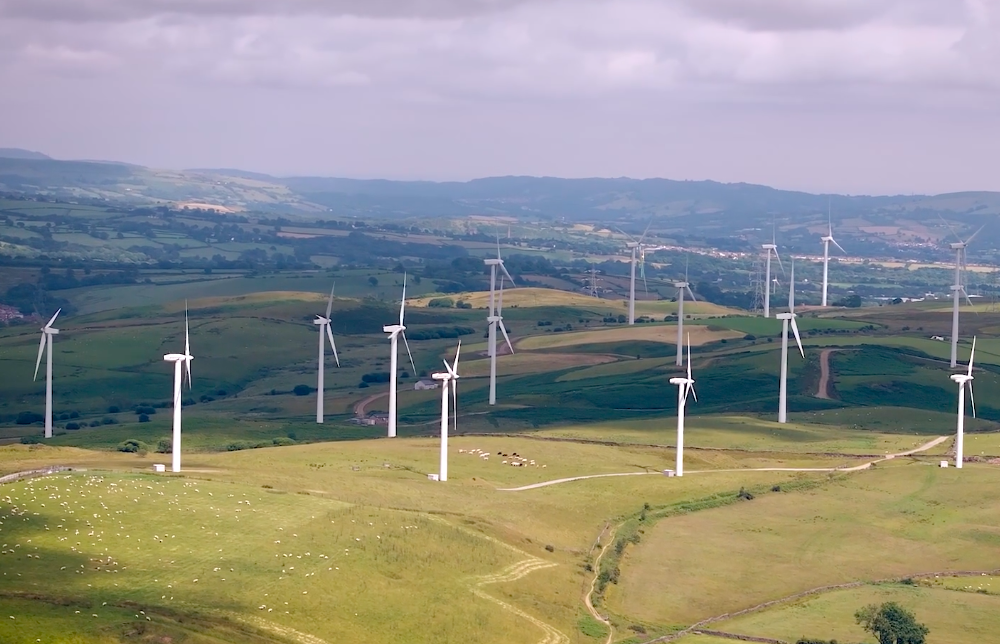
The new wind turbines proposed by Trydan Gwyrdd Cymru and other development companies are much higher than the existing ones in Wales, at over 200 metres tall. The Tower, also known as Meridian Quay, in Swansea is currently the tallest building in Wales, standing at 107 metres. Imagine two of these towers, one on top of the other, and that will give you an idea of the size of each of the hundreds of turbines proposed across Wales -twenty-seven in the Glyn Cothi development alone.
Industrialisation
Industrialisation brings more industrialisation. Wind farms require connection to the grid and pylons to move high voltage electricity to where it’s needed. And all that electricity is not needed in Wales, which already exports more electricity than it uses.
This energy is destined for England and to sell abroad. So, wind farms are dependent on pylons, new substations, and increasingly on Battery Energy Storage Systems (BESS) – a ‘wild west’ industry.
The National Fire Chiefs Council has produced robust guidelines including the need for ‘Identification of any surrounding communities, sites, and infrastructure that may be impacted as a result of an incident’, but adherence to these guidelines is not a mandatory part of the Significant Infrastructure Projects planning consent. A BESS fire, often referred to as ‘thermal runaway’, can burn and reignite for weeks, and the poisonous fumes can drift for miles.
The wind farm ‘gold rush’ in Wales means that there is no co-ordination between development companies. Green Gen Cymru, for example, wants to site 28.5 metres high pylons (roughly equivalent to a 9-story residential building) through the Teifi and Towy Valleys. In addition, National Grid (a privately owned company, despite its name) is planning a major upgrade to the electricity transmission network in Wales, including a new line of 45+ metre high pylons, running from Bangor in the north to Swansea in the south.
Trydan Gwyrdd Cymru will also need a way of transmitting the energy generated from its wind farms.
However, there is no forward thinking to combine transmission. Each company has its own agenda and its own project timeline. So we could end up with rows of parallel pylons cutting across the countryside.
And then what — perhaps AI?
AI
Keir Starmer has set out a blueprint to turbocharge AI and has pledged £2bn towards its development. Wouldn’t it be convenient to place AI giant data centres next to the wind farms, to use the excess energy so they didn’t have to keep turning off the wind turbines when the grid can’t cope? This idea is called ‘zoning’, and whilst the upside is that it could provide cheaper electricity to areas hosting renewable energy, the downside is that these areas would become very attractive to energy guzzling industries. Data centres also use a huge amount of water, which Wales has in abundance.
So it’s not going to be ‘just’ wind farms but also everything else that goes with them.
Developers, and that now includes the Welsh Government, want to maximise profits. And there’s a rampant conflict of interest here, because the Welsh Government is supposed to be representing and protecting our interests.
But aren’t we supposed to love green energy and ‘do our bit’ to save the planet? The fact that our property value will decrease by around one-third, wildlife will be decimated, the beautiful landscape in which we live scarred, farmland irreparably damaged, and much of our tourist industry lost, is a huge hit. Lives, livelihoods and mental health will be negatively affected. The Welsh Government should be protecting us from this exploitation, but instead it is complicit.
And when exactly does Wales fulfil its part in Net Zero? When we have enough renewable energy for Wales? No, because we are well on track for that. When we have enough renewable energy to fulfil the needs of the rest of the UK? No, as some of this power is already being sold to other countries through electricity interconnectors. When there are as many wind farms sited in Wales as it can possibly contain? Well, in lieu of information to the contrary, this is what we will have to assume. So how many wind farms can we fit into Wales?
Minimum distances
In 2010 there was a proposed UK Government Bill to set the minimum distances from residential premises for wind turbines, which never made it through parliament. For wind turbines with a height of 150m–200m, for example, the minimum distance required was going to be set at 3000m.
The Welsh Government has never committed to a mandated setback distance, and instead suggests a 500m buffer. I’m no mathematician, but I know that means a heck of lot of wind turbines can, in theory, be sited in Wales. I’m sure that on worksheets deep in the bowels of the development companies lies the answer to that mathematical conundrum.
Imagine trying to get even a fraction of this industrialisation sited in the Cotswolds, on the South Downs, in Cardiff, or on Hampstead Heath (near where Ed Miliband resides)? There would be uproar. Yet the people of rural Wales are supposed to ‘suck it up’ and do this, apparently, for their own and the greater good. Wales is subject once again to ‘Robber Barons’ and Industrialists, who have always seen Wales as a ‘soft touch’ and ripe for exploitation.
The Welsh Government is not abiding by The Well-being of Future Generations (Wales) Act 2015, legislation designed to improve the social, economic, environmental, and cultural well-being of Wales by placing sustainable development at the heart of decision-making.
It legally binds public bodies to work towards well-being goals and to consider the long-term impact of their action. Instead, the proposed Trydan Gwyrdd Cymru developments, and similar projects, will inflict an industrialised landscape on future generations, resulting in damage similar to that caused by the mining industry.
So what can you do? Find out what is going on in your area and beyond, and make up your own mind about it. Join local protest groups. Experience has shown that these developers take the path of least resistance, so resist! Join the The Welsh Countryside Charity (CPRW), who are active in fighting the desecration of rural Wales.
It will be a tragedy if we sleep-walk into this piece-meal industrialisation, and wake up in ten years time to find that the Wales that we know and love has disappeared for ever.
Support our Nation today
For the price of a cup of coffee a month you can help us create an independent, not-for-profit, national news service for the people of Wales, by the people of Wales.



Somehow after reading this article, wind farms just don’t look a beautiful any more. Why can’t we construct our own wind turbines here in Wales? Plenty of space in Port Talbot. Plenty of talent in Port Talbot.
Please do some research and see for yourself how blatantly false most of this article is. I do agree with you, about local construction, but that takes a huge investment. Most of the wind farm materials in Europe come from companies who have embraced wind power, and manufacture the necessary components. Germany, Denmark and France, if memory serves. Note that the first wind farm I visited was in Germany in 1992..and it had already been operating for five years. Personally, I have toured over a dozen in Germany, France, Holland, Hawaii and Curacao. I have toured the most in Ontario,… Read more »
You are right about the noise – I regularly walk through the Brechfa windfarm and the noise is no greater than the wind in the trees.
We had a wind turbine industry in the 1980s. The government saw no point in it and shut it down. I believe a prototype still stands near Rochester. Now we buy all ours from abroad. Likely the net energy to make them including extracting rare earths for magnets and using carbon for steel and concrete wipes out any ecological benefits.
I was on Twmbarlwm above Newport today and I could see dozens of ugly useless wind turbines in all directions. This is vandalism of our countryside.
Brad, you are right that Germany has a reasonable capacity for manufacturing wind turbines, but they are dwarfed by China. As with all other renewable technologies (batteries, wind, solar, electrolysis, EVs) China has comprehensively cornered the market and Europe is being squeezed out. One of the unmentioned consequences of the energy transition is Europe’s increasing dependence on China for energy. It is less visible than relying on Russian oil and gas but, when China invades Taiwan we will have the same dilemma that we had when Russia invaded Ukraine – standing up to the bully will risk our energy supply.… Read more »
A very comprehensive article! In their feedback to the precursor of Future Wales (the draft National Development Framework), Renewable U.K. Cymru estimated the maximum number of turbines that could be fitted into Wales, but they didn’t consider turbines as big as 200 m The simple fact remains that the National Energy System Operator (NESO) have for several years been estimating that Wales can produce well in excess of all future electricity demand only from offshore wind, so technically does not need any onshore wind However, the long term forecast is that Wales will always remain a large exporter of electricity,… Read more »
The big issue with offshore wind turbines is the extra cost in manufacture, transmission and maintenance and pushback from shoreline land owners and fisheries. The best thing about them is the near constant availability of wind.
They do cost more to both build and maintain, but with typically twice the output of onshore, and far less variability, the landed price of the electricity is about the same when you account for less balancing costs
It is primarily offshore wind which will dominate the 2050 grid mix, far more than any other type of generation
There is an acceptance of onshore turbines, but much smaller ones than are proposed here. I see a dozen through the front window, but none are over 50 m
Well researched and argued article, thank you. I now have a basis for my suspicions about why we are having this sneaked through, and can argue against it.
Are you arguing against the need for renewables?
There article certainly isn’t against renewables, those are a given, the question is what type and where?
Currently Wales is neglecting the offshore environment, critical to actually achieve net zero, and playing around the edges, which will never get us there
Isn’t offshore crown estate and therefore not in the purview of wales?
It is obvious that Sarah Eyles has not noticed that the countryside has been industrialised for decades now, massive farm sheds for chickens or cattle, machinery charging about, chemicals of many types, plastic everywhere and declining numbers involved in farming, 14% decline just between 2015 to 2021. You only have to drive around rural Wales to see the numbers of animals, badgers, foxes, birds killed by road traffic. But this is not whataboutism or attacking farmers who are trying to survive in a economic mayhem, just a fact. A number of claims are being made: 1) Wales produces more electricity… Read more »
NESO estimate that by 2050 Wales will need about 40 TWh (up from about 15 TWh now) per annum, but will generate about 70 TWh, and there is potential for more. Roughly 80% of the 70 TWh will be from offshore wind
A concern I have with large scale onshore wind is it’s acting as a very effective “recruiting sergeant” for climate change deniers and populist politicians, both of which will set back achieving net zero
Quoting these types of numbers is largely irrelevant in the modern grid as it doesn’t mean you can generate demand for 24 hours a day 365 days per year, which we can’t. For examples, if all of that electricity is generated in one week in June, rather than evenly spread, then clearly you need to import electricity. Funnily enough, that’s not far off what happens. We need electricity imports during most peak hours. Plus our biggest factories are reliant on electricity from English power stations.
Wales will always be part of an integrated GB grid so we will always be able to keep the lights on, even if we are being supplied from the North Sea or Scotland. My point is we can “pay our way” from only offshore
With all the inter-connectors with Europe and Ireland it is almost a Europe wide grid.
It is, sort of, but as interconnectors are HVDC we are not synchronised with Europe
I understand your point, but climate change deniers will complain about “net stupid zero” ( the stupid catchphrase of the equally stupid Richard Tice) whatever the facts tell them. Some people are not worth arguing with, and so we need to concentrate our arguments on those still capable of hearing reasoned arguments; these are still in the majority, if only just.
You’re right about climate change deniers, but my concern is about creating more of them, or adding to their support
Offshore and particularly the proposed floating wind farms off South West Wales will take far longer to be put in place. I think the recruiting sergeant for populist politicians is solely immigration, wind farms are very marginal.
Note also that underground cabling is an easy alternative to power pylons, and over time far more economical.
The only worry I would have is the danger of proximity to the electromagnetic fields from underground cables. You can see a pylon and keep at a distance if you are sensitive to the field, but not a buried cable. I think the electric field is shielded by the ground, but not the magnetic. If anyone here knows about this I would welcome their input.
Broadly correct, but buried cables are more focused, while pylons the field spreads out
Not always more economical, but often.
National Grid are currently undergrounding the 10 pylons down to the Dwyryd Estuary area near Portmeirion. They are then providing (I think) a cut and cover tunnel under the estuary. Cost anywhere from £40 million to £330 million although cost has not been made public.
They have a tunnel boring machine
As a farmer in north Carmarthenshire..I would be so angry if cables were put in the ground through my farm….it would disrupt all the land drains, water pipes…and a massive problem is when a pipeline etc comes down a hill ground water follows the dug track..
Windfarms can also attract tourists, whether on- or offshore. In Kent, for example, boat trips from Whitstable to see the Kent array are very popular. Much more could be made of the onshore arrays as a tourist attraction. Personally I would love to go up one of the turbines and see the machinery.
It’s true that wind farms and solar arrays are lucrative investments. But the suggestion that Wales is simply being “exploited” overlooks the fact this project involves Welsh Government ownership of Trydan Gwyrdd Cymru means profits can actually be reinvested directly into Welsh communities, creating jobs and funding public services. I’ll argue this should have been done 20 years ago and should be on a much bigger scale, but we are where we are. I’m curious to know – how else can Wales benefit from our fantastic resources? Fears about drops property values and decimated tourism are not based on evidence. If… Read more »
It is obvious that Sarah Eyles is a luddite who suffers from the distorted view that Cymru was at its best in about 1850, and that all change since then has been for the worse. If she is worried about damage to the landscape, why not campaign against sheep farming, which has been trashing that landscape for hundreds of years? You can plant trees around windfarms, whereas sheep eat every leaf that pops up, and result in ugly bare hillsides and impassable bogs everywhere they graze. Also , if she is concerned to protect the culture of Cymru, why complain… Read more »
“I’m not a nimby, but here are some contrived reasons why I’m against this happening in near where I live”!
Sarah Eyles has a small Community Solar farm and each member/investor benefits directly from its energy production.
So if she is in favour of renewables, why not say so and stop putting up specious arguments against?
Does her Community Solar complex benefit from generous subsidies that most of us pay as a levy on our energy bills. I resent paying this. Could she be more honest and grow lettuce rather than her bank balance?
solar energy hasn’t received subsidies in UK since about 2018.
Ironically, it’s the gas power stations that receive subsidies now!
I look at the Welsh Countryside and I see complete and utter decimation no matter where you go. Vast forests have been chopped down in the name of ship building and industrialization in the 18th,19th and 20th centuries. Only to be partially replaced and by partially, I mean a fraction of… by coniferous plantations of rigorously ordered trees or left barren to be covered in invasive fern that lets nothing else grow, which periodically are burned each year usually through arson. I don’t see meadows any more, or plains, I see industrialized farm land, where animals are forced to stay… Read more »
Very well put.
If you look at some of the paintings by Edward Pugh or Richard Wilson from 18th Century Wales, and compare them with the same views today, the thing that strikes you is that there are far more trees now, of every sort, than there were then. As far as I can tell, the main reason for that is the shift from wood and charcoal to coal and coke, both for domestic heating and industry, which mainly took place after their time. But speaking as someone whose grandfather’s house was – literally – blown up by the Forestry Commission to plant… Read more »
Do you have a specific example? Dinas Bran from Llangollen is very much different now… or Caernarvon Castle both by Richard Wilson. As for Edward Pugh, I’m struggling to find his work, but some images that I’ve seen that were not views of Snowden from various angles… seem to have way more trees than their current counterparts.
Well..a VERY biased article stating old information and blatant false hoods! Property values are NOT affected by wind farms. Wildlife is NOT decimated. Agricultural land is NOT irreparably affected. Landscape is NOT scarred. Tourism is NOT affected. What I have written has been proven all over, but the writer is instead pushing the ‘NOT IN MY BACK YARD’ narrative. I call BS and invite anyone to actually research!
Brad can you clarify your name meaning. Is Brad short for Bradley or ‘Broad Lea’, as derived from a broad open space inside a forest, or is it the Welsh word found in the dictionary meaning ‘betrayal’ ?
Just imagine how much better the mountains would look if we stopped over grazing them. Turbines would add to that and be above where nature is thriving, not where we are decimating it.
Forest farming (ie growing trees for food as well as timber) blends neatly with wind turbines, not only because you can plant trees around the turbines, but also because you can plant in such a way that the trees funnel the wind to the turbines, increasing output. The trees also provide habitat for flora and fauna, as well as minimising water runoff into valleys and thus lowering flood risk. But no, some still think that bare hillsides are “natural” whereas the tree line in Cymru, given climate and latitude, is well above even the highest peaks in the country. Except… Read more »
It’s a done deal and there will soon be no view in Wales and a lot of England without wind turbines. Even more alarming is the rapid covering of good agricultural land with solar panels. Food inflation is 6% or so I believe. We are not going to be able to import the food we need for a population of 70 odd million. Hopefully we can eat electricity instead..
We only grow about 60% of our food now, and we are not starving; it is called international trade, maybe you are happy to exist on potatoes and turnips, but I like the odd pepper and the occasional lettuce in the winter. Solar farms can provide space for growing vegetables and keeping sheep; in fact with the increasing frequency of heatwaves, the shade provide by solar panels could become essential for both crops and livestock. You could also keep hens under them. The electricity they produce can power vertical farms and heated greenhouses, as they already do in some areas,… Read more »
Most of the food production in the UK comes from England, in particular East Anglia, The Fens around The Wash, Kings Lynn, Cambridge around to Lincolnshire. All of this land is particularly vulnerable to rising sea level, which you will know is flat and often below sea level now. Sea level has been increasing around the UK and has been accelerating in the last few decades. Man made dykes can only protect this land to a degree (eventually the seawater makes it way underneath such barriers) but that is the frightening prospect if you are really worried about inflation. Solar… Read more »
Whether these are government or private schemes they should be paying proper business rates which can be rebated by councils to local ctax payers. A similar arrangement is being discussed for pylons so why not windmills.
One of your prolific promoters of Wind Turbine Energy, on Nation.Cymru, as a serious viable energy contender for the National Grid of the future, albeit costly offshore, is Jonathan Dean who frequently signs himself as a ‘spokesman for the Charity Campaign for the Protection of Rural Wales CPRW’ . How about protecting sea birds like puffins and gannets etc. etc CPRW? Do you think we are all sheep in Wales Dr Dean? We are certainly not populist recruiting Sergeant Majors even if you have taken the freebie King’s Shilling for your charity.
I would say that Ioan Richard is being a little cruel to Dr Jonathan Dean.Dr Dean has pointed out that major Danish, Swedish and German renewable players within a forward looking EU framework are constructing a pan European supergrid based on hvdc interconnection which Wales should and could be part of.These players have 30 years of complex offshore engineering experience in direct comparison to for example Bute Energy naive onshore proposals.It is obvious that the present introspective Welsh Gov. have no idea how any of these systems work but any of the contributors to this comment could for instance look… Read more »
Maximum points for starting off with a C.S. Lewis quotation.
Because nothing suits a scientific climate discussion more than a quote from a christian propagandist?