


Karl & Mohammed’s Excellent Adventure
Ben Wildsmith
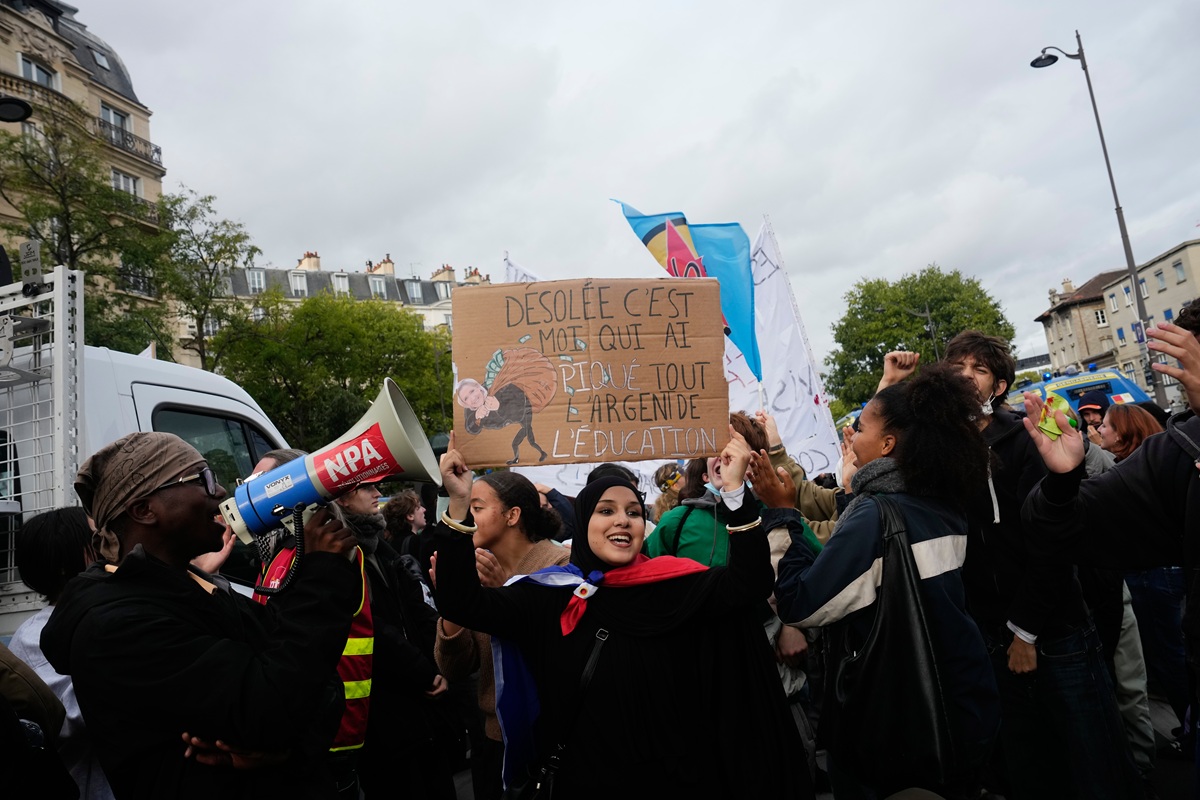
A great deal of effort has been devoted to explaining the recent unrest in France as the work of Islamists and the ‘Hard Left’.
The supposed alliance between these two ill-defined groups is repeated so often that it goes largely unchallenged as an authentic force in European politics. In the UK, we were invited to believe that it drove Corbynism and, more recently, the rise in popularity of Zack Polanski’s version of the Green Party.
The story goes that sinister leftists, or ‘Communists’ in the Fox News version, are content to allow the infiltration of their organisations by jihadists in the hope that the resulting mayhem will provide a revolutionary moment for their ideas.
In this way, naïve students and well-meaning social activists are duped into marching and demonstrating on behalf of causes that have been hijacked by subversives.
This narrative allows no rational motivation for political unrest. Those participating are either actively seeking the destruction of European civilisation or being manipulated into seeking it by mistake – knaves or fools.
Conveniently, hardly anybody has ever met a jihadist or, in recent times, a doctrinaire Marxist. We know they exist, but somewhere out there, living lives that don’t intersect with ours.
Their responsibility for events in France rests squarely with the ‘trust me, bro’ school of media analysis that routinely informs our understanding of enemy states during conflicts.
The conflation of civil unrest with international conflict is a tried and tested method of suppressing dissent.
While demonstrators might be demanding better educational provision, as in France, that question becomes irrelevant if their activities can be vaguely linked to Iran’s Revolutionary Guard or Russia. Try it with your toddler later.
‘I want chips!’
‘You only want them because your paymasters in Tehran have fooled you into believing you don’t already have them!’
We are invited to believe that thousands of people are spending their free time demonstrating against non-existent problems at the urging of unnamed groups that none of us has encountered and which believe in fundamentally different things from the demonstrators.
Does that not strike you as far-fetched?
‘I want a fairer university entrance procedure!’
‘I see you, Jean-Pierre, what you actually want is the imposition of a European Caliphate that provokes political consciousness in the masses leading to the collectivisation of labour. Any fool can see that!’
But what if, and I know this is a radical suggestion, Jean-Pierre really DOES want a fairer university entrance procedure? You see, these protests seem to be popping up in a lot of countries where we’re told that everything is as good as it gets.
As well as France, there are demonstrations in Italy (cost-of-living), Albania (government corruption), Belgium (education), Spain (housing costs), and Portugal (low wages).
Tools
If we hadn’t been told with such unanimous certainty that the European system is delivering adequately, then it might look as if there is something behind these protests that goes beyond everybody on them being the idiotic tools of evil foreigners.
Could it possibly be that young people are looking at their prospects with a mixture of fear and anger?
The relentless deterioration of public services since the 2008 crash (or heist, depending on your perspective) can no longer be waved away as a cyclical bad patch.
The economist Thomas Piketty has emphasised that France has ‘never been wealthier’. A boom in private wealth has coincided with a decline in public investment – raising reasonable questions about how that wealth has been acquired and whether it is being taxed adequately.
Beyond that, the reluctance of governments to challenge a transition to AI has seen changes to employment patterns that are most keenly felt by younger citizens. Only today we have seen Barclays cut 5,000 jobs in the UK, citing a move to AI agents. Barclays made £2.3 billion in profits in the last three months.
Conscripted
The youth of Europe is being told that it will likely be conscripted for war to defend nations that refuse to educate them adequately or guarantee their employment. Its taxes are being spent buying weapons that enrich the same corporations that ‘modernise’ their jobs out of existence and which will profit again from the eventual rebuilding of war zones.
If these protests are, indeed, the creation of sinister forces, then European governments have handed them the perfect scenario in which to operate.
Youthful rebellion has traditionally been contained by the magnet-pull of social mobility. Without the prospect of improvement, and with war the only change on offer, what will contain it now?
Support our Nation today
For the price of a cup of coffee a month you can help us create an independent, not-for-profit, national news service for the people of Wales, by the people of Wales.
Get more trusted Welsh news
Choose Nation.Cymru as a preferred source in Google News to see more of our journalism.


