


Music-making in the capital is blighted by the struggles of its two most famous institutions
Nigel Jarrett
There were no takers except me when the chief music critic of the South Wales Argus asked for volunteers on the staff to help him with reviewing.
Ken Loveland had also been the paper’s editor but was now working as a music critic for national newspapers and magazines, having been recruited by Frank Howes of The Times. KL had continued to write on music for his old employer.
One used to rely on the BBC and intelligent newspapers to stall depressing linguistic trends, but even they now mean popular music when they refer to ‘music’, and relentless police procedurals – crime stories – when they are promoting ‘contemporary drama’.
KL and I understood music to mean the nonetheless oddly-labelled ‘classical music’, some of which was Classical, some Romantic and some Modern.
Anyway, I was KL’s assistant for a few years, taking over from him in the late 1980s. Thanks to him, the Argus covered not only local musical events by mixed choirs, music societies, and amateur bands, but also concerts and opera in the capital. We were there when St David’s Hall opened its doors for the first time.
Opera in Cardiff was Welsh National Opera, founded in the 1940s as a semi-amateur company and chivvied along in the national Press by KL when he became editor of the paper in the 1950s.
By the time I was helping him to review its productions at the New Theatre, WNO had taken its place among the leading companies of Europe. Everyone wanted a stint as its director, and over the years they marched in and out: Brian McMaster, Matthew Epstein, Anthony Freud, John Fisher, David Pountney, and Aidan Lang. It was the same with music directors, who included Vilem Tausky, Charles Groves, Richard Armstrong, Charles Mackerras, Carlo Rizzi, Lothar Koenigs, and Tomas Hanus.
Despite cramped conditions throughout, the ‘New’ saw some miraculous productions, including a Wagner Ring cycle directed by Peter Stein and conducted by Armstrong and Wagner expert Reginald Goodall; a Goodall Tristan und Isolde recorded for posterity, which still values it; and an illuminating Pelleas et Mélisande (Debussy) directed by Stein and conducted by Pierre Boulez. Stein-Boulez was then a world class pairing and WNO’s appointment of them the envy of every regional company in Europe: though WNO, of course, was not regional (the status is in the title). Its enthusiasm for Janacek made its productions of his operas globally-renowned and revealing.
The company’s move to the newly-opened Wales Millennium Centre offered it a cavernous performing space and auditorium in which repertory revivals tailored for the minuscule ‘New’ were often engulfed. But expansion into the extra space was only a matter of time and effort. Pountney in particular inhabited it with some glowing productions, among them Berg’s Lulu and Wagner’s Der fliegende Hollander (The Flying Dutchman), and presided over a series of regal Donizetti masterpieces.
At St David’s Hall, it was equally exciting and sustained, at least for three decades when it was primarily a symphony concert venue. All the London orchestras and the great UK regional ones (Birmingham, the Hallé, Royal Liverpool, Bournemouth) appeared regularly, as did every concert soloist and every conductor worth flying in from every quarter of the planet; and it saw the numerical and artistic burgeoning of the BBC National Orchestra of Wales as residents, though it was later to have a home in Hoddinott Hall at the WMC.
Cardiff Singer of the World, later BBC Cardiff Singer of the World, was established there and grew to global importance (with WNO’s former Head of Music, Julian Smith, travelling to supervise far-flung auditions).
Bliss
So, bliss was it in that Spring and Summer to be alive and sitting in a Press seat. Sadly, winter has arrived early and shows no signs of defrosting.
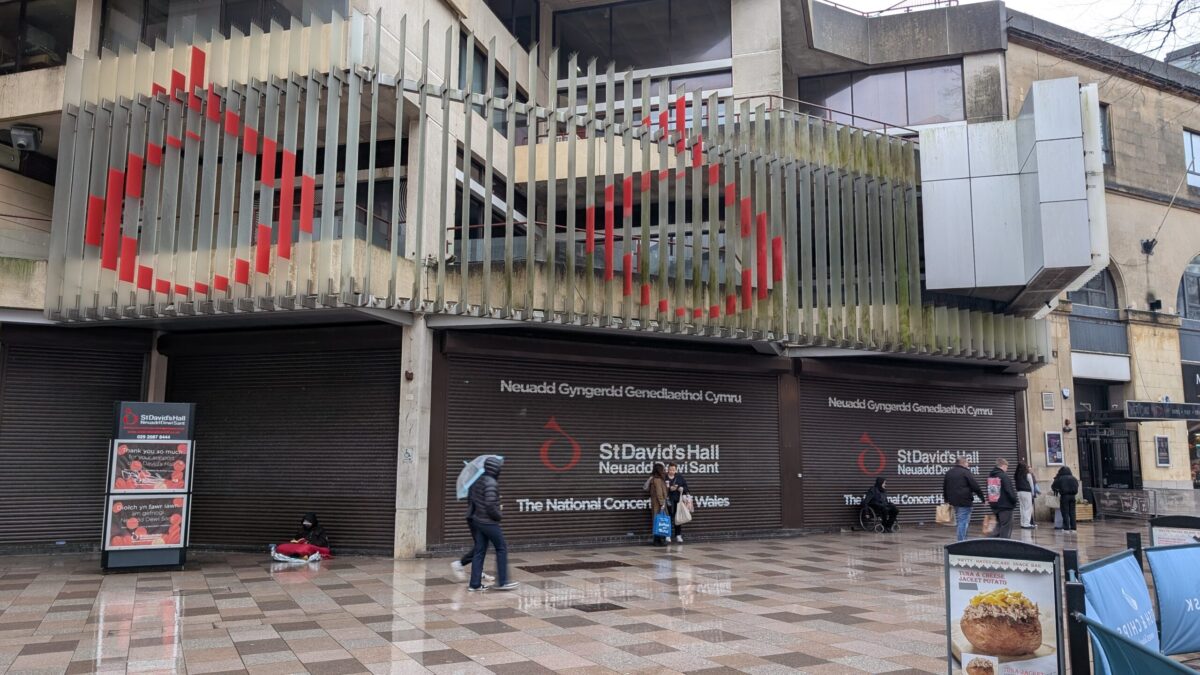
SDH became a free-for-all entertainment venue, a palace of varieties, before it went structurally sick and had to close its doors. WNO withered to an echo of its former self with cuts to its subvention by the Arts Council of Wales (12%) and the Arts Council of England (35%), leaving it prey to the ignominy of being poked with a pointed stick by Private Eye and its ‘music man’, Lunchtime O’Boulez (no relation).
The ACoE grant made it possible for WNO to tour in England as well as maintain the challenging production values to which its supporters had become accustomed.
Executives
The Eye this month criticised it for hiring two more executives – it already has a joint general directorship – at a time when the only opera in current repertory was the knackered warhorse of Puccini’s La Boheme, bedded by a few modest music-theatre ventures. But maybe the company needs more people at the top to devise and plan a livelier future.
Of course, there’s a lot of other music going on regularly. In Wales, one can always find a Mendelssohn Elijah or a Fauré Requiem in rehearsal among the amateurs, and professional music- making aplenty can be located at the Royal Welsh College of Music & Drama, Hoddinott Hall, and similar.
But, like families cowed by the high cost of living, the banners of the capital’s two cultural flag-fliers – St David’s Hall and Welsh National Opera – are limp and at half-mast. We don’t just need a new Spring; we need a fair wind to raise the colours.
Nigel Jarrett is a writer and journalist, and former chief music critic of the South Wales Argus. His latest books are Never Lost for Words: Selected Essays (Cockatrice) and Ways of the Flesh: Stories (Brimstone Press).
Support our Nation today
For the price of a cup of coffee a month you can help us create an independent, not-for-profit, national news service for the people of Wales, by the people of Wales.
Get more trusted Welsh news
Choose Nation.Cymru as a preferred source in Google News to see more of our journalism.



Although WNO’s struggles are well-documented, I don’t think one could call the upcoming “Oedipus Rex” (Stravinsky) and “Duke Bluebeard’s Castle” (Bartok) “modest music-theatre ventures”, despite their small scale.