


My 100 days plan for the NHS and Social Care system in Wales
Rajan Madhok, Retired Public Health Doctor
As I was watching the political leaders debate about the forthcoming Senedd elections on BBC Wales recently (28 April), I was trying to reconcile what they were saying with what I understand to be the problems with the NHS and Social Care in Wales, and how to fix them – you can read my views here.
I do not want to repeat what I have already written, but what I missed most was the lack of honesty that the current system is not fit for purpose and there is a need for a radical transformation of both, policy and delivery of services.
There are no quick fixes – not private sector, nor technology or more doctors and nurses are the answer, and any improvements, if they are to be long-lasting, will take time. So, the pain will continue.
More money, even if it could be found, is not the answer. The Welsh Government in its Final Budget for 2026-27 has already allocated over £12.6 billion to health and social care, and that represents over 55% of the total revenue budget. And where is this coming from? By depriving other sectors like education, policing, housing, and local authorities which are also essential for healthy societies.
We have a serious problem; unless something changes fundamentally, the NHS will keep bankrupting the nation and yet deliver poor service and unhealthy populations.
But of course, I jest, since honesty is not a well-known feature of political discourse, even though it should be. Instead, I found consolation in reading “The best laid plans’ book by Terry Fallis about Canadian politics, which in itself would not merit a mention since we have had better (sic) political satire in this country, for example, the Yes Minister and Yes Prime Minister series.
But Fallis goes one step beyond and shows how honesty can triumph as the unwilling professor is pulled into politics and who with his scientific background, integrity and honesty, wins public support, and is able to recalibrate the politics.
But I digress, that was fiction and real life is different (sic). In the past, with my rants, my late partner, Helen, at this stage would tell me to stop complaining and say what you would do if you had the chance. So, here goes: this is how I would go about if I was in power. I would park all grand ideas for now and focus on these 10 things for the first 100 days:
Everyone waiting for a diagnostic test, outpatient consultation or procedure at hospital will have a clear personal plan for when they will be seen/treated – yes, it will take time, years in some cases, for their turn to come, but not knowing where one is on the queue is unnecessary and causes avoidable stress.
No one will wait for their hospital test results for more than 10 working days; apart from some specialist tests which can take longer, the results should be made available quickly. It is totally unacceptable that having finally got to the end of one queue to have to then rejoin another queue, and the sorry saga continues.
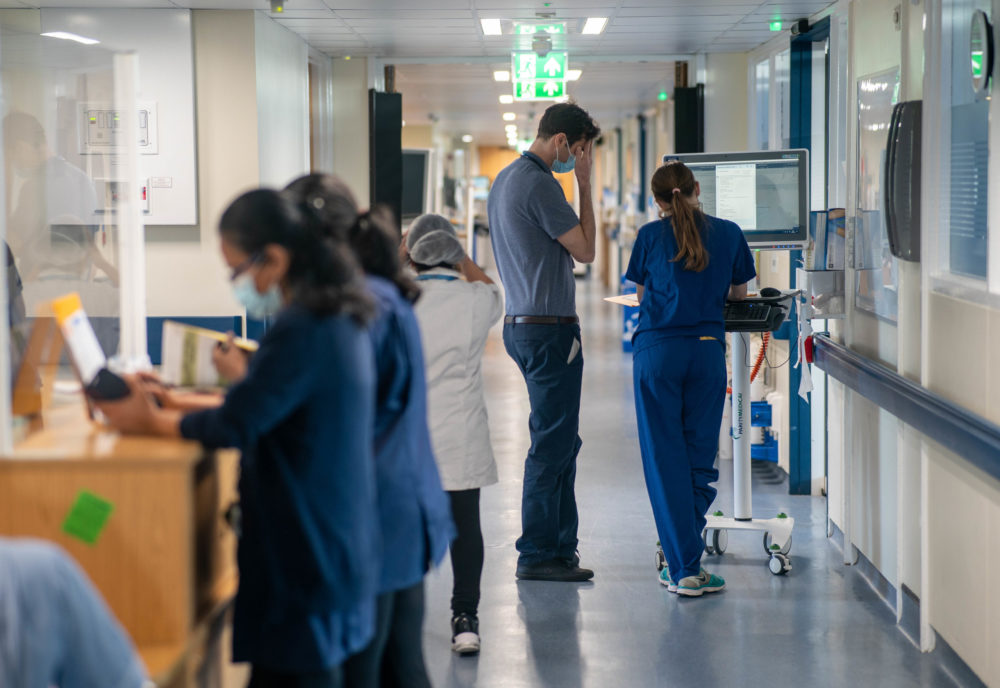
All patients in A & E minors will be properly assessed by a suitably qualified practitioner within 2 hours of their arrival – the current triage is not adequate – and given a personalised plan with options for whether to wait (and if wait more than 4 hours then their comfort needs to be taken care of) or have a planned appointment next day, for example. Why cannot every A & E have a clinic next day to assess patients brought over from the day before?
All trolley patients in corridors will be seen by a senior doctor and any patient delayed more than 12 hours will also be assessed by the senior executive on call (Under Blair’s reforms, the Chief Executives used to get a message on personal pagers for every patient going over four hours for minors and 12 hours for majors). I also recommend that every board member should spend a night in their A & E department, during a busy period, to observe.
All in-patients with no medical criteria to reside will have a family discussion involving the local community care staff about the possibility of discharge – no one needs to be in an acute bed once there is no medical reason. Joint health and social care assessment centres to be set up to do this, and should run every day, to speed up discharges and free bed capacity.
Create a dashboard with clear metrics for the above measures and report them publicly, daily if necessary. And to oversee this work, set up regional time-limited committees around each health board, independently chaired, with access to expertise in data sciences, operational and logistics, clinical matters, and human behaviour.
Big system issues
In suggesting these measures, I am mindful of the need to look at big system issues, and will say to those criticizing about not addressing mental health, care of the elderly, dentistry, cancer etc that unless we sort these out first, we cannot tackle other things, and also there will be knock on improvements to all services, since these measures will help change the culture.
Doing this will highlight where the blocks are and which can then be addressed. I have written about many of these issues in detail before -see articles mentioned above, and essentially what this will show is that the current administrative systems are unfit for purpose, that there are a few examples of good practice but these are not being universally adopted, there is much waste, there is limited engagement of clinicians, and there is little expertise about designing and running complex operational systems, among other reasons, and we must start by tackling these.
As a former orthopaedic surgeon and then a medical director I have always believed in, and practised, the first principle and which is to diagnose first – find out what the problem is – through a deep analysis, before jumping to treatment. Beware of those who already know the solutions.
The one thing I would not do is go in with chain-saw ala Elon Musk, start firing people (though some do need to go) or restructure the NHS. Rather I would show that I mean business and that I will deliver; and by bringing in science, compassion, honesty, transparency and public empowerment I will try and (re) create the vocational nature of health and social care, make workers proud to be a part of it, gain public trust, and move away from current political/managerial axis.
Speak softly and carry a big stick
But that is not to say that I would be a push over- speak softly and carry a big stick, as Teddy Roosevelt said – and so there will be other measures:
A review of the workings of all Health Boards (HB) to explore how to empower local citizens, with the boards being required to produce a list of specific actions to meet the most important/immediate concerns of local populations. All reports should have plain language summaries with clear explanations of how patients’ concerns are being addressed- no more hiding behind jargon and 400-700 pages of board papers.
All HBs to be re-assessed after the first 100 days to see their ‘Fitness to continue’ and how best to support and challenge them.
All HBs to publicly share what waste they have identified – 20-30% is waste in the NHS according to some reports – and how they plan to address this. These savings should then be ear-marked for boosting primary, community and social care.
In preparation for these, all HBs and social services to publish comprehensive reports about how these services are currently organised in their areas, where the problems are, and possible solutions drawing on most innovative models used in other health systems.
Arrogant
I will be accused of being arrogant, how dare you? Apart from extensive professional experience, I am fond of Wales, where I moved a few years ago and have contributed in various ways including by learning the language.
Do I feel hopeful? Do I believe these things will happen? The answer is I do not know. But I am willing to bet (sadly) that the winning party will regret they won, very soon, since the NHS and social care system as organised now is an albatross and will bring them down, unless they are bold and able to carry the public and workers. In a somewhat Machiavellian way, the above also makes sense politically as the problems, really, are not soluble quickly.
Delivering on these 10 points will help set the new government up for the much-needed bigger discussion about the future of NHS and social care. And in starting this discussion I would like them to remember not only the older history of the NHS and how it came out of the wartime coalition government, but the more recent comprehensive reviews by various bodies and especially the seminal reports on NHS by Derek Wanless.
Re the public, I do not know what you plan to do, all I can say is be very careful who you vote for, and be ready for ongoing struggle – any gains will need to be fought for, again and again. Organise yourselves in your areas and get ready to hold the politicians and senior leaders accountable.
Henry David Thoreau wrote: “Cast your whole vote, not a strip of paper merely, but your whole influence”
Vote as if your life depends on it, and frankly it does – if and when we get taken ill in an emergency we will end up in the same clogged and horrible A & E departments. Do it for yourselves and for the future generations.
I wish us all good luck.
Rajan Madhok, Retired Public Health Doctor
Declaration: Although I am a non-executive member on the Board of Llais, this article is written in my personal capacity. More details of my work and my Welsh journey are available at www.ramareflections.com I have no connection with John Fallis, sadly, though I would love to meet him!
Support our Nation today
For the price of a cup of coffee a month you can help us create an independent, not-for-profit, national news service for the people of Wales, by the people of Wales.
Get more trusted Welsh news
Choose Nation.Cymru as a preferred source in Google News to see more of our journalism.



There’s always been a certain arrogance with all governments when dealing with any subject matter. I have always said that inexperienced ministers(none are expert in their prtfolio) should go to the people who experience their jobs daily. Health practitioners should be consulted on health, teachers on education etc. It should be more than a listening exercise, they should have their advice accepted
It’s not the politicians are making medical decisions on their own. They are surrounded by medical, legal, finance experts. Most of a ministers job about budgets, laws, institutions and public priorities – things most medical professionals would be useless at managing. I’m not saying your completely wrong. We could certainly do with a wider range of political backgrounds in politics. Virtually all the labour and plaid MSs are essentially spads or local councillors. Tough few years
There are quick fixes to support economic growth.
Last year I had a sleep apnea appointment in Stoke on Trent. Then waited 6 months for an AI generated letter that recommended four suppliers, all non UK based – so NHS is deliberately supporting growth of Dublin, Sydney and USA economies in those recommendations.
NHS tv screens in surgeries could be promoting small businesses free-of-charge; working with Tata Consultancy to value engineer all the products NHS buys from Europe and open a hub in Aberafan; the list goes on and on..
Thanks Rajan. If only our politicians had similar plans.
Thank you for the article it was a refreshing read. A constrctive article. But I ask for more, would you write this in an open letter to the Prif Weinidog, in a couple of weeks time. I am sure that you will not have difficulties to publish such a letter I am sure Nation Cymru would step up.And I would hope that you get a sensible reply.