


No, King Arthur is not England’s
Stephen Price
An opinion piece from Antony David Davies last week caused quite the stir on Facebook thanks to its teaser, which the author himself might also have taken a little issue with.
Antony is a clever chap, and in his piece, he quite rightly wrote: “England has Robin Hood forever loosing arrows through Sherwood. It has King Arthur — riding from Camelot in film after film, so deeply woven into global myth that few even ask where he truly came from.”
Those in Wales who read the article, or didn’t land on it through social media, would have filled in the dots. Of course, Arthur didn’t come from an English Camelot, that needs no explanation whatsoever.
On Facebook, however, it read thus: “England has King Arthur, Scotland’s banners crackle with Braveheart, Ireland has revolutionary Michael Collins. So why is there no great cinematic epic telling the story of Owain Glyndŵr?”
As I enjoyed the weekend off, 194 enraged comments fell beneath the Facebook post (part one), all saying everything I’d hoped they would (because, like so many others out there at the time, I didn’t click the article, I read the teaser which made my blood boil and contradicted so much of what I’d written in the past and refused to give it my click).
Oops.
‘Classic identity theft’
Credit to the commenters, pointing out: “England does not have King Arthur. He was Arthur of the Britons. Who were the Britons?”
“England has claimed and reinvented Arthur. Classic identity theft.”
“King Arthur is based on Welsh myths and legends. Many of these that mention Arthur or his exploits are noted by historians as the inspiration for Geoffrey of Monmouths (most likely a norman) rewrites and the subsequent wave of French additions that followed. The Welsh mythos pre dates them all.”
One of the worst parts about raising your head above the parapet to write an opinion piece is the soundbite social media teaser, chosen by others who are looking for the most incendiary, appealing hook to draw in the punters.
Before joining the Nation.Cymru team, when I’d submit pieces for the joy of writing/ranting, my blood would run cold at the choice of the last line on earth I’d have opted for, devoid of its nuance, taken out of its context and plonked on to social media to wind up the masses, draw in the clicks, and work its magic.
So who was Arthur?
The first mention of Arthur is thought to be a reference in a line from the poem, ‘Y Gododdin’, the earliest known work of literature in Welsh.
The poem is from the 6th century, when much of western Britain (Wales, northern England and southern Scotland) spoke Welsh; the earliest surviving written form of the poem dates to the 13th century. The reference to Arthur in this source may be no earlier than the 9th century, but it demonstrates the fame of Arthur among the Welsh at this time.
The most important of the historical texts is the Historia Brittonum, the ‘History of the Britons’, which gives the earliest written record of Arthur who ‘fought against them [the Saxons] with the kings of the Britons but he himself was leader [Duke] of Battles’, winning twelve battles. The earliest version of this history is dated about AD829-830.
The Annales Cambriae, or ‘Welsh Annals’, probably compiled in the mid 10th century, record the date of one battle, the Battle of Badon in AD518, and Arthur’s death at Camlann in AD537-9. This suggests that if Arthur was indeed an historical figure, he probably lived in the 6th century.
As Amgueddfa Cymru write: “Early Welsh literature has many wondrous tales which form an important part of the Arthurian tradition. There are portrayals of Arthur in anonymous Welsh poetry found in 13th and 14th century manuscripts.
“In one of the poems of the Black Book of Carmarthen, Englynion y Beddau (‘The Stanzas of the Graves’), Arthur’s grave is described as a great wonder because no one knows where it is located.
“The greatest of the Welsh Arthurian prose tales is Culhwch ac Olwen. An English translation of this and eleven other Welsh tales appeared for the first time in the 19th century, publication The Mabinogion.
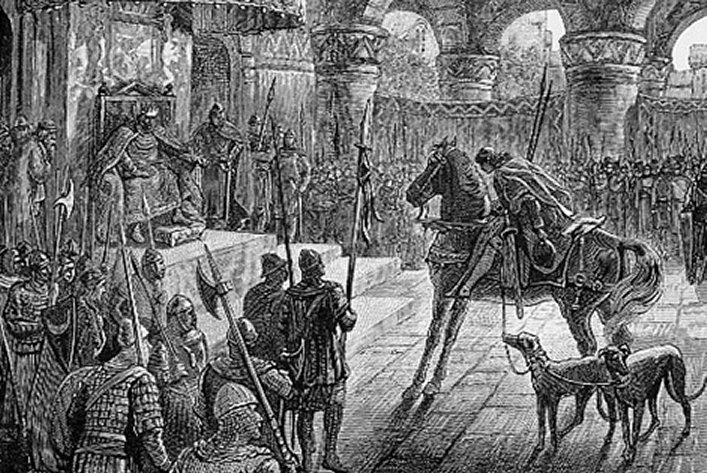
Created by Alfred Fredericks and published as an illustration to The Boy’s Mabinogion: being the earliest Welsh tales of King Arthur in the famous Red Book of Hergest, edited with an introduction by Sidney Lanier (New York: Charles Scribner’s Sons, 1881)
“Four other tales in this collection focus on Arthur – the ‘romances’ of The Lady of the Fountain (or Owain), Peredur, and Geraint son of Erbin, together with the Dream of Rhonabwy which presents a satirical view of Arthur and his world.”
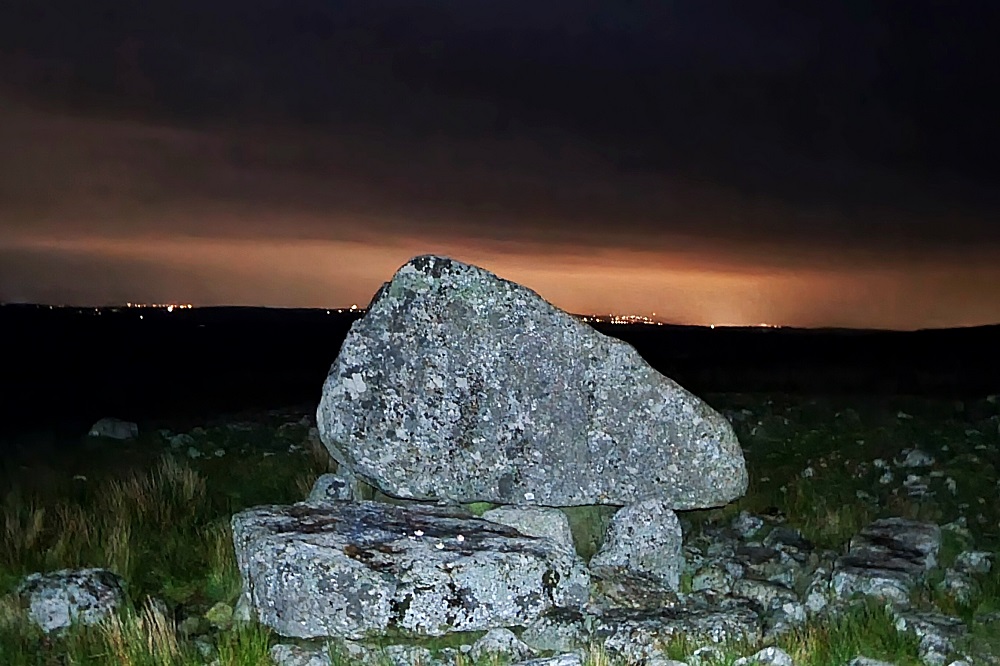
Some half a dozen Welsh Stone Age megaliths are called ‘Arthur’s Stone’, and his name has also been given to an Iron Age hillfort on the Clwydian Range, Moel Arthur, near Denbigh. According to one tradition, King Arthur and his knights lie sleeping in a cave below Craig y Ddinas, Pontneddfechan, in south Wales.
From there, the legendary Arthur developed as a figure of international interest largely through the popularity of Geoffrey of Monmouth‘s fanciful and imaginative 12th-century Historia Regum Britanniae (History of the Kings of Britain).
Geoffrey depicted Arthur as a king of Britain who defeated the Saxons and established a vast empire, but this element is often conveniently overlooked.
Many elements and incidents that are now an integral part of the Arthurian story appear in Geoffrey’s Historia, including Arthur’s father Uther Pendragon, the magician Merlin, Arthur’s wife Guinevere, the sword Excalibur, Arthur’s conception at Tintagel, his final battle against Mordred at Camlann, and his final rest in Avalon.
Adaptations…
Today’s Arthur is an altogether unfamiliar chap. Now global, he’s also a continuous source of inspiration for literature, art and, of course, the movies.
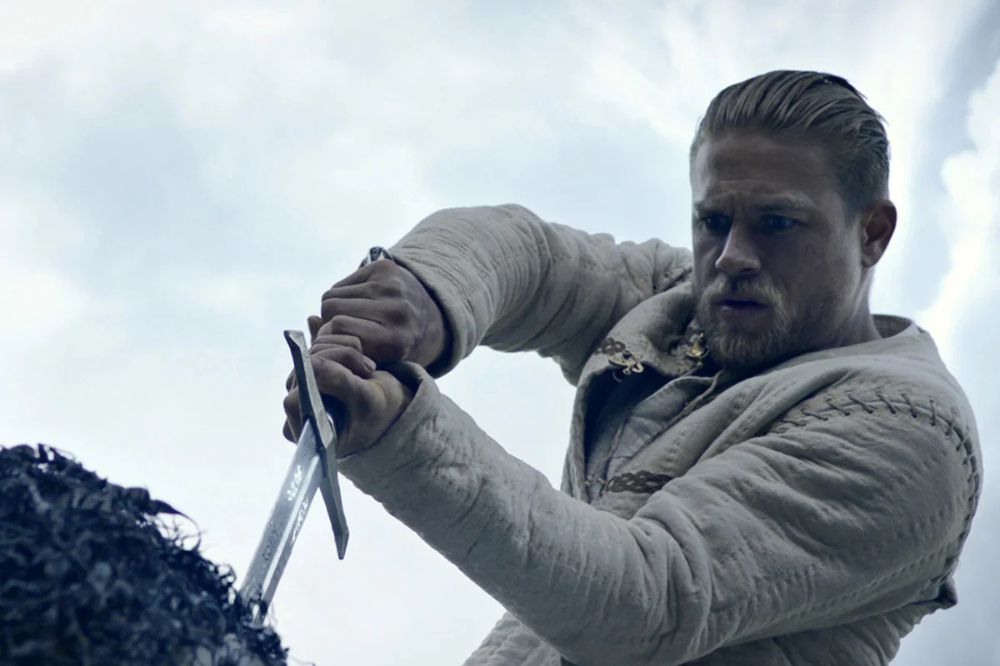
The most recent blockbuster to show us Welshies what really went down was the Guy Richie flop, King Arthur: Legend of the Sword.
Madonna’s ex-hubbie isn’t famed for creating movies with depth, so the retelling was in perfect hands, but no one expected quite the catastrophic financial loss it made. The inclusion of Becks, however, tells you all you need to know about its quality.
The film tells the ‘origin story’ of King Arthur, played by Charlie Hunnam, a man who discovers his lineage after taking the sword in the stone, and teams up with a group of rebels to face against the tyrannical king Vortigern, played by a band of typically non-Welsh talent in the form of Jude Law, Àstrid Bergès-Frisbey, Djimon Hounsou, Aidan Gillen, and Eric Bana.
Wales was only deemed good enough for a filming location – much like the exalted Havoc from Netflix starring Tom Hardy which, again, supposedly made us pots of money but managed to skip any reference to Wales or Welshness on the world screen, but I digress.
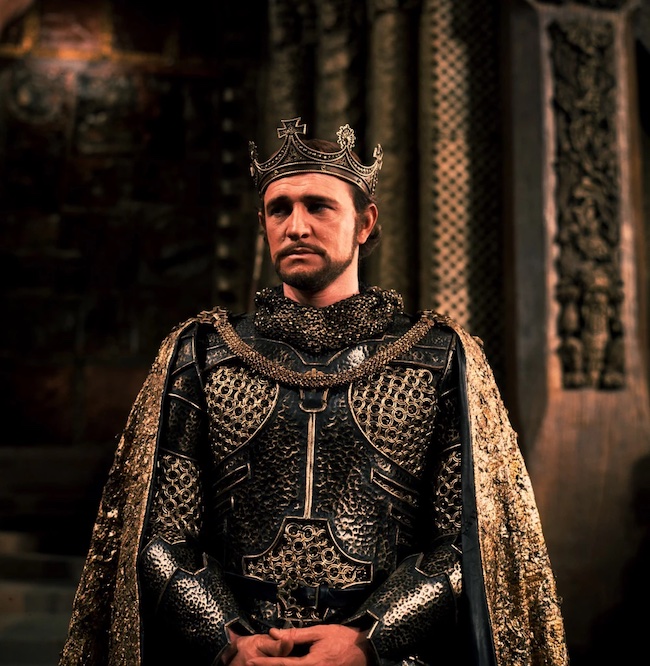
Before Guy’s failed attempt to create an ‘Arthurian Cinemantic Universe’ akin to Marvel, we’ve had plenty of other adaptations that bypass all mention of Brythonic Arthur, and some have indeed been utterly charming and fun – noteworthiest being Disney’s Sword in the Stone, and Monty Python and the Holy Grail, but like the TV series Merlin and so many others, they’re typically English affairs – The Sword in the Stone’s prize even being ‘for the crown of all England’.
It might sound petty to some, but there’s a reason the US and England are so keen to dominate our media landscape – it’s PR, it’s propaganda, it’s selling a dream, it’s power.
Since time immemorial, Wales’ identity on the world stage has suffered as we’ve been absorbed into the idea of ‘Britishness’ as a sleight of hand designation of ‘Englishness’.
The colonisation of Wales mirrors the experience of many other countries/peoples across the globe up to today, with our myths, legends, history and historic places whitewashed to fit the narrative of the oppressor – but of all the legends England could have picked, the Arthurian legend is not only the most absurd, but perhaps also the most telling.
Israel, in real time, is showing how it’s done, with Salim Nuqul writing: “Beyond physical destruction, Israeli policies have long co-opted elements of Palestinian culture. Authentic Palestinian culinary dishes have been rebranded as Israeli while traditional dresses and Arabic music have been stripped of their original cultural context and presented as part of Israeli heritage.”
As Wrexham’s success, and the success of our actors and (authentic) projects that break through, proves, putting Wales on the world stage has enormous benefits at home and abroad.
Arthur’s bizarre-but-accepted new identity, portrayed by the people he rallied against, new claimants of the ‘Briton’ title, could be seen as quite baffling for some, but his open-identity also serves as a convenient tool for ‘Brits’ who aren’t keen to see themselves as the bad guys in a story that isn’t theirs to tell.
That a Welsh legend has adapted to live on among other cultures is a wonderful testament to its power and timelesness, and it’s always a joy to see Welsh stories fly the nest and do their own thing, but to continue to whitewash Arthur’s Welshness, his status as a native Briton which lies at his very core, is an insulting twist too far.
So while we’re calling for a ‘Welsh Braveheart’ movie focused on Owain Glyndŵr (note the usual plot hole where no one is stumping up the funds or writing the script – we’re good at overlooking our own role to play here…) – let’s ensure the ‘Welsh cinematic universe’ *shudder* gets an authentic Arthur too.
It wouldn’t hurt if he was played by a Welshman either, but that would definitely be asking too much.
Support our Nation today
For the price of a cup of coffee a month you can help us create an independent, not-for-profit, national news service for the people of Wales, by the people of Wales.



Really enjoyed this — thank you for taking the time to read between the lines and fill in the dots that the teaser may have blurred!
I think your article makes some excellent points — especially around Arthur’s deep roots in Welsh myth and how his story has been appropriated over time.
I’m genuinely heartened — and humbled — to see just how much real interest there is in Welsh history and identity. Our stories and heroes matter, and they deserve to be amplified and discussed. Wales has many names worth remembering.
The trouble with a Glyndwr movie is the absence of a happy ending. Wallace was dismembered by the English state but his campaign was adopted by others, ultimately successfully. The same cannot be said of Glyndwr.
Any film could close with a phrase from Dafydd Iwan – ble mae Owain y nawr ? – no death, no burial just a heroic figure fading into the mists of border country. History shrouded in myth. Better than getting gutted on the town square in Chester, Shrewsbury or Hereford.
Although his campaign was not adopted by others during Glyndŵr’s reign the Cymry are awakening and are now realising what atrocities and suffering that happened to their ancestors and the campaign is now gathering momentum. Cymru am byth. Glyndŵr fights on. Let’s help him.
You’re right about no happy ending. This invasion of Wales was the start of the English Empire. Wales was the first nation they took with its culture so complete that there is no reprisentation of the Welsh Nation flag in the Union flag. Edward 1 was so concerned about a Welsh uprising that he built 10 castles in his ring of iron to subjugate Wales. Having done that he moved on to Scotland and Ireland.
This angers me no end when England claims King Arthur as theirs. Remember who Arthur was fighting against? Yes, the Saxons. Who would later unite with the other Germanic tribes that invaded Welsh Britain , the Angles , Jutes and Frisians who would later become the English when England was founded as a country in the month of April, 927 AD under one King , Athelstan. Firstly, every single shred of evidence concerning the myth & legend of Arthur comes from Welsh sources. The earliest being monk Nennius, who mentioned both Arthur and Myrddin (Merlin) in his work, Historia Brittonum,… Read more »
I have a Victorian children’s novel by a minor league writer whose name I forget (he was a clergyman). The story is set in ‘England’, with no reference to King Arthur being a Briton.
You mean William the Conqueror (or William the b*****d) defeated the English in 1066, not Richard the Lionheart.
It’s nice that the English let the Welsh claim English heroes as theirs. Just another example of Saxon magnanimosity in the face of Celtic insecurity. You can pretend King Arthur is Welsh, we don’t mind. You can even pretend you aren’t a county of England – it’s our gift to you!
You’re welcome.
When did Kernow unite with England?
For one thing so called Palestinian culture is mix of cultures across the middle east and is not from a single culture. The same applies to Jewish culture it spans many countries in the west and middle east and the middle eastern part outdates that of Muslim culture.
People concentrate on Glyndwr but Wales has many much better stories to tell with happy endings ,the from 1080 to 1200 is the most eventful time in Welsh history , there are many Owian Glyndwrs to choose from .
I’d love to see a series of live action film versions of The Chronicles of Prydain by Lloyd Alexander.
As a Cornishman, I claim Arthur for Cornwall or the Western Welsh as we were called in 8th century.
England will try and steal anything. They are that desperate. Only the other day Jamie Oliver was using ‘English’ nutmeg!!
It was the French who changed the stories and made it English, so do your research before blaming others.
https://m.youtube.com/watch?v=KHX2QxiWE1E
I stumbled on this very low budget 2015 film Arthur & Merlin which has many faults but leaves no doubt the battle is between the good Celts and the evil Saxons, and which side Arthur and Merlin are on. Perhaps the sequel, which seems to be stalled waiting for finance, with a larger budget and prominently featuring the indigenous British language could kick start something bigger.
I’m watching Barbarians on Netflix which is about the conflict between the Germanic tribes and the Romans. It feels very natural having the Germanics speaking in German and the Romans in Latin in the subtitled and non-dubbed original.
King Arthur was taught in Welsh schools up until the 1920s. He was a Welsh king around 650ad.English education system now denies our history.His Kingdom was the Glamorgan and Gwent areas (as we know now).To know your true Welsh history look at the work of Alan Wilson.(He,s on YouTube).
Alan Wilson and Baram Blackett’s books were eye opening when I first read them (not the easiest for reading though) but it is important to contrast that with what others are researching and concluding. Caleb Howells, Scott Lloyd, O’r Golwg on YT all give good evidence and arguments.
The evidence that he was from SE Wales is preserved in the stained glass window in LLandaff Cathedral, well worth a visit with the tomb of Dubricius (Dyfrig) who crowned Arthur as a bonus.
Maybe someone could adapt John Cowper Powis’ novel ‘Owen Glendower’ into a film? There’s an old movie line that says “if there’s a choice between the truth and the legend, print the legend”.
I have high respect for Welsh Mythology, I enjoy it greatly, I’ve been to Wales, beautiful country, rich heritage, but due to the fact that much of early surviving Welsh poems and stories are based on anonymous writers and even verbal traditions written down centuries later – it took folks like Geoffrey of Mammoth to put King Arthur out there for early public consumption. Same can be said for Thomas Malory etc. these would ultimately be the influence for future retellings including T.H. White who was really the guy who stuck “King of All England” into the Arthurian sphere. So,… Read more »
? He was a Briton. He is mentioned in various native sources. He is mentioned by Gildas and in Y Goddoddin, his life and adventures are threaded through so many old tales and poems and legends and our mythology. We don’t need to reclaim him. He was always ours. He is not fair game to others. He was not English. England didn’t even EXIST when his name was first known. His whole STORY is based on how he fought against the Saxons. In what world COULD he even be English its absurd. He laid siege and routed the Saxons at… Read more »