


Raking Through the Ashes: the future for Labour
Desmond Clifford
Polls can change but currently Labour is tussling for third place. On a worst-case scenario fourth or even fifth can’t be ruled out.
Extraordinary: I can hardly believe it. This is the party which won every election in Wales for a hundred years. Its record of electoral success is probably the best of any party in the democratic world and yet its fall could be so dramatic that it, too, might set a new kind of record.
When Mark Drakeford stood down as First Minister in March 2024, as he always said he would after five years in the post, the circumstances were unremarkable.
Indeed, they looked reasonably promising for Labour. Drakeford’s ratings were down from their Covid peak but still well within the range of normal mid-term dips, with plenty of time to re-energise the party’s fortunes before the election.
Vaughan Gething was newly elected as Labour leader and about to become First Minister. Notwithstanding misjudgements during the Labour leadership campaign, he inherited a well-established government work-programme and a functioning Co-operation Agreement with Plaid Cymru to help deliver it.
There was every reason to believe he would find a way past his party issues, gather some momentum as First Minister and then galvanise the party on the canter into the election. That was the plan.
As we know, that’s not how things worked out. In truth it might have been difficult even under the most benign circumstances for Labour to have had a bumper election in 2026.
The one thing they could do nothing about is the reality of having been in power for 27 years.
Voters are jaded and crave something fresh. The record on public services is sludge-y and Labour can hardly disavow responsibility or position themselves as possessors of radical new options.
Some fall-off in support was always, realistically, inevitable but the scale of the decline is dramatically beyond what even pessimistic scenarios might have foretold.
What happened? In office, Vaughan Gething quickly made things worse. He’d upset some of his colleagues during the leadership campaign but, once elected, showed little aptitude for bridge building.
Plaid Cymru was quickly alienated and collapsed the Co-operation Agreement early, no doubt scenting weakness and spying opportunity on the horizon.
Gething finally alienated enough of his colleagues to make his position impossible. When he lost the Senedd no-confidence vote he should have resigned immediately. His refusal to do so was intolerable and it took cabinet resignations to force his hand: the Senedd melodrama was catastrophic for the Labour Party’s reputation.
The other handicap for Labour is the performance of Starmer’s UK Government. In some ways a Labour government in Whitehall will generally tend to advantage Labour’s opponents. Up to a point, this is to be expected, but not at the scale we’re seeing.
Disappointment
There are two types of disappointment attributable to the Starmer government. One is a general complaint about malaise and poor decision-making. No one feels better off or much protected from the icy winds blowing through the economy and society. Supporters hoped for better.
The second failing is the specifically Welsh complaint. After fourteen years of Conservative government, loyal Welsh Labour votes reasonably expected some sort of advantage to accrue from a UK Labour government.
They might reasonably have expected progress on devolution of policing and justice, the revenues accruing from the Crown Estates, a HS2 dividend for Wales and other possible gains.
Anyone who makes the case for Labour’s MPs sticking up for Wales and making demands of the UK government is labelled a “separatist”. It’s bizarre. The UK Government has proved a dead loss for Wales and small wonder habitual Labour voters feel taken for granted.
Poisoned chalice
Eluned Morgan picked up a poisoned chalice. She wasn’t the cause of Labour’s sudden decline, but she was unable to arrest it. Her instincts were to emphasise “partnership in power” with the UK Government, but she misread the situation completely.
Her UK colleagues let her down repeatedly and publicly, but still she refused to level criticism against them. In Scotland Anas Sarwar was similarly screwed. He was in a potentially winning position in Scotland before Labour’s UK victory but at least he showed the courage of his convictions and called for Starmer to resign.
If the polls are in any way accurate Labour will be reduced to a rump after the election. Shell-shocked doesn’t quite capture it: Labour will be traumatised.
Whether or not Eluned Morgan herself gets re-elected looks borderline. Even if she is re-elected, I suspect she won’t hang around long.
What happens next?
Labour’s best bet would be to install Huw Irranca Davies as leader with the expectation that he does the job for a couple of years while the party sorts itself out.
Huw is a youthful 63 and probably wouldn’t be thinking of long-term leadership. He is personable, relatively aloof from factions and an honest broker.
Reflect
What the Labour Party in Wales will need is time to draw beath, sort itself out, reflect on the causes of its calamity and decide what it wants to stand for in future.
One problem is the suggestion that Huw would make a good Llywydd for the Senedd. He would indeed, and if it’s offered, it’s a helluva more attractive post than leading the Labour Party just now.
He and his colleagues will have to think carefully about priorities in all this.
It won’t be fun, but post-election it’s essential that Labour is honest with itself. If it wants a vibrant future, it needs to understand why it lost support so dramatically.
What does Wales need that Labour can best offer? The social forces that brought Labour to power a hundred years ago – industrial labour – have largely evaporated, at least in their traditional form.
In the world of today, what does that mean for Labour? The options probably won’t include a return to permanent dominance but, rather, a role on the progressive side in a multi-party field.
Who might provide long-term leadership? If elected, Huw Thomas, currently leader of Cardiff City Council, and Shavanah Taj, General Secretary of TUC Cymru, have some profile but would feel fresh, and others may emerge.
The leadership, of course, is important but so is the direction of travel. No leader will get far without clear point and purpose for the party.
Arrogance
Labour will need to understand how Wales has changed. There was arrogance in Labour’s dominant assumptions. Labour people sometimes talk about “the Valleys” as though they have some God-given freehold rights there, and there’s a version of this for other parts of the country.
They didn’t take enough note of changes in society and shifting priorities among working people. They declined to treat farmers as workers struggling to make a living. They became the party of graduates and the third sector. They played to the gallery of party activists rather the interests of the wider Welsh public.
If Labour wants to reconnect it will need to re-establish the reality of “Welsh Labour”, the concept that Wales’ elected representatives should be busting a gut to win advantage for Wales.
This requires more vigour and rigour in policy development. It also requires – critically and urgently – a rethink about the role of MPs. The days of Welsh Labour MPs acting simply as voting fodder for the UK party in parliament should end.
Partnership
Support from Wales should be complemented by an agreed programme of measures for Wales promoted by the UK party in genuine partnership with their Senedd colleagues.
I am suggesting that the Labour Party convert itself into a federal or confederal party. This is no small ask and a course which goes against all its centralising traditions.
I won’t be expecting progress anytime soon unless, perhaps, Manchester’s Andy Burnham ends up as leader. But let me put this into the scales.
The emerging evidence is clear that progressive voters in Senedd elections demand delivery of a Wales-first agenda and will award their votes to the parties most confidently offering this.
Do the math. For 25 years Welsh Labour was this party, and duly maintained its position. When they abandoned that approach, voters abandoned Labour.
Support our Nation today
For the price of a cup of coffee a month you can help us create an independent, not-for-profit, national news service for the people of Wales, by the people of Wales.
Get more trusted Welsh news
Choose Nation.Cymru as a preferred source in Google News to see more of our journalism.



Labour may improve with fresh blood in Wales; but their Westminster collegues know how to turn an issue into a crisis. HS2’s oversight committee chair has been removed for having an opinion https://www.thetimes.com/business/companies-markets/article/ministers-sack-top-rail-adviser-who-spoke-out-over-hs2-train-debacle-5fxp3npnr Prison officers morale is poor, so the government has paid for a national radio campaign to encourage more applicants to join – they should have focused on introducing 360 degree performance appraisals for managers / linking managers bonuses to staff turnover etc – slowly turn round the industry. Well managed organisation do not need to advertise roles as recommendations from individuals to their friends and family brings… Read more »
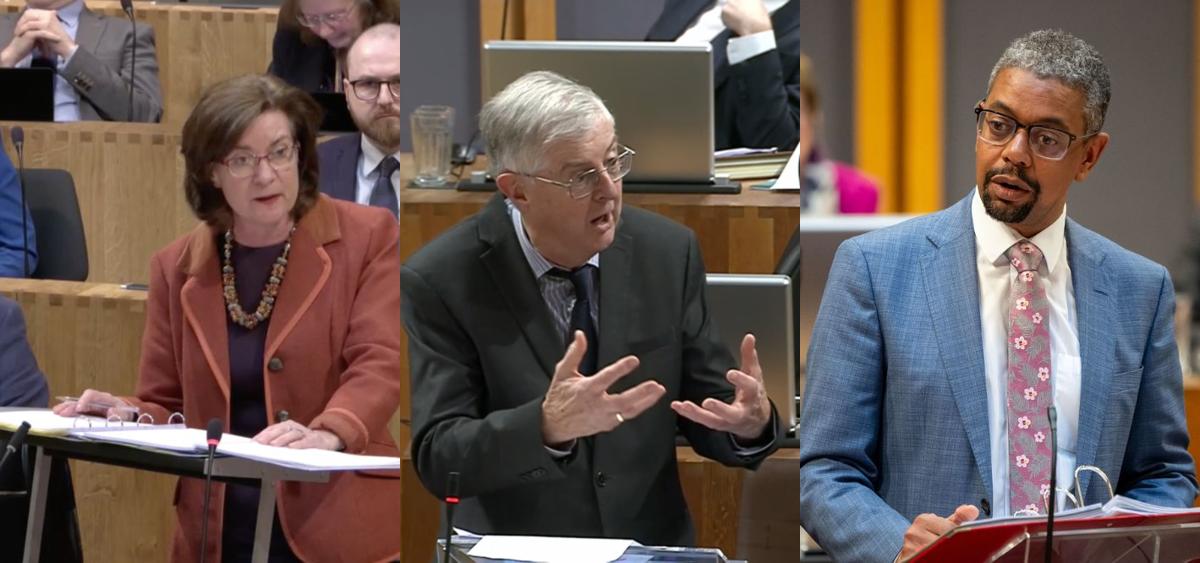
Looking at the title photo. Two things stand out- little talent and blaming others.
How did you conclude that from a photo? What does real talent look like to you?
Thank you for your reply. From the photo one is able to recognise the three. None have been particularly good at their job. Let’s see B Cadwalader holds the record for being under special measures and 2:of them have been responsible for Health in Wales whilst it was under Special Measures,
Now it is not just me, the opinion polls are all showing that some two thirds of the Labour vote has deserted them. This is not due to Starmer because Welsh Labour has been trailing it’s English cousin now for two years.
It was never going to be world beating having the oldest, sickest and poorest population in the UK, without needs based funding from central government.
Well there you are. Blame it on Westminster. It is down to devolved government. If you saw the documentary “Ysbyty Dim Lle ” you will see that much of it is due to bed blocking. That is a purely organisational problem, between the hospitals and the care sector. If you ask me it is part of the North South problem. All the attention is given to the South.
There’s two parts to this. There’s understanding what’s actually possible and there’s outperforming that. If you don’t understand the first you can’t appreciate the second when it happens.
Bed blocking is absolutely the problem in healthcare and is down to a lack of capacity in the care sector. But the root cause is too many old people, especially in the north with it being a popular place to retire. And funding that doesn’t recognise that.
Distribution of funding comes from Cardiff. So they are not channeling sufficient to the North. That is what was said before the Referendum, that the North would take second place to the South Though the South are going to find money for a new station on Deeside industrial park. The fact that it is to be sited 2km away and on the same line as another station is irrelevant. The fact that the other station is hardly used(it’s a request stop) is also irrelevant. Being a bit cynical I think that it being put there as a sop to the… Read more »
Betsi Cadwalader holds the record for being in special measures. All three have been health ministers, all three put the blame on someone else for the appalling state of the health system in Wales
This election isn’t a referendum on Welsh Labour. It’s a response to the spectre of Reform.
After the poor-performing Welsh Labour era (sometimes seen as arrogant) and after viewing the parties standing in the May elections – IMO it is past the time to get rid of thdevolution.
After the dreadful Johnson regime and the Truss disaster IMO it’s time to abolish Westminster.
What an absolutely disgusting attitude.
One country being governed by another is not democracy of any kind, and it’s dangerous to think so.
If Cymru’s only hope of democracy is threatened or removed, then it’ll be civil war. Is that what you’d like?
No its time to get rid of the Labour government. If we don’t like the UK Government should we get rid of Westminster?