


Red line: Badger culling can not return to Wales
Stephen Price
In good news this month, England finally followed Wales’ lead by ending their controversial badger cull as confirmed by the UK government.
The government said it was planning to move towards vaccinating badgers to control the spread of TB, and development of a vaccine for cattle is under way.
The Badger Trust said the move was “good news for badgers” as culling was not an effective way to tackle bovine TB.
The trust’s chief executive Nigel Palmer said: “You can’t solve a disease in one animal by killing another animal.”
“Until they address the problem in cattle, which is where the problem lies, they’re not going to get on top of it.”
Progress for our wildlife, at last, I thought.
And then, over the weekend, whispers from a Plaid Cymru source – the party which I proudly gave my vote to in the Senedd election – that, surprisingly, the outlook for badgers in Wales might, I repeat might, not be so certain.
As reported by the BBC’s Steffan Messenger: “A ban on muck-spreading over winter months to protect rivers doesn’t work and will be changed, the Welsh government’s new environment minister has said.
“The regulations – brought in by the previous Labour government – were championed by river campaigners but angered many farmers.”
Farm slurry – a mixture of water and cow manure – is a ‘natural’ fertiliser, and has been spread on our fields for as long as we have farmed.
Farmers, angered by a ‘heavy-handed’ restriction on spreading slurry from mid October to January, are arguing that they should be able to do so judging by the weather.
Quite sensible you’d think, especially since I’ve known places like Crickhowell flood in September and February – and with ‘climate chaos’ a potential norm for Wales, they have a point.
Second billing to the muck-spreading, Messenger’s article added: “Asked whether Wales could see badger culling in future in response to bovine TB he [Llyr Gruffydd MS] said he agreed with Wales’ TB Programme Board that the disease should be addressed “in wildlife” as well as livestock.
Scapegoats?
First to the cow (and chicken) shit.
It’s no secret that I’m one of those animal-rights, tree hugging types, and most of my free time is spent away with the fairies clambering rivers and woodlands, taking photos, exercising the hounds, taking it all in.
Every day, one way or another, a walk takes me to a lake, river or canal, and during one such walk, five or so years back, I witnessed an otter swimming in the River Gavenny – the water skimming above its body as it moved upstream.
For a moment, the world stopped still, and just as when I’ve witnessed hares, badgers, red squirrels and rare birds in the past, I felt saddened that this wasn’t the norm. That we can’t simply coexist as we once did. That, to this day, this was a once in lifetime experience.
When I returned home, I called Natural Resources Wales – a call I’d planned to make months prior after seeing the river regularly turn cloudy, lifeless and grey, but always put off.
In a nutshell, I explained that I’d been seeing sewage overflow regularly enter the Gavenny from two outlets near the old Pen y Fal Lunatic Asylum, and that I felt it my duty to report it finally – that I owed it to the otter I’d just seen to do more than complain in local Facebook groups.
In an oft-recounted display of dismissal and discreditation, the call handler told me that the otter’s presence was actually a good sign of the river’s health, but that it would be logged.
Since then? Sewage continues to flow from the outlets, as it does in very many of our water courses and our seas. But our water companies continue to do so with little comeback, and our farmers – the growers of our food and custodians of our land – get all the focus and red tape to deal with.
Blood in the Willows
Over to another scapegoat – the beautiful, intelligent, and widely persecuted badger.
Hundreds of thousands of badgers have been culled in the UK since the cull began in 2013. 250,000 is one estimate, but it’s likely to be much higher when factoring in the deaths of the young who are left to fend for themselves – and how many have we all counted on the roads since then too?
We have no mercy, and no shame.
A targeted cull took place in Pembrokeshire in 2009, and was cancelled in 2012 after the Welsh Labour administration concluded that culling was ineffective.
In Wales, unlike the case as was in England, there has been an active approach to detecting bTB in cattle. The frequency and regularity of testing in Wales is as much as four times higher than in England, and Wales applies a stricter approach to interpreting skin testing, designating animals as reactors that would not be classed as such in England. In contrast, DEFRA in England has revised the sensitivity of the SICCT test, reducing its effectiveness in detecting the disease by 25%. This is concerning, especially since this test already has a low efficiency level, with as many as 50% of infected animals being missed.
Welsh Labour must be commended for their stance on the cull. In a statement to the Senedd in May 2025, then-Deputy First Minister Huw Irranca-Davies reaffirmed the government’s commitment to eliminating Bovine TB in Wales without resorting to culling badgers.
Carolyn Thomes, in the role of Labour Regional Member of the Senedd for North Wales, said at the time: “We face a persistent challenge with bovine TB in Britain. Bovine TB is horrible for farmers, cattle, and wildlife. Wales has taken a different approach to England—an evidence-based path—and is doing better because of it. While England has pursued controversial badger culling, Wales focuses on the primary driver of bTB outbreaks: cattle-to-cattle transmission. I have to make it clear that the comparison stats provided by DEFRA on bovine TB statistics between countries is wholly inadequate, as it’s not showing like-for-like requirements. England relies on a test that allows 25 per cent of bTB in herds to stay undetected.”
We protest about orangutans being killed for palm oil plantations, or jaguars and sloths losing their habitat for cattle ranchers, and have much to say about the world’s precious animals and rainforests being decimated but are we really any better here? Or have we simply got used to the end result as our norm?
The sad thing is that we wrote the book on ecocide – and we continue to eradicate and sanitise as much as we can – nothing is safe, and we kid ourselves that Wales is green, pleasant and wonderfully wild because we only tend to occupy tree-lined paths and roads, rarely looking down from mountain tops to see just how little tree cover and wildlife habitat we have left.
Do as we say, not as we’ve done and maintained.
Bovine TB – the clue is in the name
Badgers are a perfect figurehead for the ongoing war man has waged against nature.
Badgers and their setts are ‘strictly protected’ in the UK under the Protection of Badgers Act 1992. You read that right – strictly protected. How there are any left is a wonder.
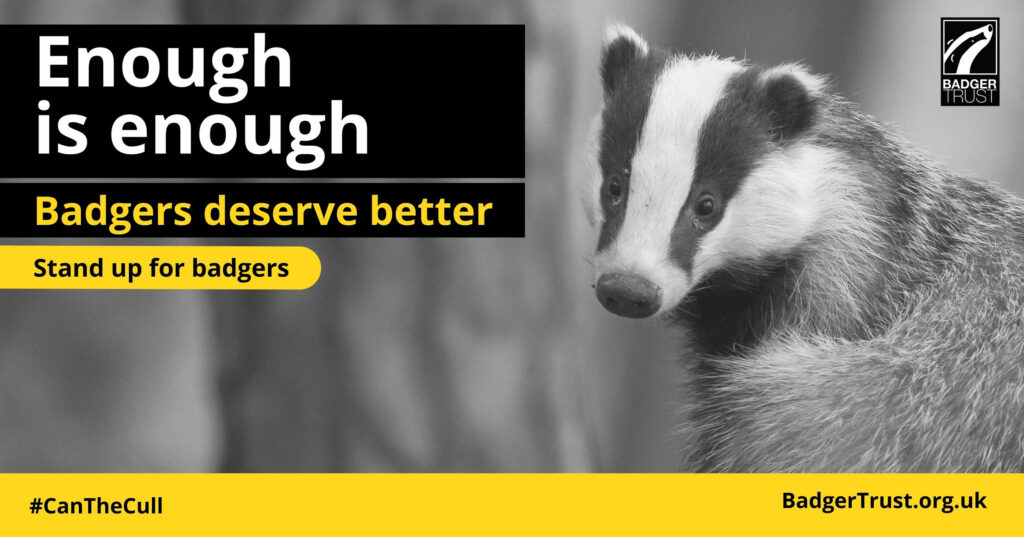
Badger Trust’s view is that to solve the problem of bovine TB, the UK government needs to be more like the Welsh and change the focus to cattle. Badger Trust set out in detail their recommendations on cattle measures as part of the government’s bTB eradication policy in our submitted response to their ‘Call for Views’ in April 2021.
They share: “Science tells us that the badger can only play a very small part in the spread of bovine TB. Cattle continue to account for almost every case of infection cow to cow – over 94%. The remainder come from a variety of sources including ‘unknown’.”
The Trust says that the government has been reluctant to use the most effective methods to take the steps needed to stop bTB, arguing that the focus needs to be on cattle and cattle-based measures including better cattle testing; controls on cattle movement; effective slurry management; additional biosecurity measures and cattle vaccination
Steffan Messenger added: “River Action wrote on X: “Wales is facing a climate and nature emergency – so why has the new Welsh government cabinet dropped a dedicated minister for climate change and not prioritised nature?”
“Meanwhile, the Future Generations Commissioner for Wales told BBC Radio Cymru it was “disappointing” not to see the environment mentioned in the first minister’s core missions outlined in the Senedd this week.”
And I would add that the vast majority of Wales does not want more blood on their hands.
Badger culling cannot return to Wales in any way, shape or form, or we will witness another historic political suicide from a party we’ve put our faith in to do better and to act with kindness and compassion to all.
England’s U-Turn further demonstrates the need for Plaid to fully commit to supporting farmers to transition away from the more milk at any cost approach our supermarkets have forced them to dance to.
Persecuting our wildlife needs to become a thing of the past, and like I and many others have done already – consumers will switch to alternatives if they’re faced with the hidden costs behind their pint of the white stuff.
Patrick Barkham wrote in the Guardian: “Our relationship with the badger has always been oddly confrontational. We seem compelled to find it, watch it, feed it, photograph it, poke it, catch it, torture it, defend it, kill it. It seems to be virtually a competitor on an island denuded of big mammals. Perhaps it simply plays too significant a role in our landscape for us to ever leave it in peace. When its interests clash with ours, we seek to “manage” or exterminate it, just as we can’t help ourselves in our curiosity, greed and desire to seek dominion over every other part of our miraculous world of animals and plants.”
As the Badger Trust pleads: “The problem does not start with badgers; bTB is a respiratory disease in cattle, and focusing on badgers is nothing but a scapegoat approach.”
I’ve overlooked a few things with Plaid to give them my vote, but I won’t be able to overlook even contemplation of a badger cull, and there are many, many more who feel the same.
By all means, look once again at the state of our rivers and go for the throats of water companies who are allowing human shit and grey water from our households in our rivers – and work collaboratively with farmers and wildlife trusts to do better.
But it’s time we all atoned for our abominable treatment of animals – both wild and farmed – and allow future generations to look back on a time when the war on nature came to an end.
Plaid proudly had my vote, but as I’d say to any other party – they’re not harming wildlife in my name.
Support our Nation today
For the price of a cup of coffee a month you can help us create an independent, not-for-profit, national news service for the people of Wales, by the people of Wales.
Get more trusted Welsh news
Choose Nation.Cymru as a preferred source in Google News to see more of our journalism.



I,m in so much agreement with your every word,Plaid also needs to take a step up not back,there is lots to be done out there to protect our wild life.
Badger vaccination is just a useless public relations gesture. We see the Westminster Government are going to try the failed attempt to vaccinate badgers to control the spread of bTB, in the same way as was the failure in Wales. The reason why it failed was because of the shortage and expense of the vaccine itself, and once obtained has little effect on the wider badger population. This is because to vaccinate you have to first trap the badger and some are trap averse so don’t get vaccinated and some are trap inquisitive so you end up vaccinating them a… Read more »