


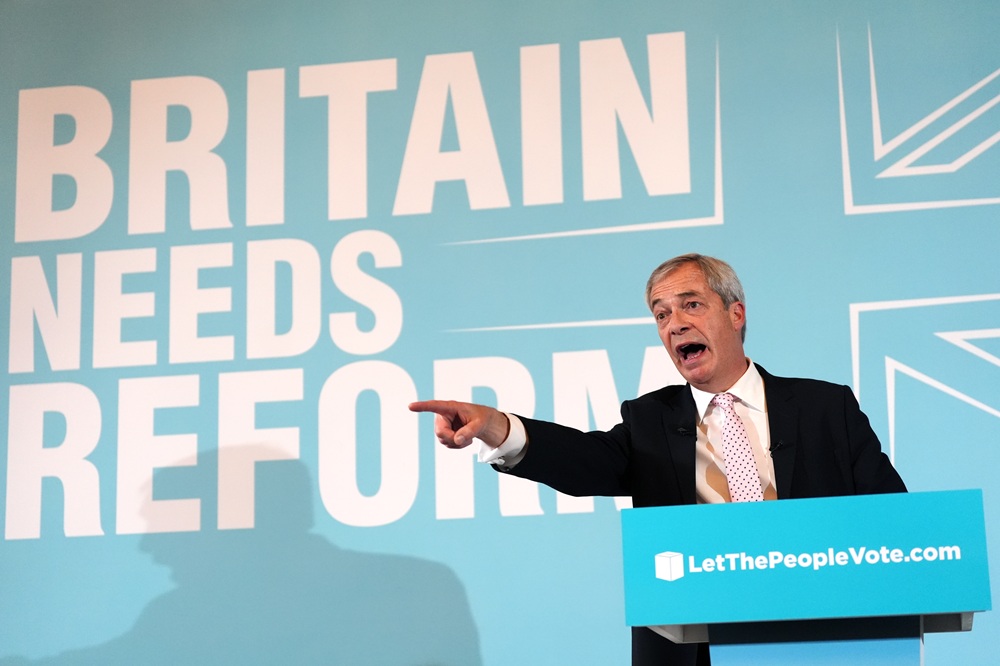
Reform conferences provide a setting where groups of racists can gather to wallow in their mutual bigotry
Martin Shipton
The party conference season will soon be upon us, but for all the attention that’s devoted to it, there’s unlikely to be much to enjoy.
It’s fair to say that for many years now, the word “conference” has been a complete misnomer when applied to the insipid propaganda-fests for devoted party tribalists that these events have become. Even to call them rallies would be to flatter them grossly.
Most parties still pay lip service to the notion that their annual conference is the supreme decision-making body where grassroots members come together to thrash out the policies on which their candidates will stand for election.
In practice, though, such idealism was put to bed a long time ago.
The change occurred in the 1980s after a succession of dramatic public rows at Labour conferences, punctuated by jeers from the floor and walkouts from the platform, gave a realistic portrayal of the tensions that exist within all parties, where individuals hate each other more than they hate their opponents.
But while party managers shiver at the prospect of such rows breaking out in public, I look back with nostalgia to the honesty such bust-ups reflected.
Surely it is inevitable that people within political parties that aspire to form the government of their country will disagree about the right policies to adopt. As a corollary, it is also surely appropriate that proposals up for debate should be subjected to rigorous scrutiny by those who will be expected to support them if they are accepted. Isn’t that what democracy should be about?
Party managers see things differently, however. For them, public disagreements represent disunity – something that the public doesn’t like and that those in charge of political parties cannot tolerate.
When a faction takes control of a party, the faction leaders take the view that everything necessary must be done to disempower and ultimately eliminate those who are not adherents.
This was the course of action followed by Keir Starmer and those who pulled his strings – most notably Morgan McSweeney. Having conned party members into believing Starmer was more left-wing than he was, once in charge he ruthlessly purged those perceived as enemies. But while there was a huge amount of Machiavellian behaviour going on, as chronicled by the journalist Paul Holden in his book The Fraud, none of it saw the light of day at a party conference.
Those managing the party made sure through careful manipulation of the conference agenda that “unhelpful” motions from left-wing branches didn’t make the cut, leaving the thwarted delegates to express their dissatisfaction among themselves in the bar or tea room rather than from a podium.
The more thoughtful journalists would write analytical pieces pointing out that the party was in fact riddled with divisions, but the impact was far less than it would have been if fiery speeches delivered in the conference hall had set the conference alight.
The upshot was that the party managers got their own way without too much resistance. In public, they had demonstrated to great effect who was in charge – and made it appear as if the party was united, even though it wasn’t.
The flaw in their case was, then, that the image they tried to convey did not match the true situation. Starmer may have got stage-managed standing ovations, but even many of those who were standing knew that he was a dud. And when the party’s showing in the polls failed to recover from a position where it would face electoral humiliation, the deceptive façade that had worked at the conference had totally lost its cachet. Starmer was turfed out and didn’t survive for another conference season.
In contrast to the fundamentally dishonest manoeuvrings of the Labour Party, at the other end of the conference spectrum are the Greens, who wear their commitment to party democracy very firmly on their sleeve. The result of such openness is that opponents can take advantage of their candour to portray them in an extremely negative light.
Tasers
The other day the Daily Express – a paper that loyally depicts Nigel Farage as a secular Messiah who can save Britain from the foreign hordes – ran a story under the headline: “Green Party to consider banning police from using Tasers and pepper spray – ‘madness!’”
The idea of banning Tasers and pepper spray was introduced as if it was highly likely to be adopted as Green Party policy.
The Conservatives’ Shadow Home Secretary Chris Philp was recruited to dismiss the proposals as evidence of the party’s “latest madness”.
In fact, as party leader Zack Polanski pointed out on social media: “In the Green Party, any member can propose a policy. It’s in our constitution, and members decide whether to debate it.
“So when the media presents that as the Green Party ‘proposing’ a policy, they’re misleading you. Worth asking why the billionaire press constantly attacks us.”
It quickly emerged that the proposal to stop police officers using Tasers and pepper spray was not going to be discussed at the Greens’ conference after all – although other controversial ideas like phasing out prisons would still be on the agenda.
Polanski’s point that any member can propose a policy is a noble defence of grassroots party democracy, even though I suspect that most people would see the proposals themselves as falling somewhere along a spectrum ranging from eccentricity to utter madness.
Philp went for the jugular, stating: “The Green Party have shown themselves to be a disgrace and a danger to the public. They are certainly no longer the harmless badger and whale-loving party they were in the past.”
Every party has members who put forward ideas that most would say defy common sense, but it seems unjust to condemn the Green Party for proposals that haven’t been adopted as its official policy.
Oddballs
The Conservative Party has its own oddballs, some of whom have defected to Reform UK – an entity that isn’t so much a political party as a personality cult. Democracy doesn’t exist in any sense, with policies being set and decisions taken by Farage himself and a changing coterie of minions with whom he is liable to fall out at any time.
Reform conferences don’t even pretend to debate issues. Their purpose is to provide a setting where groups of racists can gather to wallow in their mutual bigotry.
Get ready to enjoy the conference season.
Support our Nation today
For the price of a cup of coffee a month you can help us create an independent, not-for-profit, national news service for the people of Wales, by the people of Wales.
Get more trusted Welsh news
Choose Nation.Cymru as a preferred source in Google News to see more of our journalism.



The donkeys on the right hee haw their filth and lies as if it they are facts, but in the end all they do is bray and sway to the command of their billionaire owners.
People with a some amount of sense can see through their hate filled faecal material that ensures any talk of taxing their billionaire owners are drowned out by a massive front page picture of a boat filled with migrants invading England and colonising the island with Islam.
Donkeys are the heroes of Gaza…
No, the innocent children and women massacred by the evil zionist government, their idf goons and marauding settlers are the real heroes. May they rest in peace. Aameen.
Why Donkeys are a lifeline:
Mobile four leg drive ambulances, regardless of fuel supplies and bombed and blocked terrain…
Essential transport for water, food and building materials etc
Evacuation for displaced families and their belongings…
They suffer wounds from shrapnel and emaciation, starvation and thirst, psychological trauma…
They deserve more than being used as an insult…
Good point.
My apologies to donkeys for equating them with deform and their lot.
Thank you so much on behalf of Man’s real best friend, Amir…
‘In Islam animals are viewed as creations of God that possess their own spiritual standing, communities and rights’…
The Quran goes on to say cruelty, neglect, overloading and hunting for sport is prohibited, kindness to any living creature is rewarded by God…
My question was answered as I hoped it would be…
Which asylum hotel are they holding outside of…?
It’s poster boy time again…RIP Jo Cox…
That is a rallying call if ever I saw one…Janus Faces surround us…
Will soon be appearing daily from mid-September on the end of Desolation Bay Pier…
“He’s not the Messiah, he’s a very naughty boy!”
In typical Farage form the newly reelected MP in Clacton is going missing from the H of C , the first week of session after the summer recess. Back In London , It seems that the hope of Cunningham becoming Mayor has just disappeared over the horizon with its backside on fire. She has taken a walk in the betting. https://www.oddschecker.com/politics/british-politics/london-mayoral-election/winner Reform having just polled only 1,6% in a by -elction in Wandsworth . The heavyweight Cleverly has just announced his candidature . Sounds as if they will be reaadmitting the girlfriend beater McMurdock at the conference A man still… Read more »
I am sad that the great NEC/NIA in Birmingham, a venue i have visited at least three times to see bands play, has chosen to host this hate event which belongs in a tent in a muddy field BNP style where attendees can scream out the N & P words to their dark hearts’ content. It is more polished than than that now but a polished turd is still a turd. I do hope when the humanoid waste has dribbled out that the place will be deep cleaned and made ready once again for humanity to enjoy.
A Herd of Cows
A Flock of Geese
A Murder of Crows
And A Vomit of Reform Voters
I wonder if the scumbags who threatened a Black Woman and a Young Girl with chants of Send them home in Doncaster on Saturday will be at this conference!
So much for them banging on about the safety of Women and Girls.
Not only being content with that they then charged into Doncaster Minster and threatened the Canon only because he addressed a Stand up to Racism Protest.
The Church Members who were there at the time were terrified.
Again so much for them banging on about claiming to uphold Christian values in what they call a Christian Country.