

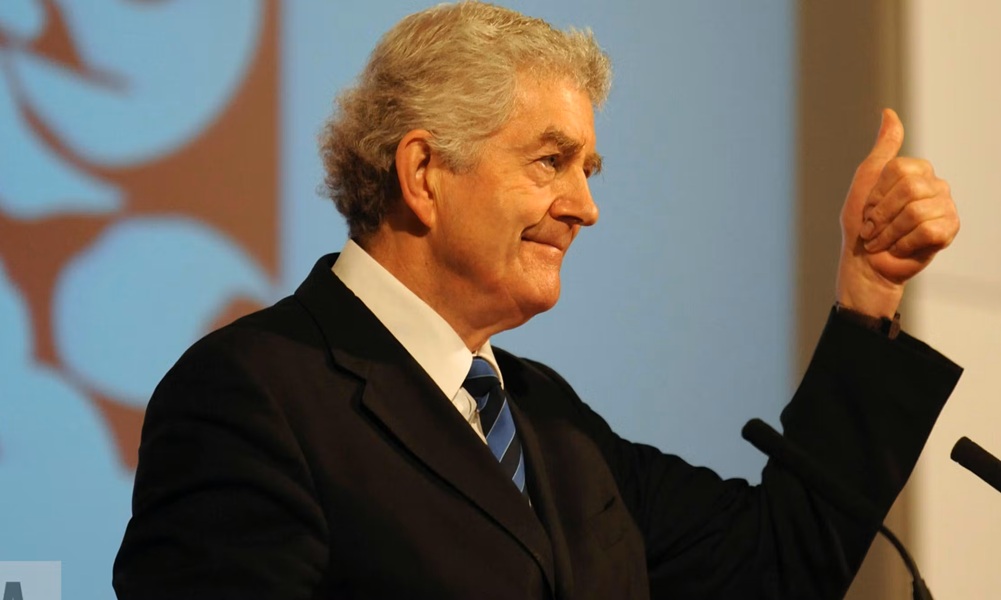
Rhodri Morgan, cast in bronze
Desmond Clifford
The devolution era of Welsh politics unveils its first statue outside the Senedd this week: Rhodri Morgan, cast in bronze.
Rhodri is the outstanding figure of Welsh politics so far this century. There’s a case for saying he saved devolution from withering on the vine at a time of fragility and uncertainty.
Only those who begrudge devolution itself will begrudge Rhodri Morgan its first statue.
A century ago, the Edwardians erected numerous statues of statesmen, barons, bishops, industrialists, philanthropists, generals and politicians. Their stones still stand, eroded by time, some forgotten and casting obscure shadows.
Some of those statues are embarrassing now. Slaver Edward Colston was famously toppled into Bristol harbour. Sir Thomas Picton in Cardiff City Hall has been boxed off (ludicrously) with plywood for some years. Denbigh voted to keep its statue of HM Stanley (“Dr Livingstone, I presume?”) after a public debate and local vote.
Contemporary Wales has revived statue mania. New icons are unveiled at a rate not seen since the height of Empire. Just the other week, campaigner Elizabeth Andrews was unveiled in Rhondda Heritage Park, the latest – for now – of the Monumental Welsh Women.
A few years back “Codebreakers” was unveiled in Cardiff – Billy Boston, Clive Sullivan and Gus Risman – black rugby union players who switched to the professional rugby league game. Max Boyce had the rare accolade of attending his own statue’s unveiling in Glynneath; unusual because statue convention rarely commissions the living.
What do our new statues tell us? We live in a period of rapid change in our collective sense of Wales. Statues preserve memory of individuals, but they also tell us about values, what society wants to celebrate and be inspired by.
A hundred years ago, this was Empire and the privilege – as many then thought – of sharing Britain’s imperial destiny.
The statues of our age promote values of modern Wales. Aneurin Bevan has top spot in the centre of Cardiff, and few argue with that. Headteacher Betty Campbell has a good place near Cardiff train station.
In place of imperial virtues, modern statues represent equality, service over wealth, humanity over conquest, diligence over status.
Rhodri Morgan’s statue recognises the age of devolution. He will occupy a position on the Senedd estate in Cardiff Bay which, I guess, will become equivalent to Parliament Square in Westminster.
On this theme, I’d suggest to Cardiff and Senedd authorities that the Mahatma Gandhi statue in Cardiff Bay, currently perched bizarrely and disrespectfully on the corner of a traffic island, should be relocated to the Senedd estate.
Parliament Square in Westminster places leading British figures – Churchill, Lloyd George, Disraeli etc – alongside significant global figures like Gandhi, Lincoln and Mandela (with Millicent Fawcett added recently to mask an obvious embarrassment).
There are few parliaments in the world that would be prepared to share space with “foreign” figures in this way and the mix indicates an admirable generosity of spirit.
In Cardiff Bay Rhodri will now stand forever, dispensing irony from beyond the grave. He thought the Bay development was a Tory folly and he opposed it tooth and nail.
He also opposed the new Senedd building and, if it had been left to Rhodri, it might never have been built. He proposed an extension over the car park of Ty Hywel in preference to the Richard Rogers landmark. Happily, he was outvoted by his colleagues.
Cardiff Bay Barrage Bill
The UK Parliament’s late-night debates on the Cardiff Bay Barrage Bill in the early 1990s occupied a big space in Welsh political journalism. Rhodri Morgan and Alun Michael were on opposite sides.
The Bay fell inside Alun’s constituency, so he was in favour; Rhodri’s constituency lay next door and it galled that Britain’s largest urban regeneration project brought billions to Cardiff South but nothing to Cardiff West.
Rhodri and Alun later served side by side in the first Welsh Government Cabinet in 1999. Alun was the first First Minister, but Rhodri had only to bide his time. Within months Alun was ousted and Rhodri began his decade as First Minister.
Rhodri inherited a demoralised, feeble institution but from the outset he cultivated a sense of conviction and pride. By force of personality, he persuaded the Welsh public of devolution’s merit.
Tony Blair had an inexplicable vendetta against Rhodri and tried hard to frustrate his political career. To his credit Rhodri was remarkably gracious towards Blair in person but, politically, he owed Blair nothing and pursued robustly independent government. Rhodri put the word “Welsh” into Welsh Labour, and it stayed there for 25 years.
Economic boom
It was Rhodri’s great good fortune to govern through a prolonged economic boom. Money poured into the Treasury and the early Welsh Governments were rarely circumscribed by lack of it.
Rhodri abolished the WDA and absorbed its functions into the Welsh Government. The WDA had lost energy and failed to adapt to devolution, but it wasn’t obvious that the civil service was better placed to do the work.
A better long-term solution might have been to end the WDA in its previous form and to develop a Mark II version, slimmer and managed differently – effectively what Plaid Cymru is now doing.
Other quangos were abolished and brought into the Welsh Government too. This resulted in the civil service becoming too big too quickly – bloated even – and harder to manage.
Abolishing the pre-devolution quangos should have been planned more carefully and accompanied by major civil service reform, but this never happened. Instead, the larger civil service got sludgy and lost focus, which it has struggled to regain ever since.
Rhodri was outward-looking and an internationalist. In Brussels, he was expert and a big hitter on the European regional scene. He established many of the relationships the Welsh Government still cultivates: Ireland, Catalonia, Brittany, Silesia among others.
He prioritised promoting Wales abroad and was extraordinarily good at it. It was Rhodri who established the Wales for Africa programme, which still pre-occupies the Senedd today.
Rhodri responded to the generous instincts of Welsh civil society and the simple belief that rich countries should help poor ones (i) because it’s morally right (ii) helping communities generate prosperity is the best way to avoid societal collapse and mass migration.
Rhodri conceived of Wales with an international personality, which the nation’s First Minister is best placed to represent.
‘Soft nationalism’
Rhodri promoted a brand of “soft nationalism”. As First Minister, he leaned into Wales politically in ways which inhibited support for Plaid Cymru. That strategy served Welsh Labour very well until recently.
For Rhodri, it was more than mere tactic. He became more nationalistic as First Minister and grew sensitive, on the country’s behalf, to sneer or condescension aimed at Wales from London or anywhere else.
In 2007 he showed real courage in facing down Trad Labour’s snarling grandees to form a coalition with Plaid Cymru. Rhodri was right; the coalition was Wales’ best government to date.
Only a tiny number of people knew Rhodri well, and I wasn’t one of them. I was in another bucket of people who knew him for a long time and saw plenty of him without ever getting closer or more distant.
He had a genius for recall: names, dates, facts, history, sport, jokes, quirks. If you knew something he didn’t, he would lock onto your brain like a character from a science fiction novel and suck out the contents. Three weeks later you’d hear him relate as his own things he’d gleaned from you.
Just occasionally, he could make something up. Taciturn moods were rare but not unknown. Normally his conversation flowed like a river in full torrent and his store of knowledge and anecdote was without compare.
Detached
When he became First Minister in 2000, tv cameras captured spontaneous ripples of applause as he arrived on the terraces at Pontypridd for a rugby match. When he left office in 2009, his personal ratings were through the roof, way ahead of Labour, from which some felt he’d become somewhat detached.
In semi-retirement, he penned a column for the Western Mail under the title “Mr Wales” – a moniker which would have been ridiculous attached to anyone else.
I hope we don’t go statue-crazy with Senedd luminaries, but Rhodri won’t stand alone forever. There’s a Ron Davies claim as the architect of devolution which will need to be addressed one day.
Perhaps there are people sitting in the Senedd today whose claim will be manifest in years to come.
For now, it’s fitting that Rhodri is first and that his vivid spirit will stand guard at the democracy he helped build and embed.
Support our Nation today
For the price of a cup of coffee a month you can help us create an independent, not-for-profit, national news service for the people of Wales, by the people of Wales.
Get more trusted Welsh news
Choose Nation.Cymru as a preferred source in Google News to see more of our journalism.



Excellent article Des. More praising with faint damnation than the opposite but spot on as usual.
Quote: “The principal architect of Welsh devolution is former Labour Secretary of State for Wales, Ron Davies. As the key figure behind the Government of Wales Act 1998, he successfully steered the legislation through parliament that established the National Assembly for Wales (now known as Senedd Cymru).”
“The outstanding figure of Welsh politics so far this century”…..sorry but this is a risible claim. Rhodri Morgan couldnt even bring himself to condemn Tony Blair’s illegal war in Iraq in 2003, and even 3 years later he was still sitting on the fence on the issue
http://news.bbc.co.uk/1/hi/wales/4675922.stm
Who decides these things without consultation. No one asked me. Did anyone ask you? Who decided to spend our money on a bronze statue?
I’m no fan of Labour, but at least Rhodri Morgan fought tirelessly for devolution and as First Minister for Wales , this cannot be said of today’s Labour party and our so-called MSs & MPs who have consistently put party over country.
I should clarify for information that the statue is funded by private donations, not public money.