


Saisplaining: Let Welsh people speak
Stephen Price
Earlier this month, Nation Cymru published one of the most heartfelt, honest opinion pieces regarding the housing crisis facing people from Wales I’ve ever read.
The piece from June Slater was an update on her so-far-fruitless aim to buy a rural property in her homeland.
Reading it at 7am one weekday morning ahead of its publication, my blood ran cold, and for the rest of the morning June’s words stayed with me, along with a deep sadness.
Echoing my experiences of west Wales in particular, June shared: “I’ve been struck by the fact that in rural west- and mid-Wales I come across surprisingly few Welsh people—to the extent that I’ve sometimes found myself wondering where all the Welsh people have gone!”
She added: “A smallholding next to a friend—himself a recently-arrived Englishman—has just been acquired by someone from Hertfordshire, who bought it off people from Yorkshire, to add to the other people from Birmingham, Suffolk and London who’ve moved to the small valley in question.”
Her personal observations reflect recent data, showing that between 2020 and 2022, according to Compare My Move, there was an increase of 27.9% in people moving from England to Wales. Almost half (47.4%) of those who moved to Wales cited a lifestyle choice, and 26.3% did so for their retirement.
She wrote: “If these trends in Wales continue, it seems likely that in a couple of decades’ time those who identify only as Welsh will end up being a minority in their own country. I can’t see many other small countries thinking this is a good thing, but there’s precious little that can be done about it unless and until Wales gains independence, something that’s probably becoming less and less likely as the English population of Wales grows.”
A brave piece, littered with caveat after caveat to tread carefully, to not offend her English loved ones, primed for her very real, very common experience to be torn apart by the (135 and counting) wolves of Facebook alone.
Here are just some of the comments that befell what I thought was one of the most important pieces we’ve published this year, if ever:
“So all immigrants welcome in Wales except English ones ?? Comedy fking gold”
“My question is “Who sold these houses in the beginning?””
“What about the thousands of Welsh who have left Wales and are living abroad, including my son and four of my friends children who have now made their homes in other countries.”
And the obligatory, we were pushed out of Bristol by Londoners, it’s no different anywhere else in the UK…
Or my favourite: “We are not immigrants we live on the same land, BRITAIN, as such we can go anywhere in the UK to settle
“You fkin Welsh carry the biggest chip on a shoulder I’ve ever come across.
“Let’s kick all the Welsh outa England back to no jobs, no money and no hope.”
Please, name me a country where Welsh migrants make up 50% of a county in another land.
And time and time again, the whataboutery of England’s population (some might say immigration) crisis forgets that Wales is not England. Moving to another country is not the same as moving elsewhere in your own land.
Any post such as this will also attract a lot of the ‘if they learn Welsh it’s fine’ arguments too, but doesn’t this overlook the fact that one can be and is, in fact, Welsh without speaking Welsh? We are a people with two, or more, tongues.
If a young couple from Blaenafon or Wrecsam who speak English, whose family have lived in the area going back centuries, lose out on a home in their square mile, is it better if an English person with Duolingo buys it instead?
The social media responses could have been written by an AI bot such is their predictability, but one thing each response overlooks time and time again is the root cause, the root problem: Wales not being an independent nation.
A nation at the whim of the land next door that has waged war upon its people for over 1,000 years. And our land and property, just as our resources have been for centuries, are there for England’s whim and taking.
With Wales facing immigration from another country (England), that relatively few English counties have seen percentage-wise, where do we go? Especially when so many of us really are quite happy where we are.
We suffocate slowly, in spirals of debt, paying inflated prices set for the Rightmove scroll of incomers, or accept that getting onto the ‘property ladder’ (ych!) is simply not for us. In our own villages, towns and cities.
Lloyd Warburton shared some *interesting* statistics on X earlier this week:
I’ve been looking at some 2021 census figures for Ceredigion lately.
Total born outside Wales: 45.6%
People aged 65+: 52.0%
People who consider themselves to be disabled under Equality Act: 55.7%
People in ‘bad’ or ‘very bad’ health: 59.1%This is under-discussed. There is much…
— Lloyd Warburton🏴🇺🇦 (@LloydCymru) December 8, 2025
He added: “This is under-discussed. There is much talk in parts of England about the impact of immigration on health services. In Ceredigion we’ve been living with it for years, yet much discussion of it is shut down as ‘anti-English racism’.
“If anything, the impact on Ceredigion is much more pronounced than in English cities. Much of the immigration into England is younger, working-age people. In Ceredigion, a much larger chunk of those incomers are elderly and in worse health. Our services are not designed for this.
“I’m not sure if anyone has misread this, but just for the avoidance of doubt, the percentages above are the percentage within each group who were born outside Wales, for example, 59.1% of the people in Ceredigion in bad or very bad health were born outside Wales, compared to 45.6% of the county’s population being born outside Wales.”
How anti-English to state facts.
From my own experience with articles such as June’s I’ve found that an English audience simply cannot handle just swallowing a fact. This is our experience. End of. It has to be argued with, we have to be called out and corrected, and we have to be told what for.
I’ve lived in my few square miles for most of my life, with detours to Swansea and Cardiff for studies, but lived in Ceredigion briefly, and my expectation of communities similar to my own, and Welsh speaking ones at that, were thwarted at the gate.
After a series of viewings with a Brummie agent, the terraced house I lived in (that went to sealed bids in a hot post-Covid market hell of buying in Wales back then) had countless empty homes nearby, and the two (very nice, might I add, just as June did) neighbours who took the time to chat were from England.
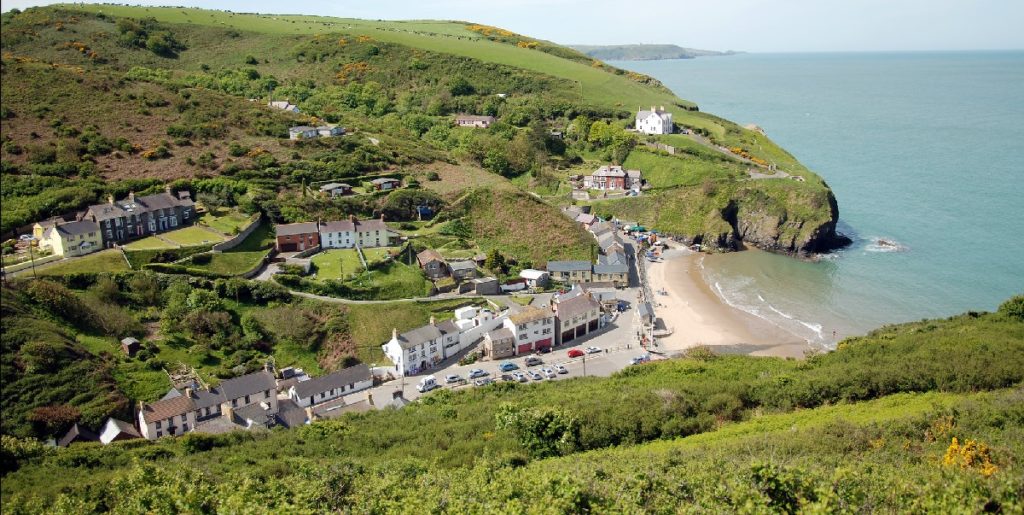
Like my first visit to Llangrannog as a school child, the media’s portrayal of the area as a Welsh-speaking heartland rang hollow.
Generally, it felt cold, isolated, unwelcoming, at odds with my first trip back ‘home’ to the valleys, and a walk around Bryn Bach Park where I chatted to more people, and received more warmth, in ten minutes than I did in months in Ceredigion.
And the situation is complex, of course – I’ve seen houses out west linger on the market for durations that would be unthinkable in the south east.
It’s not simply a case of ‘if it’s priced lower it will sell to locals’. These hollowed-out communities with diminishing facilities and job opportunities are no-go-zones for many of our younger people.
But why is that? And why is nothing being done about it?
Extractive economics defines Wales’ makeup at every level. Perhaps, just perhaps, if we were independent we might be able to address Wales’ problems with a Wales-led approach.
Perhaps, even, the people in control might care. Imagine that!
And it’s not just the farmhouse, detached or new-build either. It’s the council flats, the ex-council houses, the cheap-as-sglodion valleys terraces.
We just can’t win.
The sheltered accommodation where my dad lived in Abergavenny is now a home to more English-accented folk than Welsh. A nearby care home where I worked briefly the same: Elderly folk who retired to Wales ahead of their one-way trip to an overpriced care home, or the parents of recent English immigrants who want them close (but not too close!)…
And when we dare say, “hey, we’re losing out here…again”, the divide in the response is quite a clear one, with most people in or from England taking the “Who sold it to them in the first place?” stance. While the Welsh, unguarded and in private, meekly mention the new makeup of their own streets, and how things are changing.
Under the umbrella of ‘white’, Welsh people as an indigenous minority people or culture cease to exist, and all is fine. We can, and do, move to England. The English can, and do, move here.
But what is the solution? To keep building more and more so that, in some small token way, we at least get half a chance?
With the housing market anyone’s for the taking, if things continue this way, England’s white flight and Escape to the Country will mean Wales will only exist as a historical idea. A ‘not England’, but one shaped and led by (as many of our councils already look), you guessed it, folk from England.
To shut down conversation, too, is a privilege of the English who live here or don’t, and one the Welsh are either afraid to voice or, too-aware of the futility of complaining.
As England’s first colony, we must put up or shut up, as the reaction to June’s opinion piece demonstrated.
Welsh communities from Chepstow to Holyhead might be able to charge a little bit more for council tax on a second home, which is fantastic PR for councillors and the Senedd, but where it matters, where we are really losing, is in the simple exchange of contracts that begins on Rightmove.
The cards are held by the retired couple from Portsmouth, Manchester, Reading (it’s not always the London Bogeyman) in search of the good life, or the work-from-homer wannabe-hippy settling down in leafy Pontcanna or the Mumbles.
Hey, they might even download Duolingo or have a book on Welsh history. And then it’s fine. Like Film Cymru’s obsession with English actors in Welsh films (although strangely a Welsh lead in film about English gentry), we are most-indebted to those showing us how it should be done.
June’s piece ends with a sorrowful plea for something to be done, anything to be done. She writes: “Are such levels of English immigration into Wales—and into rural Wales in particular—sustainable if we want to see a viable Welsh culture, identity and language surviving into the future? I suspect not, but I’d be very glad indeed to be proved wrong.”
Our anthem pleads for the old language to survive, but the same rallying cry could perhaps be asked of Wales’ people.
What will it mean when we are outnumbered by a colonial superpower in our own country? Democratically, linguistically, culturally?
Can we really say we are Wales, without being by and for Wales’ people?
If Welsh people wish to vocalise their experiences of being Welsh and living in Wales, it’s for them to speak out loud without being Saisplained, without angry English folk telling us to be quiet, that they’re the victims, and that it’s all somehow our fault anyway.
As ever though, others know better than us. It’s why we can’t be an independent country, you see.
Wales has no future without independence. Not a meaningful one, anyway.
“O bydded i’r hen bobl barhau”
Oh shit, I can’t say that.
Read June Slater’s ‘The quest for a home in my homeland continued…’ here
Support our Nation today
For the price of a cup of coffee a month you can help us create an independent, not-for-profit, national news service for the people of Wales, by the people of Wales.



We need to help the Welsh people, who by dint of economic circumstance have moved away for work, and so help them return home.
https://www.citizensinformation.ie/en/returning-to-ireland/overview-of-returning-to-ireland/
What Ireland is doing is an excellent example.
Unfortunately the opportunities in England are much bigger and better. You’re looking at a 10k salary difference even between Cardiff and Bristol alone. If people leave when they’re young then they’re not even considering a return to Wales until they are much older.
According to Moneyweek you wouldn’t choose Bristol. The average salary is only about £4k higher than Cardiff and expensive housing means you’d only gain £1.2k more in disposable income. Economic migrants would be better choosing Newcastle.
https://moneyweek.com/personal-finance/average-earnings-by-region
Nah. Not in the sectors my friends and I work. 10k at least.
Then that’s a selective argument but if you mean finance Bristol, along with Edinburgh are outliers outside London for historical reasons. You won’t find those salaries in Exeter or Swindon.
Wages will be higher for white collar jobs in England. Much higher. These are the jobs that Welsh youngsters leave Wales for.
They’re in London which is where those in charge of the UK economy chose to hoard the wealth and opportunity. And you have to wonder why because the UK would be richer if like more successful economies such as Germany or the US, the wealth and opportunity was more evenly spread out
No. Bristol, Manchester etc all pay better.
Which you haven’t evidenced.
They really do though. Just look at any job site. The further east and south you go, the higher paying the work. Manchester is also a bit high, which is… uncharacteristic for the north of England but there we have it.
It’s worth noting however, that while pay is better in England, it also has a higher cost of living.
I personally find it is ‘cheaper’ to live in Wales despite not being paid as much for example, so I have more disposable income at the end of the month… or rather, less debt.
There’s not a £10k difference between Cardiff and Bristol which was Mike’s original point that I provided a link to challenge. Salaries certainly go up the closer you get to London which was my other point that the wealth and opportunities have been hoarded within the UK capital (in practice within commuting distance of the capital).
Always has been in white collar jobs I’m afraid – financial services, professional services etc. Obv you’re public sector so wouldn’t know.
Hello my freind. So you think its cheaper in wales. Wake up now!!!!! I’ve just moved here the rent is dearer the council tax is higher. The electric is through the roof prices. Your feul is higher than a city. Get real obviously you don’t pay the bills in your house.
Moved here from where? The electric is similar throughout the UK which in turn is the most expensive in Europe.
You’re making a solid point, I have thought the same thing. A lot of people now work from home, including Welsh people living in England, so they realistically could work and live in Wales. But how, is the main question, do you help them move home? The challenges are finding a home where you’re not close to, it’s harder to view homes, knowing who to call to fix any problems on the new home. You’ve moved off so you’d be practically moving into a new area even if you return home, being a bit estranged. A lot of the same… Read more »
Quite a change from the situation which I encountered when I first moved (from England!) to south-west Wales as an undergraduate student back in 1964. I studied at Lampeter, which in those days was a pretty overwhelmingly Welsh and Welsh-speaking town.
I wonder what it’s like there these days? I’ve not been back for a good many years.
I stopped at the Co-Op in Lampeter on the way on the way to Aberaeron last week. There were about a 5 or 6 people there, an old local fella said hello but everyone else had an English accent.
I have wondered, having read of an incident a few years back when a young mum in a Lampeter supermarket was berated by another woman shopper for ‘talking foreign rubbish’ because she’d been telling her toddler, in Welsh, the names of products on the shelves. Something like that would have been pretty inconceivable during my time there.
Is the Co-op still where it was in my day – on Bridge Street near the junction with Drovers Road?
Globalisation has twisted everything into impossible knots. England for the English is racist, Wales for the Welsh is not, wanting to preserve a country’s culture and language is great but sometimes when other countries do it it isn’t etc etc. A tangled web.
Need to look deeper Mike. Many who identity as English sincerely believe they are native to this island. The existence of Wales, Welsh culture and language challenges that narrative, raising awkward questions about floods of Germanic ancestors coming over here in small boats and failing to integrate. The response (in order of preference) is to ignore, belittle, assimilate and eliminate.
And now you’re going down the route of inigigenous people, we were here first etc. Your feelings towards the English are the same as theirs to others. See how easy it is…
This isn’t about Wales at all. Just look at the massively disproportionate reaction to the sight of small boats on the channel triggering deep seated and long suppressed memories of the true English back story. It needs an archeological psychologist to unpack the unresolved traumas that have created a nation so uncomfortable in its own skin its instinct has for centuries been to invade and abolish just to avoid difficult questions like what really happened that forced their ancestors to flee the Germanic motherlands? And what really happened during the dark ages? It’s baffling we know what Roman bathhouses looked… Read more »
Science suggests no one is truly native to Britain.
Everyone is African indeed but the point is about the origins of modern day attitudes that cause avoidable harm. There’s no need for anyone to “ignore, belittle, assimilate and eliminate”.
Exactly. More extreme Welsh attitudes to the English are just as bad as more extreme English attitudes to their ‘foreigners’.
I would politely suggest that one was historically defensive and one historically offensive (in the hostile sense).
Perhaps, but discrimination for things our ancestors did hundreds of years ago, or by those who hold power that many didn’t choose… is a bit disingenuous.
There are a lot of people from England who either live in Wales and/or support Wales who would be happy to see Wales have more powers, more funding, more prosperity. It’s the same with Scotland, the biggest proponents of Scottish independence were actually the English.
Except the same attitudes persist on a defensive vs offensive basis. There are still folks who seriously want to abolish Wales. Why should anyone take that on the chin. Of course it’s not everyone but plenty also live here and support abolishment. They get angry when Wales does things differently as we saw in Covid. They get angry at bilingual letters, S4C and adopting the proper names for national parks. They point their TV aerials to Bristol. Pretending otherwise is just another way to support abolishment.
And one more thing. Can you imagine this happening anywhere else. Can you imagine an American moving to Canada and campaigning for it to become the 51st state or cheering when Trump engages in economic bullying. Or a Texan moving to Louisiana and joining an Abolish Louisiana party seeking to have it annexed by Texas. Or a Flemish Belgian moving to Wallonia and objecting to them teaching French in schools. It doesn’t happen because it’s not normal human behaviour. Yet it’s normalised here. And if some odd folks tried it, the others adoptees would soon stand up to defend their… Read more »
Probably not. Nobody is native to the entire American continent either, would you be completely comfortable saying that to the people who believe they are?
Yep, because that’s what the science says.
Of course that’s not to say I don’t understand the rights of the people that were there before. No one should be kicked out of their homes, raped, murdered etc. However, that’s no reason to discriminate against the seventh or eighth generation descendants who had zero say in the matter.
This same argument for me, holds for refugees and migrants. Shut the borders sure, but there’s no need to discriminate against those already here and contributing to society.
I don’t agree with Mike very often… but here we are.
Ban AirBnbs, they hollow out comunities
As for Costa Geriatricas, Plaid need to push for Barnet Formula increase to reflect high numbers of English oldies
Ceredigion – very English, very sad
Barnett isn’t fit for purpose. Joel Barnett himself said it was a temporary measure, here we are 47 years later, stuck with it.
The SNP seem pretty happy with it and Plaid wouldn’t want to upset them.
Everyone needs a home. The problem is not that Wales is not independent but that housing is dominated by finance, big developers and landlords, who between them have restricted supply and inflated prices.
So build more government housing that anyone can rent or lease. Simply fighting big finance, big developers and private landlords will just reduce the number of available homes, pushing up prices further.
Yes. That is exactly what is needed. 150 years of experience shows that the private sector will not do it. That requires breaking the.power of those with vested interests in the current crisis.
and… where are you building this housing? They can barely put up a wind turbine without someone complaining.
You fund local authorities to build more housing and let them decide where they put it.
I am a bit reluctant to tow the line of “Well were you born here?”, that kind of exclusionary language is not what I’ve found to be welsh to mean. It’s actually the same thing we criticize England for.
You just need to exchange a few words… Welsh for English, English for Muslim and you’ve got something out of Yaxley-Lennon’s playbook.
“They come over here, take our jobs, take our homes, take our girls, overload the NHS, take our benefits…”
How long before we start chanting “Save our kids”, “Stop the boats” and frothing at the mouth?
There’s a world of difference between the Welsh position (anti-colonialism) and the “Stop the boats” protests in Kent. Bear in mind that a Westminster Government could legally reverse its position and stop the boats the following morning; the housing market free-for-all and Wales’ lack of independence means that Wales is powerless to prevent large-scale demographic change of the kind discussed in this article.
Nah, it’s exactly the same thing. Nothing wrong with a country wanting to preserve language and culture etc but it’s the hypocrisy of it all. It’s fine for Wales to do it, but not England or the US etc. It’s just a rather nuanced issue.
The problem is the english don’t really know what their culture is, or who they are; they define themselves by who they are not (as do many post -colonial societies). So they look down on not only the Cymry, but also the Scots, the Irish, the Indians and Pakistanis, in fact almost everyone who isn’t them. In my experience, very few english in Cymru have any awareness of the history, language and culture of the place (ask them who Dic Penderyn was and see the blank looks); they think of it as another county of england, where the locals talk… Read more »
No, mate, They’re very different issues, for the reasons I’ve explained. Don’t pretend that the hollowing out of small rural Welsh-speaking communities is the same as a people trafficking on the Kent coast.
Personally, I have no issue with English patriotism; in fact, I think it should be encouraged. The real issue is that England and the United Kingdom are often treated as if they are synonymous. Think of the Dad’s Army theme song, or the footage from the 1966 World Cup final, where England fans were flying Union Jacks rather than the Cross of St George. The British national anthem is still sung at England matches, and Westminster wears two hats at once, acting as both the UK and English Parliament. I remember going to school in England in the 90s where,… Read more »
Agree blaming all incomers is wrong, but most visitors, weekenders and incomers are here because they feel the call to be here, and we have plenty of room for all. Hiraeth is not exclusively for y Bro Cymraeg. Welshness can be acquired. The problem is lack of housing, jobs, infrastructure, and air bnbs, absentee owners and unwillingness to join in on the part of a minority of incomers
Make sure you toe the line before you tow it, you wouldn’t want to get tangled up.
Just walked past a big group of people wearing Clwb Rygbi Llandysul hats… A lot of them English and none of them speaking Welsh (locals or blow-ins). Doesn’t bode well.
Swop English for ‘foreign’ and Welsh for ‘English’ in that sentence and you can see how complex the issue is…
Yes. The world is a complex place.
Precisely.
Valid points in the article; but some of this is self inflicted. 11,000 affordable homes in West Wales stuck in the planning system whilst Welsh Government and NRW spend years to organise committees and “reviews” on nutrient levels. Meanwhile youngsters leave.
The glacial planning system is a huge huge problem in Wales and the UK. Needs to be a priority for whoever wins in May.
There is outline planning permission for 20,000 yet to be built homes in Cardiff alone. The big developers have deliberately slowed delivery to keep prices and rents high.
True, but we also don’t have enough planners in local government to get things through. Add regulations etc on top and you have a ponderous situation.
Agreed that there are too few planners and that the system can be rationalised. But regulations are needed on matters like fire safety and protection of natural resources. Land banking by developers should be heavily taxed to raise money for council housing.
If I could have found a job that paid me anywhere near as well as I did in Swansea I’d have stayed in Ceredigion I miss it so much.
How much power the Senedd has in this department is debatable. So it’s a difficult issue to solve now. However, what could be done could be something like what the immigration service in the UK, as a whole, currently does – create entry requirements that have to be met to live in Cymru. An ability to speak Welsh and an understanding of Welsh culture and history. To keep these aspects alive – more important than in the bigger population of England. Obviously, as an independent country we could do this without delay – so the quicker we gain independence the… Read more »
“They don’t even know how to speak Welsh or understand our culture” is really no different to “They don’t even know how to speak English or understand our culture”. Complicated times.
What nonsense. 80% of the people of Wales do not speak Welsh.
Exactly.
We recently put our terraced valley’s house up for sale. We were inundated with English and some foreign developers. It was shocking that they had first pickings. I asked and made notes and we made a decision on a slightly lower offer which allowed the only local resident who came, to buy it. We were even offered higher after this but refused. We have little money but felt we had to keep to our principles even if it hurt.
Interesting. Which valley? I think a lot of people assume it’s still like 1990s where you could go months without hearing an English person but it hasn’t been like that for about 20 odd years now.
Just another point. Some time ago I wrote to the Plaid leader about the fact and sadness that every business owner I came across has an English accent and most business owners are English and where are the Welsh and our beautiful accents in Wales. He wrote back with a lack of interest and a PR answer.
He knows he’d be crucified for saying anything. I didn’t agree with all of Leanne Wood’s poltics but she was unashamedly “one of us”. My local Plaid candidates seem very self-conscious about appearing “too Welsh”. We act like a defeated people.
Really, I’ve just raised the same point, the empty shops are there, is it a question of asymmetrical funding, age, intention, semi-retirement or beginning a life in retail. Or a portion of the population with a disposable income, over and above the breadline. Sometimes all people want are a bag of humbugs, there appears to be a hair fetish among men and boys. Nail art is doing well while the tattoo parlor has slowed. Bread has become very sour or positively poisonous…unless you visit our own Llasa… Good luck to anyone who starts a business in Gwynedd.
So what do you want? Housing is cheaper in Wales than in most of England, so that’s not the problem. English people moving to Wales, and presumably bringing their money with them, is surely better than empty houses. Should welsh people be banned from leaving Wales? 🤔 Is it lack of jobs in Wales that causes the exodus of young Welsh people? Who’s responsible for that? Do you want the beauty of Wales transformed into an industrial landscape. Perhaps the mines and steel works need to re-open? You call English “blow ins” colonialists. But without them the Welsh towns and… Read more »
Good points. I also think the picture lets the side down somewhat. Falling into unfortunate stereotyping.
Are you saying there are better ways to support Welsh culture (please share) or to give up and accept an inevitable future as a county of England?
And you’ve missed the point. Are people uncomfortable because they support supporting Welsh culture but not the way it’s being done, or because Welsh culture exists at all.
It would help if there were more/better quality services, like public transport, healthcare and utilities. As it is most people who were born in Wales think of it as a dead end by the time they’re 18.
I doubt we would be having this discussion if Councils had the funding to build new Council houses for rent in their areas. So called ‘affordable housing’ for sale tacked on to reluctant property deveoper plans are anything but.
The Wales Act limit on Welsh Government, and hence local authority, borrowing for capital expenditure (which creates assets that offset debt) is a serious constraint. Only a mass programme of public home building can solve the housing crisis.
No need to abolish capitalism either. In the freemarketeer’s dreamland of Singapore, 80% of residential properties are owned by the state.
Yes that’s true. But in Britain financiers, landowners and developers have acquired substantial economic and political power over the past half century, which will have to be broken to open the way for a large programme of council and social housing.
It’s political will that’s the problem, not those playing the ball where it lies. What needs to be challenged is a cult ideology that wrongly believes that ever-smaller-government is the only route to economic success. I recently heard a Tory say without any hint of irony that the only way to compete with China is by shrinking the state. The same China that only achieved this success by unprecedented government intervention surely proves beyond all doubt that government isn’t a fundamental barrier to economic success. The left is just as responsible for this situation because they justify the cultists position… Read more »
I agree with a lot of this. Just a couple of points.
The small state cult is driven by real interests of wealth and power that have to be confronted. Class war is real and continuous.
A 50/50 private/government split looks artificial. It should depend on what benefits ordinary people. We also need space for structures such as worker or community owned business, or cooperatives.
To confront it means understanding where it came from, and the answer to that is empire when wealth and power were accrued and hoarded by immoral means, through theft and exploitation. That wealth and power has defended itself with false narratives that turned into cult mantras that are simply wrong. Liz Truss not only proved this with an obviously bonkers economic plan, she also revealed the party and the membership also believed it, revealing that they are fundamentally clueless about running a modern economy when they can’t get rich through simple exploitation and theft. The 50/50 split is essential to… Read more »
I agree with increasing the role of the public sector. But I’m not in favour of fetishising any economic statistic, whether it be deficit/debt ratios or the public-private split, an artefact of doubtful validity. Doing so always leads to constrained decisions and poor results.
How you measure something is separate to agreeing a fundamental principle. The 45% figure is based on government spending as a share of GDP which indeed is debatable, from the point of view of what counts as government spending, whether this is a good measure of the size of the public sector, and of course the whole concept and value of GDP. But these are internationally accepted measures. They are better than nothing at all, and in the absence of respected and accepted alternatives, they are all that we can use. Do you have an alternative but similarly respected and… Read more »
There are varying recognised relevant measurements. ONS stats for the UK show that government consumption plus government investment totals less than a quarter of GDP whereas private consumption is around 60% and business investment around 20% (the total slightly exceeds 100% because of the trade deficit). The 45% figure includes transfer payments, for which government acts as a redistributive intermediary but does not itself consume.
The case for bringing water, rail, etc. back into public ownership or for building council homes stands on its own merits.
Quote from Article above says it all:
“Wales has no future without independence. Not a meaningful one, anyway.”
Sorry but that says nothing. Explain how an independent Wales would build the homes our people need.
We’d probably use bricks, machinery, builders etc.
Indeed. But how would independence allow us to overcome today’s constraints? It might allow us to break through artificial fiscal limits that hinder public building but that is a question of political will more than constitutional formality.
Free of english domination and able to set our own financial rules, councils here could, for example, buy acres of land at agricultural prices, then give themselves planning permission for housing on that land. This would massively increase the value of that land and boost the council’s wealth by millions, and make it easier for them to borrow the money for house building. Having built the houses, the fair rents paid over the life of the houses would cover the cost of the build.
I agree with what you want to achieve but it would not be guaranteed by independence. Nor does it require waiting until independence, a distant prospect. We face a housing crisis here and now that could be fixed within the UK if the political will existed, although greater powers for Wales could help.
Of course. I grew up in a post-war new town with wonderful schools and good quality houses (Parker-Morris standards). Our school even had its own swimming pool. That was all done in the early fifties when the UK was flat broke after the war, so why can’t we do it now? I just think we would be better off free of the sclerotic english political system, full of self-styled pundits who smugly assure us that “the markets” won’t stand for it, or that people won’t vote for a party that instigates policies that might threaten the value of your house.… Read more »
…and having built houses on prime agricultural land, how would you feed the people living in those houses? By importing food from England?
Am I suggesting that all agricultural land be built on? Or even a noticeable percentage of it? I get so tired of reductio ad absurdam arguments from those who fail to think before posting. Go away and look up the acreage of farmland in Cymru, then the number of houses needed, then look up the acreage needed for those houses. When you have facts in place of ignorance, get back to us. Incidentally, land in Cymru can be much more productive if we got rid of sheep, so if you don’t want food imports you should be advocating that.
Stop. You are asking questions they cannot answer…
When they stop refurbishing the holiday lets builders will have more time…
In some locations that might indeed help but only if builders are then productively employed on affordable homes.
It’s a dog’s dinner at present with a choice of direction in the future, that one is on the table is almost beyond belief but rationally so was Brexit…
Let’s get one thing straight: There is no way on God’s earth to prevent English people from moving into Wales. Similarly there is a whiff of hypocrisy in saying Wales welcomes all immigrants – except English. Nor will Wales be saved by an independence referendum – not if you wish Flintshire & Monmouthshire to remain in your state. Instead of the hopeless task of keeping people out we should move to the only feasible option – keeping people (i.e. young people) IN. The only way to do that is to offer them affordable housing slanted towards people born or already… Read more »
Predictably you’ve received some down-ticks, but I suspect that you’re at least in part wholly correct. Not only in respect of those ‘good jobs’ which are lamentably considerably absent in most rural areas, but also because inevitably there are parts of what is officially and formally Wales in which the majority of locals don’t see themselves as particularly Welsh. Like you, I’d cite Monmouthshire and Flintshire; Monmouthshire which for long had the sort of ambiguous status of being ‘semi-appended’ to Wales – within my lifetime the official legal terminology of ‘Wales and Monmouthshire’ was still in use – where, in… Read more »
Walk into a pub in Monmouthshire or Flintshire on an international match day and the locals will mostly be cheering on the team in red and whoever is playing against the team in white. If Wales were to vote for independence then I have no doubt that the No voters would be very disappointed, but that doesn’t necessarily mean they would want to join someone else’s country. I cannot imagine the late Eddie Butler, or Gary Speed (both sadly no longer with us) from Monmouth and Flintshire respectively would want to join England.
I always thought sell ‘Monmouthshire’ and spend the money on Cymru…
Unfortunately the Welsh have always blended into other cultures without much fuss and their contribution is never appreciated. As such we tend not to make a fuss when we ourselves face oblivion in our own country. We are forever welcoming while facing our own destruction. When the percentage of those living in Wales but born outside of Wales goes above 50% you can kiss goodbye to any hope of independant Wales and we will exist only by name. Sad times indeed. But hey, Nadolig Llawen everyone, and welcome to Reform Wales. They’ll probably round up the Welsh speakers in May… Read more »
I’m probably a bit of an odd one, I grew up in Wales with English parents but I speak Welsh conversationally and have a Welsh girlfriend. I haven’t lived in England, but I agree there needs to be more done to retain and attract younger Welsh speakers to the area and keep Welsh people in Wales, rather than have them all replaced by English retirees. Borth felt like a nursing home at times. Culturally I consider myself more Welsh and have a Welsh grandfather; I grew up in rural Ceredigion and it really isn’t a place for young people. Aberystwyth,… Read more »
Point of information: I know Bronant , the school is still open, but Llanilar closed due to the lack of school aged children some years ago.
After much personal wrangling over my feelings on migration over the years, I came to the conclusion that it’s entirely reasonable to like and respect individual people on a case by case basis, wherever they are and wherever they’re from, and at once dislike general demographic trends.
If the Welsh had anything intelligent to say, then great!
Unfortunately being, mostly, labour voters, their opinion is worthless.
Fancy renaming the Brecon Beacons and Snowdonia when that’s what they’ve been called for many years.
Crazy, but that’s the Welsh.
You don’t sound like a winner.
They were not “re-named”.
Their names were restored, not renamed.
You sound like the type who only moves here for a cheaper house, then immediately puts up an english flag in the garden in order to show everyone what an individualist you are. Everyone then ignores you, and you are reduced to trolling on here. I suggest you go down to your local pub and let them, in a loud voice, have the benefit of your opinions on the Cymru.