


Securing ethical investment in the arms industry is a tough ask, but if Adam Price can pull it off, it may be his finest political achievement
Martin Shipton
Britain’s last attempt to have an “ethical” foreign policy ended in both tragedy and farce, and there is good reason to be sceptical about how the Plaid Cymru government’s promise of an ethical arms industry in Wales will play out.
When Labour won a landslide general election in 1997 following 18 years of Conservative government, Robin Cook was appointed Foreign Secretary.
He quickly stated: “Our foreign policy must have an ethical dimension and must support the demands of other peoples for the democratic rights on which we insist for ourselves.
“The Labour government will put human rights at the heart of our foreign policy.”
As many observers had predicted, delivering such change was nowhere near as easy as announcing it.
Inevitably, it led to international tensions. In one familiar and relatively low-key incident, Israel’s Prime Minister Benjamin Netanyahu (yes, he has been around a long time) pulled out of a dinner with Cook after Cook complained about the expansion of Israeli settlements.
Cook was demoted to Leader of the House in 2001, after which little was heard about an ethical foreign policy.
Two years later, Blair took Britain to war in Iraq, enthusiastically signing up to a US-led quagmire that resulted in the loss of hundreds of thousands of lives. There was no United Nations mandate for the invasion, the excuse for which – that Iraqi dictator Saddam Hussein was planning to attack UK interests with weapons of mass destruction – was bogus.
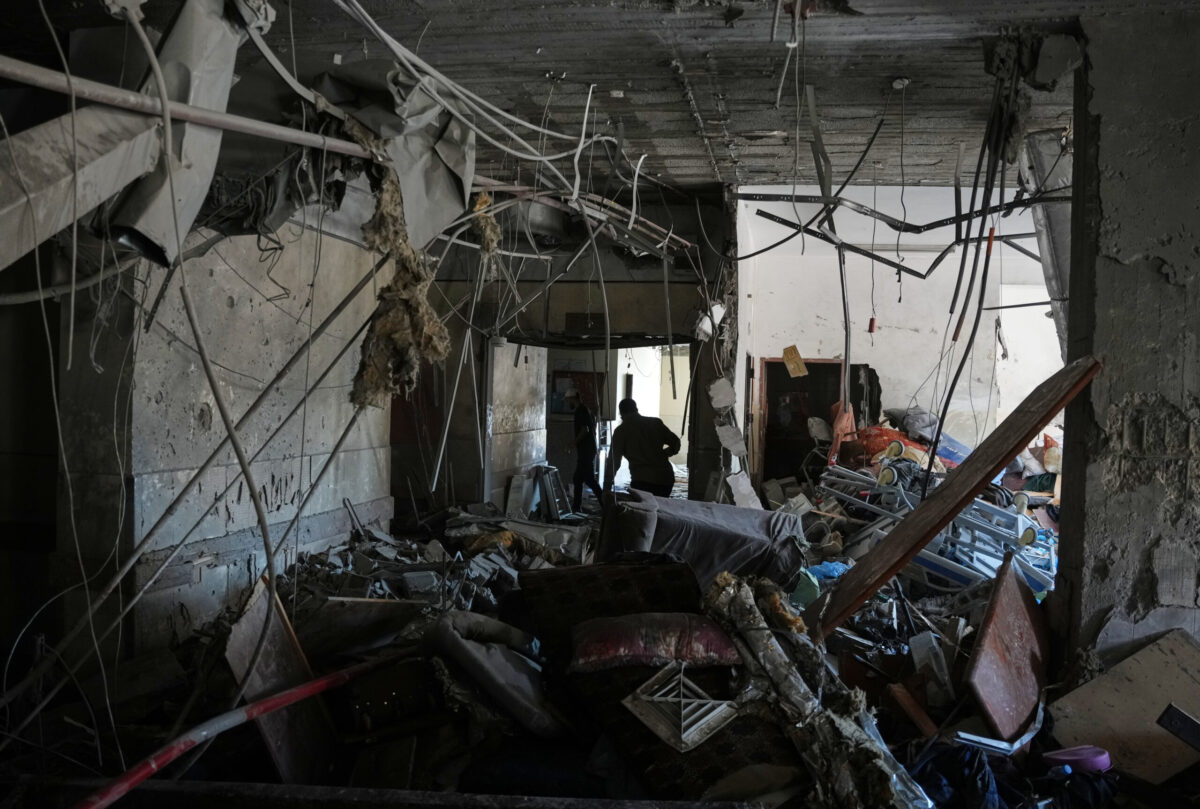
Fast forward to the present, when we have been witnesses to what the International Court of Justice has stated can plausibly be described as a genocide.
Recent atrocities in Gaza and Yemen form the basis of Andrew Feinstein’s new book Making a Killing: How the West Profits from Slaughter in Gaza and Yemen.
Feinstein is a former ANC MP in South Africa who exposed corruption in his own party and then moved to the UK, where he runs a non-profit news agency called Shadow World Investigations.
Together with colleagues from his company, Feinstein has investigated the extremely murky industry, riddled with corruption on a grand scale, that the Welsh Government intends to create an ethical framework for.
The book is packed with excellently sourced revelations about the involvement of well-known companies in corrupt weapons deals for decades. Governments, including that of the UK, do not emerge from the story with credit.
Since 2015, the UK has licensed at least £500m worth of military exports to Israel.
There are also a number of additional open licences in place that the government does not publicly report on, so the figure is likely to be much higher.
Even though the government has suspended a small number of arms licences, there are still hundreds remaining.
The UK provides approximately 15% of the components in the F-35 fighter jets which are used in airstrikes across the occupied Palestinian territory.
These include the rear fuselage and active interceptor system, ejector seats, aircraft tyres, the refuelling probe, the laser targeting system and the fan propulsion system.
The UK Government has said it only supplies these parts to Israel indirectly, via a global programme led by the US company Lockheed Martin. The UK is a programme partner and supplies parts produced by BAE Systems and other companies.
The UK Government claims this global supply chain means that parts cannot be tracked. This is untrue. The legal obligation to stop supplying parts that risk being used to violate international law would apply regardless.
The UK also produces components for Israeli armed and surveillance drones. The parts are made by UK-linked companies and then assembled in Israeli factories. These drones are ever-present above Gaza and the West Bank, used both for spying missions and in attacks on civilians.
Intelligence
The UK military provides intelligence from spy flights over Gaza and the West Bank to enable Israeli military operations. The UK also allows the US to use UK military bases on Cyprus to do the same, which facilitates Israeli attacks on Palestinians.
The UK also trains Israeli military personnel in Britain, but the government keeps details of these missions secret.
In an attempt to provide assurance that due diligence is undertaken to ensure that weapons do not get into “the wrong hands”, UK companies wanting to export military goods to another nation need to apply for a government licence first.
A licence shouldn’t be granted, or should be revoked, if there’s a clear risk that the country receiving the arms could use them to violate human rights or international law. Fine in principle, but there is evidence that the rule hasn’t always been complied with.
In September 2024, the UK Government finally recognised the risk that UK arms are being used in violation of international law in Gaza. As a result, the government announced some restrictions on direct arms sales to Israel.
However, suspending a small proportion of the more than 360 licences is not enough.
The government created a loophole for F-35 fighter jets. It has argued it will continue to indirectly supply parts to Israel via the global programme led by the US, for reasons of international peace and security – a transparent piece of sophistry.
Additionally, the UK continues to support Israel militarily with intelligence and training.
Such matters – and they apply to Britain’s involvement in other conflicts too – touch on the kind of ethical considerations that will face the Welsh Government in devising its ethical framework for the arms industry in Wales.
Under pressure
Adam Price, the Minister responsible, is in the unenviable position of being under pressure from opposing sides.
The Welsh Conservatives have rubbished the idea of forcing arms companies to comply with more stringent ethical requirements, claiming the existing licensing system is working fine and that strengthening it in Wales would result in firms moving to England.
Meanwhile, peace activists have begun to criticise Plaid Cymru for not introducing stricter measures sooner that would stop Wales being complicit in a genocide.
The UK Government has agreed to increase “defence” spending, and there is an expectation that Wales could benefit from new investment in the sector.
The test for the Welsh Government will be whether it has the leverage to insist on authentically ethical investment that doesn’t end up killing innocent civilians.
It’s a tough ask, but if Adam Price can pull it off, it may be his finest political achievement.
Making a Killing by Andrew Feinstein, Ruth Rohde and Jack Cinamon is published by Verso at £25.
Support our Nation today
For the price of a cup of coffee a month you can help us create an independent, not-for-profit, national news service for the people of Wales, by the people of Wales.
Get more trusted Welsh news
Choose Nation.Cymru as a preferred source in Google News to see more of our journalism.


