


Six Years On: Reflecting on Storm Dennis and why action on flooding needs to be accelerated
Heledd Fychan, Plaid Cymru MS for South Wales Central
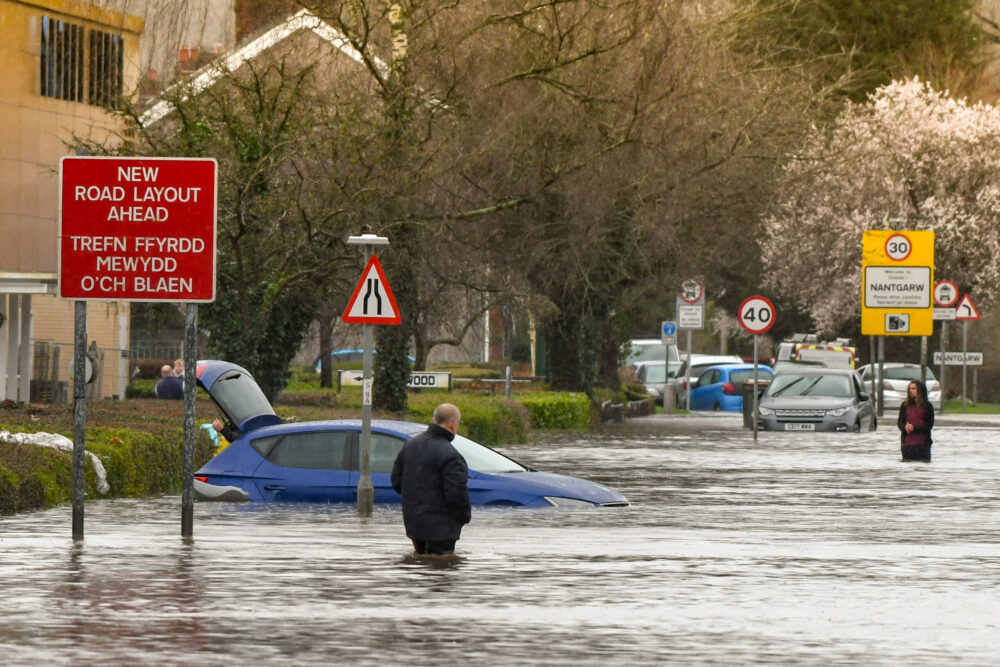
It is hard to believe that six years have passed since Storm Dennis devastated so many of our communities, leaving behind a trail of destruction as well as long lasting trauma for residents.
I was a Councillor for Pontypridd Town ward at the time, and could not believe the scale of the damage not just in Pontypridd but across nearby communities. As part of a team of volunteers working from Trallwn Community Centre, I met countless flood victims whose lives had been turned upside down and visited their homes to offer help and advice. With the authorities overwhelmed, it was the community that stepped up to offer support, with volunteers helping to clean people’s homes and carrying furniture that had been destroyed into skips.
Natural Resources Wales (NRW) acknowledged that the scale of the disaster had far exceeded their operational capacity. Their own review concluded that their resources “could not fully cope with the size of the task at hand for an event of this scale and significance.” They also made clear that managing future flood risk requires a fundamentally more coordinated approach—one that brings together all levels of government, public bodies, businesses, communities and individuals. Only through this joined up effort, they argued, can Wales strengthen its resilience and adapt to the growing threat of extreme weather events driven by climate change.
Whilst some progress has been made, the change in approach has not been at the scale NRW called for. And as I’ve seen following subsequent floods in the region I represent, much more needs to be done to support residents and businesses.
Research undertaken by the British Red Cross underscores just how vulnerable Valleys communities remain to future flooding. Their Every Time It Rains study identified Rhondda Cynon Taf as an area with some of the highest levels of “social flood risk” in the UK—meaning communities are not only highly exposed to flooding but also less able to cope with and recover from its impacts. They highlight that Wales overall faces the highest chance of flooding of any UK nation, with the Rhondda Valley requiring urgent and accelerated action to protect residents.
Polling carried out as part of the research shows the scale of concern in Wales:
- 44% of people worry about the impact flooding could have on them;
- 26% say their area has already experienced household flooding;
- 84% do not know how to prepare for a flood; and
- 87% believe flooding should be a priority for devolved government.
These findings reinforce what communities across the Valleys have repeatedly expressed: despite resilience and ongoing local efforts, preparedness and support structures still fall short of what is needed. The British Red Cross warns that without significant, sustained investment—and clearer, more accessible guidance—those already hit hardest by storms like Dennis will remain the most at risk as extreme weather intensifies.
Over the past six years, I’ve spent countless hours meeting with residents, community groups, and local businesses—listening to their experiences, frustrations, and campaigning with them for change. This includes supporting the residents of Clydach Terrace in Ynysybwl, where residents face the highest risk to life from flooding than any other community in Wales and whose homes will now be purchased by Rhondda Cynon Taf Council and demolished. And whilst I’m relieved a solution has finally been found for Clydach Terrace, I worry that progress is far too slow for other high-risk communities. It’s not enough to declare a climate emergency – there also needs to be action. And in this regard, the Welsh Labour Government has fallen short.
To truly protect communities across the Valleys, we need a far more ambitious and coordinated approach to flood resilience. That starts with accelerating investment in both hard infrastructure and nature‑based solutions—from strengthening culverts and defences to restoring floodplains, expanding wetlands and increasing upstream tree cover to slow the flow of water before it reaches towns such as Pontypridd.
Local authorities, NRW and the Welsh Government must work together to deliver clearer, more accessible guidance so residents know how to prepare for and respond to flooding. This includes practical information, awareness campaigns, and support that reaches people before the next storm hits—not after. That’s why I’ve consistently advocated for the establishment of a Welsh Flood Forum to lead this work.
Crucially, funding must reflect social vulnerability as well as physical risk. Communities like those in Rhondda Cynon Taf, where the impacts of deprivation and repeated flooding collide, need faster decision‑making and dedicated long‑term support. And residents must be at the heart of these plans, shaping solutions that work for them.
Our communities are still carrying the scars of Storm Dennis, and all subsequent floods. I’ve lost count of the number of people who’ve told me that they can’t sleep every time it rains, for fear that their home will be flooded again. We can’t continue to let them down.
What they need now is a government willing to match that determination with the urgency the climate crisis demands. By investing in resilient infrastructure, accelerating nature‑based solutions and providing clear, accessible support, we can ensure that the people of the Valleys are not just recovering from the last storm, but are protected from the next. That is the commitment they deserve, and it is long overdue.
Support our Nation today
For the price of a cup of coffee a month you can help us create an independent, not-for-profit, national news service for the people of Wales, by the people of Wales.



Those angry about flooding would do well to direct their ire towards farmers who insist on keeping sheep on upland areas despite the proven damage to the land and its flood resilience. The sheep must be removed and replaced by trees as a matter of urgency. Instead we have the grotesque spectacle of the farmer’s union complaining about the Elenydd rewilding scheme, which will take place on land which no farmer owns. In his book “Feral”, George Monbiot mentions that it took years to explain to farmers that beavers don’t eat fish (the farmers objected continually to the reintroduction of… Read more »
The surge flooding at Pontypridd was from the Rhondda and Cynon catchment. This has low levels of sheep grazing but does have the clear felling of 1.1million trees for the Pen Y Cymoedd wind turbines (72) with the associalted trackways driven accross the mountainside.
There may eventually need to be a government insurance scheme to cover flooding risk in some areas, similar to the earthquake cover provided by the NZ Gov.
How much “accelerating investment” is required? Which budgets will be cut to pay for it? It probably won’t be long before Plaid has the chance to act. I think it would be helpful to know?
Can you spot the spelling mistake on the bilingual road sign? What the hell is “MEWYDD”? Welsh councils are so ignorant when it comes to Welsh spelling. For shame.