


Something Important About Rock Cakes
 Ben Wildsmith
The appearance of Christmas selection boxes in Morrisons this week had me triggered like a greyhound at a squirrel convention.
The brutal erasure of autumn, with suitcases and summer shirts replaced by midwinter products overnight stands for the wider loss of nuance in our troubled culture.
Only coffee shops have found a way to monetise the muted tones of the season – dumping buckets of pumpkin spice flavouring into everything they sell as a nod to the sweet decay of life.
Other than that, we’re offered only the money-with-menaces Halloween traditions forced on us by our American masters before being funnelled through self-service tills to accumulate debt for the little lord Jesus. No crying he makes? I should cocoa, he costs me a fortune every year.
The desperate, flagshagging veneration of tradition that’s arisen in recent times was born in supermarkets. Traditions are the rejection of choice. We follow football teams and gods to the exclusion of others and usually inherit which ones.
That feeling of being part of something greater than our own preference is what compels loyalty and inspires emotion. We are doing something because it has always been done, not because it suits us individually.
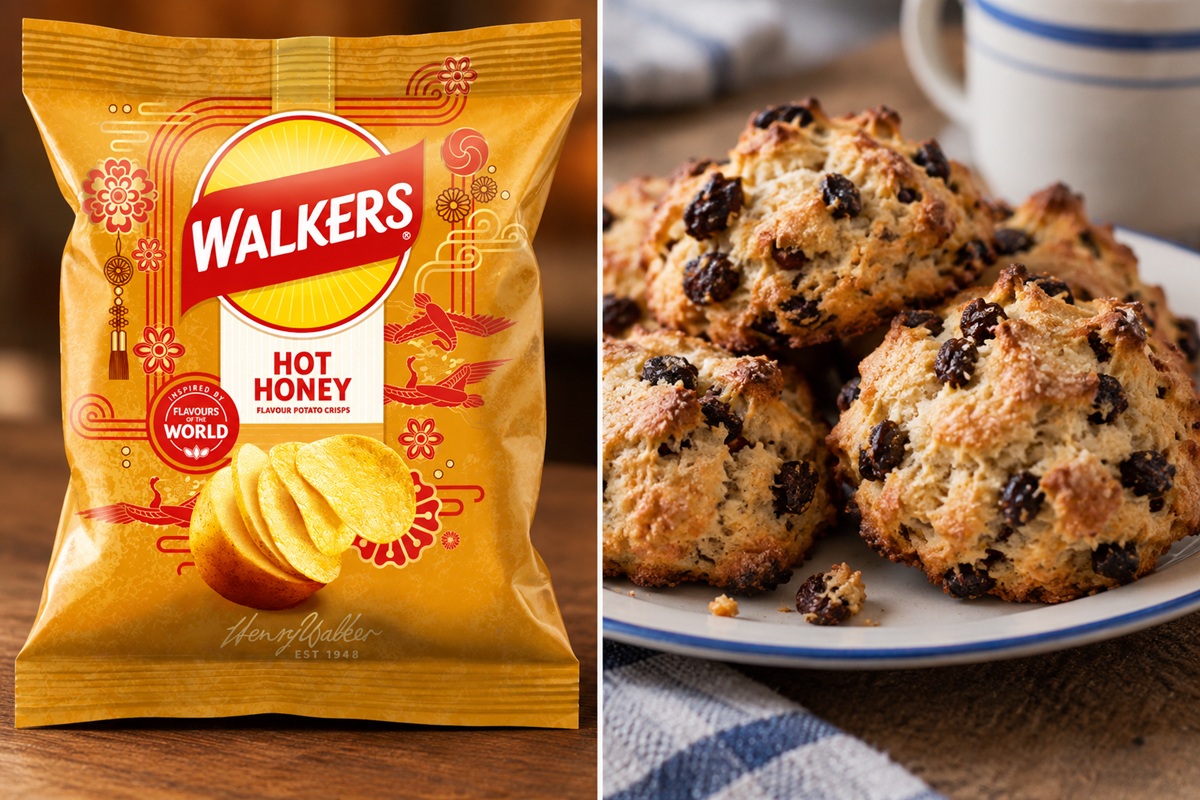
My granny used to make rock cakes for us all every Sunday. She’d cheerfully admit they were awful, but her mother used to make them like that, so she did too, and we all had to eat at least three each. I can still taste them now.
Supermarkets are the opposite of that. Under their bright lights we are offered the whole planet’s traditions, packaged up and toned down for mass acceptance. In them, the degraded echoes of civilisations compete to satisfy our restless desire for novelty.
The cultural descent of foodstuffs occurs ever more quickly as our attention spans atrophy. Take hot honey as a current example. ChatGPT tells me (thanks Satan, saved me some time there) that last year’s culinary craze originates from Afro-Brazilian cookery in which honey and hot peppers have been combined for generations.
A New Yorker called Mike Kurtz brought it to America, launching Mike’s Hot Honey in bottles and setting in motion a trajectory for the product that saw it hurtle through hipster food trucks, farmers’ markets, and high-end restaurants before ending up on the menu at Wetherspoons – which is a supermarket that identifies as a pub – and finally coming to rest as a flavour of crisp.
Perhaps you’ll buy a bag in Morrisons whilst picking out a plastic, Christmas-style tree from communist China.
Tradition is a bore. As with all things authentic, it has a frustrating downside that counterweighs what we enjoy about it.
Granny’s ghastly rock cakes were the price that had to be paid for the weekly ritual of family togetherness. Outside of that context, they were nothing but hard, dry, curranty balls of burnt dough.
Everyone who endured them, cracked jokes about them, and remembered them is dead now, except for me. I’m the last person alive for whom they have any meaning.
They wouldn’t have taken off in supermarkets, for obvious reasons, but they are remembered here, thirty years after they were last made, because their value couldn’t be distilled down into a powder or patent-protected chemical compound. That lay in something that’s at odds with the impulsive, individualistic nature of consumerism – in the monotonous compromises of shared experience.
Individualism
Supermarkets arose out of the 1960s enthusiasm for individualism and became dominant when that strand of thinking became a religion in the 1980s.
What you desire, personally, ceased to be a component of what we all agreed upon and became your end of the social contract – a reward for earning money, a right bestowed by the gods of consumerism. Sick of chopping onions? No problem, here’s a bag of them chopped up for you in the chiller.
Choice and convenience have replaced ingenuity and effort as our measures of virtue. Our eyes dart across continents as we scan the aisles for something to sate our hunger as easily as possible. Bombay Bad Boy it is.
But somehow, even the supermarkets themselves know that we’re not actually happy with all this. As well as forcing what’s left of our traditions through their tills at Christmas and Easter, they attempt to insert themselves into them as active participants.
Before long, we’ll be encouraged to care about the ‘daring’ new John Lewis Christmas advert, as if its annual unveiling is somehow an integral part of the Nativity.
Inauthenticity
These temples of inauthenticity recognise what has been stripped from us by the commercialisation of all things that were once shared. There is a palpable wound at the heart of Western lives that has begun to weep pus into the public sphere.
Elemental components of the human experience, such as the passing of seasons, were celebrated together for a reason. We are, whether we like it or not, yoked together in this as we edge towards our graves, and reminding each other that we are not alone is how we remain sane.
Choose the funeral plan that’s right for you…
Virtually everything we once had together for free has been surrendered in the name of choice and convenience, then sold back to us. Social media has exploited our need for connection with scientific precision, rationing out dopamine hits as we sit alone reaching into a digital void for the simplest of human needs – other humans.
A hugging emoji is a nice thing to receive but it’s not a hug, is it?
In Dover yesterday, masked men were massing to protest about immigration under the banner of ‘Patriot Platform’.
Maggie
For them it’s ‘our’ everything: ‘our’ flag, ‘our’ country, ‘our’ women and girls, ‘our’ values. Decades after Maggie sneered that there was no such thing as society, the fruits of that idea lie rotting on lamp posts – flaccid, Temu emblems of a culture that sold itself too cheap.
When you don’t know where your food has come from, when your music venues have closed, when your libraries are empty, when your children are unhappy, when your friends are online, when your religion is shopping, you have a right to be angry.
The agency of individualism is a pleasure during easy times. When the clouds gather, however, we search for what we know, what binds us. To find that it’s gone is a bereavement.
All that loss brings grief and confusion, an ache where something used to be, something important.
Support our Nation today
For the price of a cup of coffee a month you can help us create an independent, not-for-profit, national news service for the people of Wales, by the people of Wales.
Get more trusted Welsh news
Choose Nation.Cymru as a preferred source in Google News to see more of our journalism.



Sadly, the aptly named “holiday creep,” like a rash, is upon us again. Christmas, like other holidays, has become devalued. If it’s not summer holidays being advertised in December, it’s Easter eggs on the shelves in January, or Halloween costumes and pumpkins on sale in August.
It is important that, in perfectly reasonable anger, we do not mix together things that are not part of the problem with those that are. You fondly refer to your aunt’s rock cakes – hand made, from her own recipe, apparently barely edible, but no doubt made with love every week. You also make reference to the fact that people who are tired of chopping onions can now buy them chopped and frozen to save themselves the effort. Whilst I agree with all you are saying about the money-makers taking away our seasons and seasonal traditions and handing us “purchasing… Read more »
Fair play to Ben Wildsmith. He pinpoints Maggie Thatcher as the root of the rot in our society. ‘Me’ was all that was important to her, and the ‘us’ of society was anathema to her. Selfishness and ‘devil take the hindmost‘ were her clarion calls
Thatcher wasn’t the root cause, she was the symptom. People actually had to vote for her and she was far from the only one calling for politics of division over the years. A demonstration of how far we had fallen as a society. Saved the Falklands though, so she has that.
As a fan, who lives in Japan, let me assure you it is even worse here. Neither Halloween nor Christmas is indigenous, yet early October, before the summer heat has properly subsided and while we still enjoy cicadas humming in the evenings, plastic pumpkins are on display and children compete for weird outfits, and as soon as that is over along jingles Santa, supermarkets blaring our non-carols. New Year gatherings can parallel those of your grandmother’s rock cakes (BTW I used to make them in Ynys Mon using precious WWII rations), a time for family gatherings, before the absurdities of… Read more »
Wow ! What an article to cheer up your day! (Even if it does speak the truth). Ironically, as we, supposedly, live in the age of individualism we choose to be dictated as never before. We let ourselves be drawn by social media and supermarket driven Christmas and probably because our work driven lives have become so mundane. It does make you think about how free we really are. (Thought I’d add to the joy 😊).
My granny used to make rock buns, actually as a child it was my favourite thing she made, probably because they were made with quite a lot of sugar in the crust on top, but there must be some knack of getting them to have the right consistency and not dry out too much.
Rock cakes could be made with ingredients available on ration, you could use dried egg powder with a splash of vinegar to save on precious fresh eggs. Hence, probably, their popularity with your grandmother’s generation.
Christmas? They haven’t even got Halloween out of the way yet! As for the right wing nuts going on patrol like some kind of 1950s America Kukluxklan addicts except black instead of white, I would be tempted to believe them about women and girls, except a chunk of them are wanted for being child abusers and violence against women. If everything they’re doing wasn’t specifically against the teachings of Christianity, whether Catholicism or Anglicanism, I might believe their claims that they’re true Christian believers. They have no idea what it means to be English, let alone British and seem to… Read more »