


Sticking his oar in, again…
Ben Wildsmith
There have only been two consequential prime ministers in my lifetime, and I hate them both.
The others: Ted Heath, Harold Wilson Mk 2, Jim Callaghan, John Major, Gordon Brown, David Cameron, Theresa May, Boris Johnson, Liz Truss, Rishi Sunak, and the new bloke might as well be rolled together into a sludgy whole like strands of plasticine. Their singularities were shaped by events, rather than their effects upon them.
Not so Margaret Thatcher and Tony Blair. They were the ones that counted.
Thatcher’s decisions were as beneficial for part of the population as they were catastrophic for the rest. For that reason, she retains a significant following amongst people who either did well from her shattering of the post-war consensus, or who fondly imagine that they would have thrived had they been adults at the time.
Her reductive conflation of national economics with household accounting strikes a chord with many to this day, and the idea that individual effort is a guarantor of personal success remains comforting to some – particularly those whose efforts were made in the warm waters of familial privilege. (Paging Jacob Rees-Mogg).
To misquote The Big Lebowski, ‘Say what you like about the tenets of Thatcherism, but at least it’s an ethos.’
Tony Blair’s legacy is altogether more complex. After the polarising trauma of the Thatcher years, and the chaotic incompetence that followed, Blair offered a new mode of politics.
In place of ideology, we were offered ‘values’. Presentation moved from the periphery of governmental concerns to become of primary concern. Political and economic theory was to be distrusted as evidence of dogmatism. Instead, we were persuaded that a modern government could pick and choose solutions to problems as each demanded.
It was neither this nor that, it was the ‘third way’, a public/private partnership in which managerial pragmatism was the guiding principle.
For a while, this approach chimed perfectly with the electorate. Very few people fancied returning to standing around picket lines in donkey jackets waiting to be battered by the police. We also welcomed the relaxation of public spending after being told for so long that schools and hospitals were extravagances that, really, we ought to be paying for privately were we not such feckless losers.
Blair had two advantages that he remains unwilling to acknowledge. Firstly, people had an ingrained idea of what a Labour government was for.
It was assumed that its priority was the uplift of working people, so all the Mandelsonian business-speak and leveraging of private capital must only be the new way of bringing that about. So, the ideological void at the heart of the government went unchallenged.
It might be New Labour but it’s still Labour, look they’ve got John Prescott on the front bench, you can’t get more authentic than him…
Secondly, Blair was operating during a period of sustained global growth. That allowed for substantial investments in public services, creating visible improvements to communities across the UK. ‘Things can only get better,’ the red campaign buses had blared (Blaired?), and in your local hospital or school, they probably did.
What didn’t change, however, was where the money was coming from. Private capital continued to flow into public services, creating long-term financial obligations for subsequent governments.
Structural catastrophe
Increased public investment was floated by a reliance on financial services that masked the structural catastrophe that was unfolding in the local economies of areas deindustrialised over the previous decades.
We had a new wing on the hospital, but low-quality jobs and no built-in resilience when the markets corrected.
That happened in 2008, and politics since then has been a series of unpleasant distractions from the reality of our national situation.
Shifting the blame to Europe brought us Brexit, when that fared as it was bound to, immigrants came into the crosshairs of virtually all politicians.
Last year, the new Labour government seemed to suggest that our best hope for economic reinvigoration lay in manufacturing weapons for a war with Russia.
Carnage
The reality of what a government without ideology means became manifest to most when Blair took the UK to war in Iraq against the clear objection of the public. His legacy is a party that sees the carnage of continental war as an opportunity.
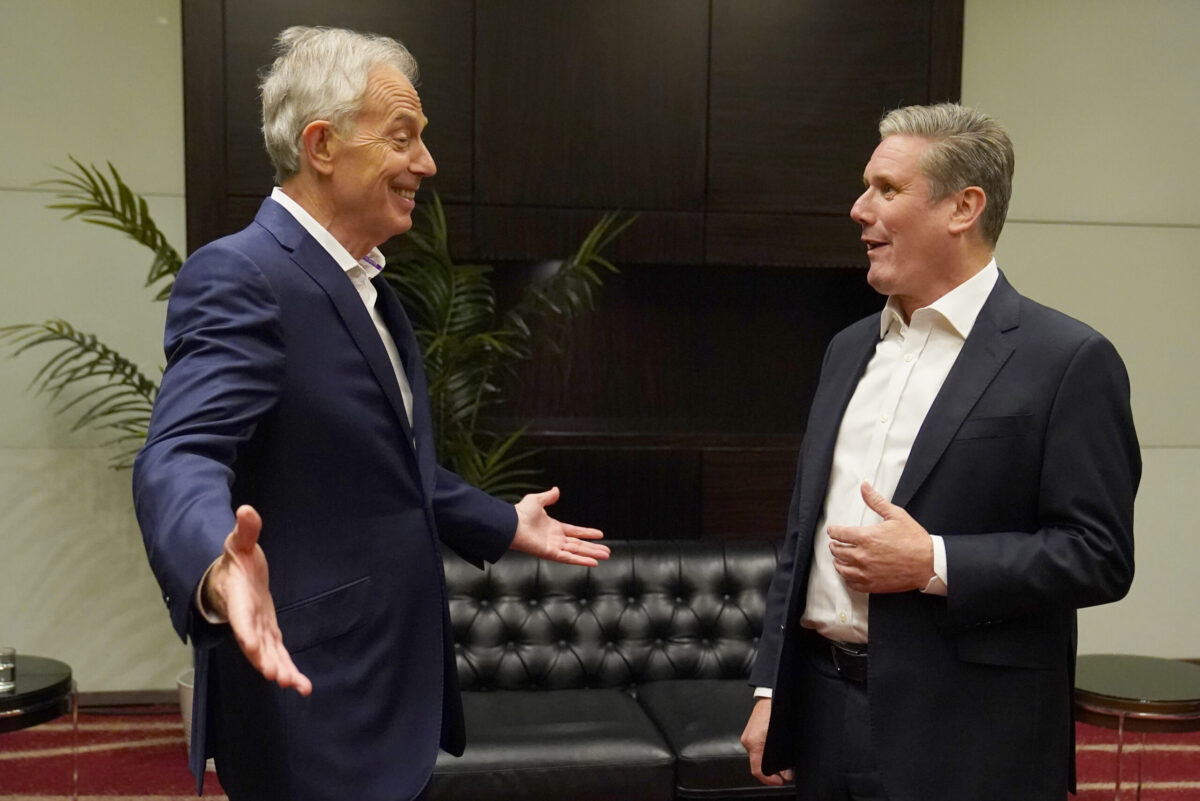
So, when Blair popped up this week to warn against a ‘lurch’ to the left by his party, he was returning to the scene of the crime.
His nihilistic, soulless outlook is visible to all in our hollowed-out high streets, identikit shopping centres, and the immoral, hypocritical stance the UK takes to the rest of the world.
Who on earth does he think would listen to him now?
Support our Nation today
For the price of a cup of coffee a month you can help us create an independent, not-for-profit, national news service for the people of Wales, by the people of Wales.
Get more trusted Welsh news
Choose Nation.Cymru as a preferred source in Google News to see more of our journalism.



Why on earth listen to Blair?
He spent his time in politics crawling to media owners like Murdoch and Rothermere.
He re-appointed Mandelson after he was sacked for dishonesty. They deregulated the financial sector further than Thatcher, handing control to crooks and grifters directly leading to the 2009 crash and a decade of Austerity.
Austerity for ordinary families and an estimated £250 million fortune for Blair.
Yes, let’s listen to him, but remember who has bought and paid for his honeyed words.
Why listen to him? Because he’s right. It doesnt matter if we want to hear it or not – sooner or later we have to accept reality.
He is around two thirds right in my view; but you hit the nail on the head. The public and politicians are delusional. Reality has arrived big time.
Then he’s no different to Elon Musk and JD Vance who tell British People that Tommy Robinson is the voice of reason for the UK
But they’re not mostly right. And Blair is.
Why post such nonsense? If Blair is not worth listening to then tell us why. Dont claim that he supports Tommy Robinson when he simply doesnt!
When you have to make up the accusations against Blair, it begs the question of why you cant make a factually correct case?
Blair shouldn’t be listened to full stop.The War Criminal should be rotting away in jail.
Why is this guy still a free man?
Because he has not committed any crime. The Iraq inquiry was highly critical of some of his decisions but nothing he did was criminal in any way.
Complicit in the Murder of 1 Million Iraqis, I don’t know what planet you live on but it certainly isn’t Planet Earth
That was all a whitewash it was all about oil and the American dollar same that is happening now in Iran the winners write the history the inquiry was told what to say wake up mun
Talked much sense on the radio the other day, especially about AI which could transform the NHS, the need to help businesses rather than destroy them, the unsustainable welfare bill etc. The most important point was the lack of any strategic planning by UK government in dealing with a world that is passing us by.
Unfortunately, populist politics means ‘Talking much sense’ is now replaced by ‘I want now’.
The Labour Party, at long last, is now finished, and the only people that don’t know it is the Labour Party. Weirdly I agree with the fossil Blair, but it makes no odds: they’re done with.
And Blaire, supports Burnham,that in itself is very worrying for him,and Country ,as a potential future PM,he would not.get my vote,it,s all beginning to look very, very contrived.
Blair was so damaging to us all with his normalising of neoliberalism but particularly, the Labour Party (oh dear, how sad, never mind) due to his coming from somewhere vaguely out in the left? Thatcher, who did far more damage for which we are really still paying for (“there is no society”) at least came from the distant far right & was not such a betrayal?
Look, it’s ME ….. Superman. I have come to save the party. Get lost Blair and keep your beak out. You have already caused unnecessary suffering looking for non-existent weapons of mass destruction. Their existence only existed in your head!! The sad thing is that you’re still free and making millions.
Blair is just being serious. This idea that we can keep increasing tax on a shrinking working population whilst increasing spending and increasing debt is fantasy. Its not about being left or right wing – its about being serious and facing up to reality.
Hahaha you got that one wrong taxation for working people under the previous Conservative Government was at it’s highest for 70 years
Totally correct. Taxes shot up under the Tories as did spending and borrowing. But Labour has not tried to reverse it; Reeves has doubled down and gone even further!
At some point basic maths will kick in and the government (whomever that might be) will have to change direction.
Reality needs to start with the biggest single government expense that have jumped £40bn since 2021: state pension benefits. Time to stop paying it to the wealthy.