


Tackling pavement parking needs to be our top priority
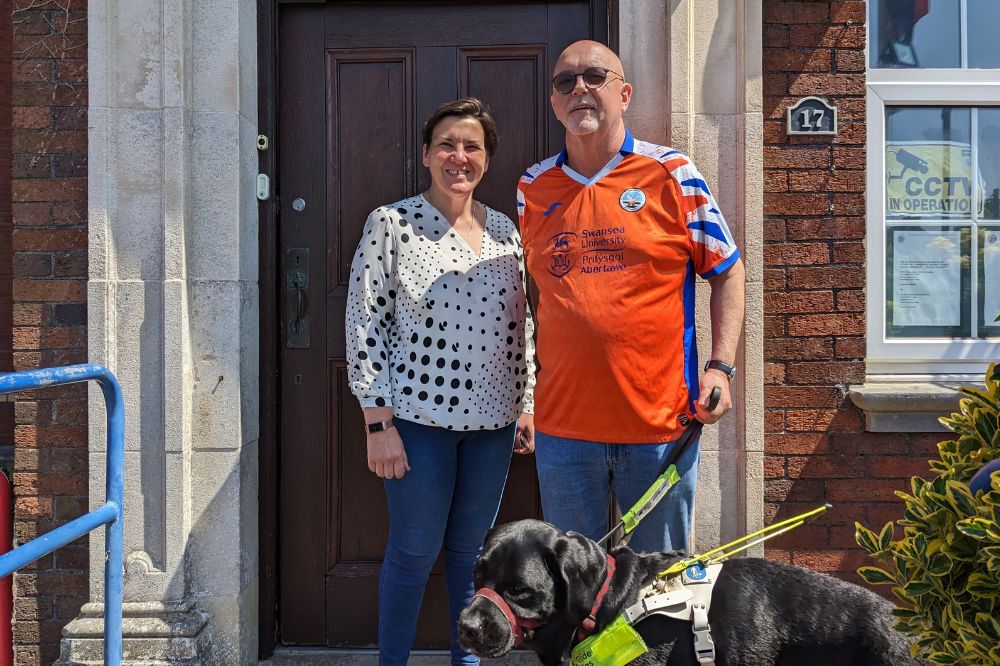
Tonia Antoniazzi – MP for Gower
We’ve all been going along the pavement to find a car with its wheels on the path, maybe even blocking the whole thing.
For some, it’s a frustration we’ve become used to enduring. But, for others, it’s a serious barrier preventing them from going about their daily lives and restricting how they travel in their own neighbourhoods.
This is why I’ve been in consultation with Roads Minister Lilian Greenwood about introducing a new pavement parking law.
For Mark, one of my constituents, pavement parking is the single biggest issue that impacts his safety and independence.
Dangerous
Mark is registered blind and has had his guide dog, Bobby, since 2019. When the pair are trying to navigate their way around their hometown of Morriston, Mark encounters cars parked on the pavement on a daily basis – forcing him and Bobby into the road.
This can happen several times even on a short stretch.
Mark can’t see oncoming traffic when he’s on the road and Bobby isn’t trained to tell him when there’s a car coming.
He relies entirely on sound, making the situation dangerous and stressful for both of them.
Mark describes the barrier caused by pavement parking as “absolutely horrendous” and he isn’t alone in experiencing this.
Sustrans and Transport for All found that 73% of disabled people believe banning pavement parking would help them walk and wheel more.
Prams
As well as blind and partially sighted people, people with a mobility impairment are particularly affected.
While disabled people are often worst hit by pavement parking, we’re all affected in some way, especially if we’re pushing a pram or walking with children.
It’s putting some of the most vulnerable members of society in unnecessary danger. I know, because my constituents tell me about it.
According to polling by Sustrans, 68% of people would walk or wheel more of their journeys if there were fewer cars on the pavement.
This would improve our health and the environment.
Action
There is a precedent to addressing pavement parking. In London, you can’t park on the pavement unless the council have put up a sign saying it’s necessary and safe to
do so there.
That’s been in place since the 70s. Laws making it illegal to park on pavements in Scotland also came into force in December 2023.
The rest of the UK is lagging behind. The Welsh Government is committed to action, but it will be difficult without changes in UK law.
I know that Lilian Greenwood, the Roads Minister, wants to tackle pavement parking. Colleagues from all parties are supportive of action.
It’s now been more than four years since the then-UK government ran a consultation on pavement parking. It’s time for a response to finally be given, and, ultimately, action to be taken.
Tackling pavement parking needs to be a priority. It’s a social justice issue. And people like Mark have been waiting too long for change.
Support our Nation today
For the price of a cup of coffee a month you can help us create an independent, not-for-profit, national news service for the people of Wales, by the people of Wales.



‘Sustrans and Transport for All found that 73% of disabled people believe banning pavement parking would help them walk and wheel more.’ I’m sure that has to be true, but in some situations it’s easier said than done. In the early 1980s I lived in a rather narrow cul-de-sac in the Gwent valleys in which the majority of properties were built in the late 19th and very early 20th century and had no drives. So parking on the road was unavoidable, and people tended to park partly on the pavement, just to ensure that in the event of a house… Read more »
The answer is probably marked residents permit bays along one side of the road.
Might have worked in that situation to an extent, since the more modern houses on the opposite side of the road did have drives on which they could park their cars.
But once space was allowed for those home owners to be able to access their drives, I rather doubt that there would have been space sufficient to provide enough bays for the use of those living in the older, driveless, properties opposite.
Planners cannot see beyond the ends of their noses or next tea break
I’ve no evidence to decide on that. My last employment prior to retirement was in local government, but I never had any dealings whatever with planners or with the folk whose jobs involved them with roads or with parking issues.
“Colleagues from all parties are supportive of action.” – I doubt Reform are.
Stop building houses on every patch of urban land then. Some pieces would be much better turned into car parks. But where’s the money in that!?
Residents car parks?
I would love to ban pavement parking – especially where drivers prefer to use the pavement to their driveways because it’s more convenient. It’s a pain in our road. However we also have to remember that many homes have car-owning adult children living with their car-owning parents, that many home-owners either use their garages as a storage area/workshop or have converted them into kitchens etc, and that many modern cars are too big to fit into garages. If a pavement parking ban had been brought in 20 years ago it might have worked; now may be too late. How are… Read more »
The only answer is real enforcement. We all need regular designated parking wardens not people coming occasionally.
You need to lead from the front here in port Talbot there left turn passing a furniture shop. There used to be a public toilet on a concrete slab forva long time a Jaguar has been parked on the slab. To get to that slab the driver has to mount the kerb and drive across the pavement. Recently there have been two cars. bit annoying as there are two carpark within 30 metres. Enforcement offices pass here regularly on their way from station road checking for parking infringements to the car parks to to check for infringements. They do nothing… Read more »
Probably a heresy on these pages but I always felt that pavement parking should have been addressed before the revised 20 mph speed limit. Often the same people who clamoured for lower speeds could be found shoving their vehicles up onto verges, paving or any old surface they considered fair game.
Pavement parking in my road has encouraged people to break the 20mph limit and use it as a rat run.
The same Tonia Antoniazzi who has refused to sign letters banning arms sales to The IDF,voted against the BDS and has refused to support motions against the The genocidal policies of Netanyahu’s government towards The Palestinian people.
Correction Tonia did vote to oppose a ban on trying to make BDS illegal.
We all have views on what’s happening in Gaza, but I think you need to get a sense of perspective here. It’s an article on pavement parking. To your credit you have corrected yourself in your next post.
It’s much the same everywhere. The trouble is that, in most areas, if pavement parking was banned then it would simply relocate the problem: pushing the parking into surrounding streets. Many believe (as I do) that we have too many cars on the road these days. However, if you ask anyone who complains about this, and other parking issues, they will usually reveal that there are two, or maybe three cars attached to their household, so really, they’re part of the problem.
The only way to solve that is expensive parking permits that double for each additional car. Perhaps 1st car £150 per year, 2nd £300, 3rd £450.