


Taking musical inspiration from the Merthyr Rising
Michael Hall
As a musician/writer born and raised in Merthyr Tydfil, the Merthyr Rising of 1831 has always been an event that lingered in the peripheries of my mind.
We were taught about it in school, ironically enough within the walls of Cyfarthfa Castle, which was constructed in vanity by the iron master William Crawshay II, toward whom much of the vitriol behind the Rising was aimed.
Yet the events of June, 1831 always seemed so distant and unrelatable. As kids perhaps we weren’t able to grasp the importance of the Rising, or how it reverberated through history, its echoes affecting the socialist and union movement across the world. Equally plausible though, is that it wasn’t taught to us with any sense of pride or broader historical context. Merthyr, often unfairly derided by the wider world, also has a long history of short-changing its own legacy.
In my role as a songwriter in Martyrs, as with my solo work, Merthyr plays a large part. When Jon (my collaborator in Martyrs) and I were choosing a band name, a nod to our hometown seemed to be the only choice (the fact that it is also the name locally given to the mighty Merthyr Town Football Club also suited us well). It was where we grew up together, shared formative experiences and, again in Crawshay’s castle, formed our first high school band. Even when our work isn’t specifically tied to Merthyr, the town serves as a backdrop for our narratives.
Our most recent Church Street EP, is themed around Merthyr Tydfil, containing songs about our teenage years there (‘Church Street’), the issue of addiction which has long blighted the valleys (‘Twist The Cap’) and the seemingly endless summers of a Welsh childhood (‘You’ve Been Here Before’). The final piece of music delivered to me by Jon for the EP sounded, in spite of its juddering guitar and baggy beats, like it could be a modern folk song. In a time when the quantity of protest songs appears to be inversely proportionate to how much they are needed, it seemed to me that traveling back to those tumultuous days of 1831 would be the ideal place to begin to craft our own.
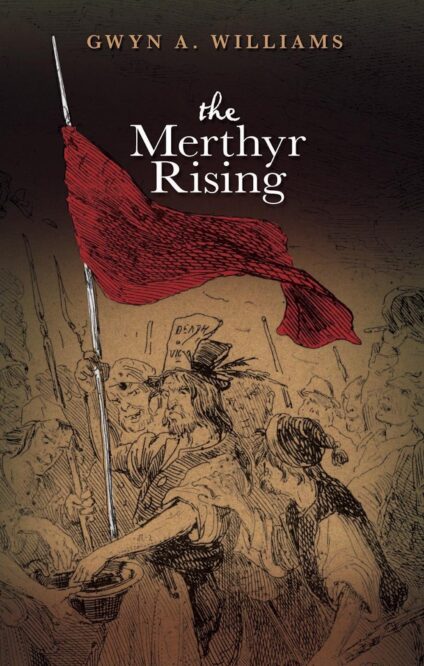
It’s not often a song’s lyrics will require a bibliography (fortunately) but all credit for ‘He Breaks Horses’ goes to Gwyn A Williams’ masterful ‘The Merthyr Rising’ as well as Joe England’s ‘Merthyr: The Crucible of Modern Wales’.
My mother’s copy of Williams’ 1989 book had long lingered on my bookshelf, a looming academic presence often dodged in favour of Dylan Thomas’ book of love letters or a battered Steinbeck paperback. Finally, down it came.
In sitting with the book over a period of weeks, making dozens of pages of notes, and cross-referencing with England’s text, it became clear that the Merthyr Rising was not only a far more complex and far-reaching event than I had known, but also one that speaks to our current climate in a way I hadn’t comprehended until fully absorbed by Williams’ precise and pointed telling of the tale.
Without wishing to relitigate the events which took place that summer in Merthyr, here’s a broad, admittedly subjective overview: Iron workers were being financially brutalised by the local debtor’s court (The Court of Requests), while their wages were altered at the whim of the iron masters. Job security was becoming a serious issue, and poverty in Merthyr was beyond rife.
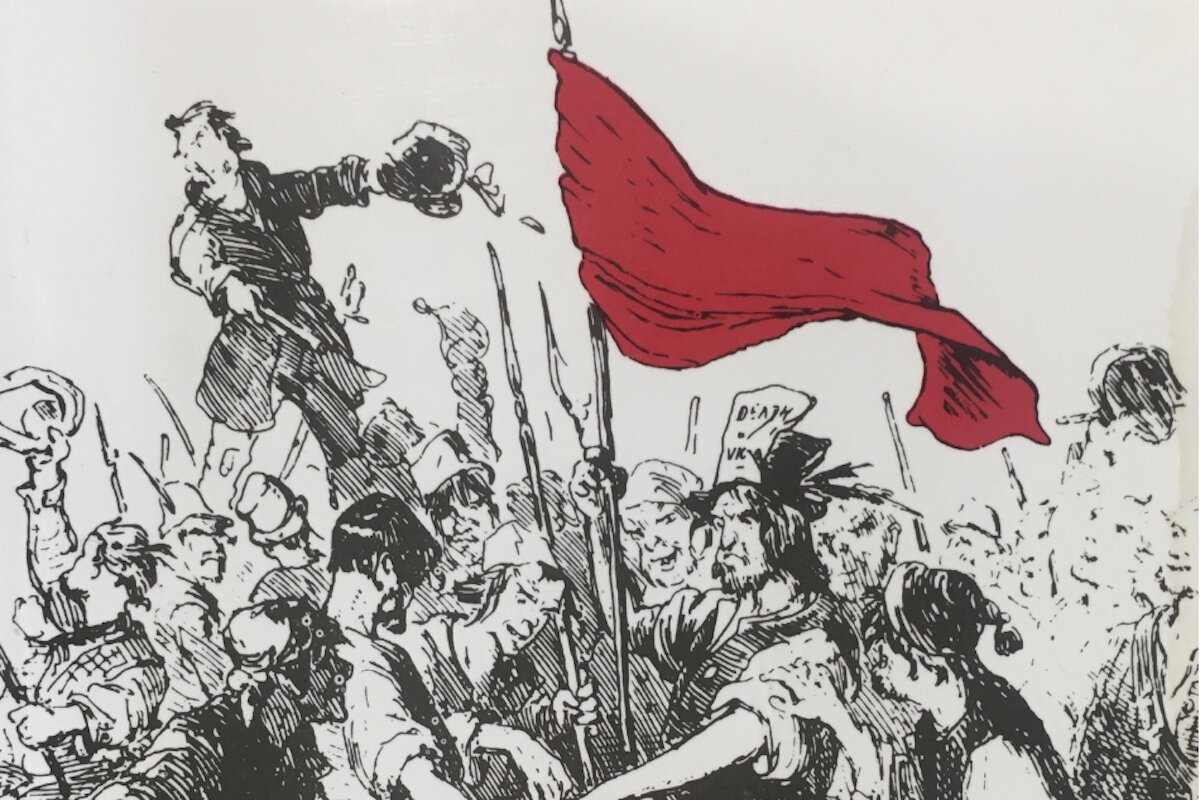
Possibly inspired by other early union protests in Manchester (what became known as the Peterloo Massacre, though far more blood was shed over the ten days of unrest in Merthyr) and perhaps even the French Revolution, the workers of Merthyr rose up against the Court of Requests and the cruelty of the iron masters, becoming the first to raise the Red Flag of the labour movement and sewing the seeds for workers’ rights and unionisation across Wales and, indeed, the world.
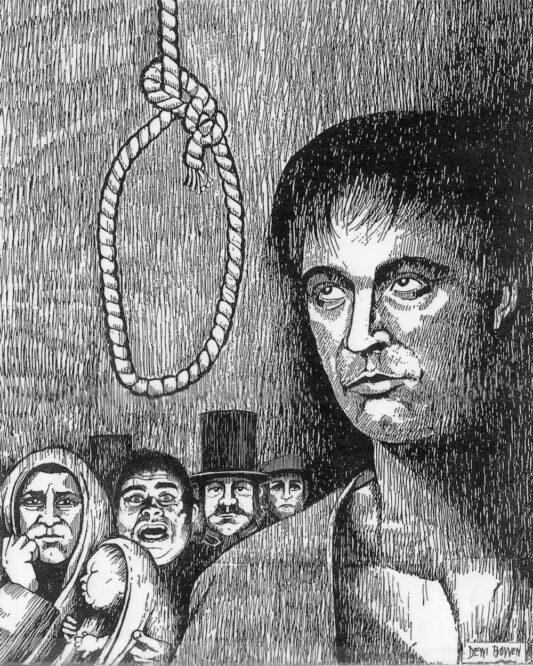
The protests culminated in the murder of up to 24 protesters by armed soldiers brought in by the iron masters, and the execution of the now-legendary working class martyr Richard ‘Dic Penderyn’ Lewis.
This is a terrible oversimplification of a series of intricate and overlapping events, and I would compel the reader to pick up a copy of Williams’ book to learn more.
What I saw there in the pages, and in reviewing my reams of notes, was not only a testament to the importance of Merthyr and its long, proud history of activism, but a mirror to the modern world. In an age of zero hours contracts, widespread poverty and increasing division wrought by late-stage capitalist corporations and corrupt politicians, it wasn’t hard to read the story of the Rising as a lesson applicable to the 21st century.
What touched me most deeply as I wrestled the details into a palatable lyrical form was what we can learn from a revolt of this kind, nearly 200 years later. The workers of Merthyr took out their frustrations on those who actively oppressed them, rather than falling foul of the inclination to blame other, equally deprived groups.
Of course, historically, entire nations have often been manipulated into in-fighting and hanging the blame for their troubles on immigrants or people of other faiths or skin colour. Events like the Merthyr Rising prove there can be exceptions.
The rise of workers’ unions in light of the Rising and other similar protests in the ensuing years, illustrates that change is possible when aim is taken at the right targets. Though the Rising itself could be considered a failure for many reasons, its impact should not be understated.
In crafting ‘He Breaks Horses’ I tried to be respectful to the memory of those lost in the Rising, while attempting to create something that, in partnership with Jon’s quite brilliant and evocative music, could become a patchwork of detail and atmosphere; a mirror angled to reflect the past into the present.
Many will say there is no place for politics in pop music, and that is their right, but it’s worth reiterating that any time you put on ‘Get Up, Stand Up’ by Bob Marley, ‘Born In the USA’ by Bruce Springsteen, ‘A Design For Life’ by the Manics, ‘Strange Fruit’ by Nina Simone or even ‘American Idiot’ by Green Day you are listening to music whose heart is unapologetically political. Music is, in my opinion, an inherently political form of expression – but that’s another conversation for another day!
I’m not attempting in any way to compare our weird little folk song to the masterpieces of modern music listed above, only to say there is a place for protest in music, there is a place for politics, and as far as we’re concerned, there is a place both for Merthyr and its radical history.
The narrative around Merthyr Tydfil needs to shift – it is a place rich with history, where the self-educated working class created great political change as well as great art.
While looking back and re-evaluating Merthyr’s importance in the historical records, we would do well to also look forward to its equally ripe potential. In understanding more about Merthyr’s past, I feel we may find a key to unlocking its future.
I hope you enjoy ‘He Breaks Horses’, the lyric video for which is below.
Support our Nation today
For the price of a cup of coffee a month you can help us create an independent, not-for-profit, national news service for the people of Wales, by the people of Wales.
Get more trusted Welsh news
Choose Nation.Cymru as a preferred source in Google News to see more of our journalism.



A great article – you should add Yma o Hyd by Dafydd Iwan and Tryweryn by Meic Stevens to your list – renember that nearly all of the Merthyr risers were Welsh speakers, and that Dic Penderyn’s last words were “Arglwydd, dyma gamwedd”
Thank you for reading the piece, Phil, and I truly appreciate your reading recommendations. The phrase “Dyma gamwedd” features in the last line of the song, fitting, I thought considering they were the last words he spoke. Thank you again.
…I meant listening recommendations, sorry!