

Ten years of YesCymru: independence made mainstream – but to what end?
On the tenth anniversary of YesCymru, one of its co-founders reflects on how the movement transformed Welsh politics — and argues that independence must be judged not as an end point, but by whether it delivers real autonomy and freedom from domination.
Leon Noakes
February 20th marks the tenth anniversary of the launch of YesCymru. As one of several co-founders, there from its very beginnings, I take this opportunity to take stock of the movement’s progress, its impact upon Welsh politics, and ask: Does today’s YesCymru resolve any of the civic vacuum I felt back then?
People under a certain age may now find this unbelievable, but before the creation of YesCymru, the notion of Welsh independence was considered an anachronism.
Eager to prove themselves as professional and mainstream as any other political party, Plaid Cymru’s politicians became absorbed in the performative language of the new devolved settlement, hemmed in by language set out for it by its opponents, whether a scathing mainstream media or the trendy sophistries of academia.
Suddenly, Wales was the first ‘post-nation’, and the party had apparently never been in favour of ‘indy’.
Under the leadership of Ieuan Wyn Jones, and navigating the dizzying doldrums of power in Cardiff Bay, Plaid had loosed its moorings.
The election of Leanne Wood as leader in 2012 showed early promise but ultimately left unresolved the party’s ideological impasse.
I had countless conversations across Wales during that time, with people all wanting things to step up a gear. A long-time Plaid activist, Syd Morgan, created the Welsh Nationalism Foundation (with EU funding), and asked a question that resonated far beyond party structures: ‘What is Plaid Cymru for? Are we more than just a Lib Dems for Welsh-speakers?’
Scotland, meanwhile, had seen the SNP storm ahead and secure an independence referendum for September 2014.
The contrast was a cruel one, and some of us sought to address it. My own offering to this culture of frustration was to pen a stage-play, highlighting the complacency of former Welsh activists—those comfortably settled in Cardiff’s leafy suburbs, content to ride the promise of collective autonomy even as its energies ebbed away.
Result Night (co-written with Sara Hawys Roberts) was staged in Newport, Cardiff and Swansea. Its central character had once been a campaigner for Cymdeithas Yr Iaith, but now notoriously ‘wouldn’t lift a finger for Welsh independence’.
A modest intervention, but we managed to send the message: How are you lot going to feel, come September 18th? (We fully expected Scotland to go its own way.)
Spring and Summer 2014 saw the beginnings of what would become YesCymru. A small core team, comprising Hedd Gwynfor, Iestyn ap Rhobert, and Sion Jobbins, held meetings in Victoria Park, Cardiff, to organise a ‘Wales for Yes’ rally, designed to spur on our Scottish cousins.
Mere weeks in, several people crashed out; it was looking like coming to nought. Others withdrew, wary of potential professional or commercial repercussions, handing all tasks to a precarious few.
The previous two years had seen the stunted growth of something called the Welsh National Rights Movement, set up by me and musician-activist MC Mabon. This humble outfit boasted several dozen members and regular meetings in Pontcanna but saw scant activism.
Frustrations
As things turned out, people mostly wanted an outlet to vent their frustrations at what were deemed Plaid Cymru’s salaried select.
At our last ever meeting, in May 2014, Iestyn ap Robert arrived with a sense of foreboding: the September rally might not go ahead. It was from this that I became involved in a revamped organising committee for the Cardiff Bay rally.
Those early organisers were: Iestyn ap Robert, Hedd Gwynfor, Sion Jobbins, Branwen Alaw, Armon Gwilym, and myself.
Weeks after the rally and the referendum, several of us sat down to consider whether to set up a new campaigning organisation, to channel momentum for the independence cause in Wales itself.
For me, there was no question. And so, with no party machine, no funding, and no clear precedent, it was decided to shrug off some fetters and ensure that Welsh independence could become mainstream and a source of hope and national pride.
We did not know what YesCymru would become. A pressure group; a campaign network? What we did know was that Wales lacked a civic space in which independence could be imagined as something normal rather than eccentric — something discussed by ordinary people rather than whispered about at the margins.
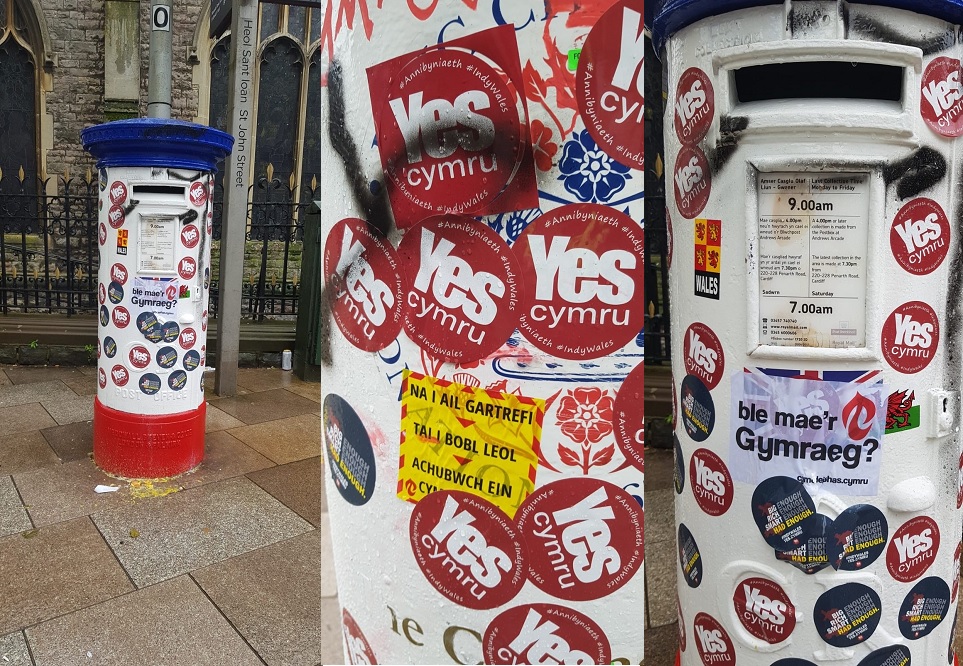
As one of the co-founders, one of my contributions was symbolic but lasting: I devised the original YesCymru branding, the name, colours and logo. The circular roundel sticker, discovered on lampposts across Wales and beyond, designed on my own laptop in late 2014.
It mattered to me that our name be short, snappy, bilingual, and positive. ‘YesCymru’ might seem obvious now, but you should have seen some of the rival suggestions!
This was not a party brand, not an ethnic tribal badge, but something both assertive and inviting as a marker of civic involvement and grassroots activism.
Ten years on, YesCymru clearly succeeded in one crucial respect. It brought thousands of people into political activity who had never previously found a home in Welsh public life.
Through local branches, meetings, debates and acts of creativity, independence moved from being a fringe aspiration to a question that now sits firmly at the centre of Welsh politics.
Anniversaries invite celebration, but they should also invite reflection. Because the real achievement of YesCymru is not simply that independence is now discussable, but that Wales has begun—tentatively and imperfectly—to ask a deeper question: what would independence actually be for?
Independence is not simply about changing who governs Wales. It is about ensuring that Wales cannot be overruled, overridden, or structurally ignored, even by institutions that claim to act in our interests.
From a civic-republican perspective, freedom does not mean being left alone, nor does it mean simply choosing a different centre of power. It means living under rules we have the real capacity to shape, contest, and, if necessary, change—without being dependent on the goodwill of others.
Destination
Too often, independence is treated as a destination rather than a discipline of autonomy—as if constitutional change alone guarantees freedom.
But from the standpoint of autonomy and non-domination, simply exchanging one framework of dependency for another does not answer the question at all. Membership of larger political and economic blocs may be compatible with independence, but it cannot substitute for it; alignment is not the same thing as self-government.
Plaid Cymru is not unique in this regard. Across much of the democratic world, parties of all stripes have settled into a form of political inertia — more concerned with managing systems than challenging them.
As the American social critic Christopher Lasch warned decades ago, political life can harden into a self-referential professional class, increasingly detached from the civic energies and moral expectations of ordinary citizens. Seen in this light, the temptation to treat membership of large supranational institutions as an end-point rather than a context reflects a broader retreat from civic ambition.
Once the meaning and potential implications of the word ‘independence’ are mulled over in this way, the question then arises: What is YesCymru for? Independence from what, and for what?
For me, the answer lies in republican principles — above all, non-domination, whichever direction power flows. That does not require unanimity on every constitutional outcome, but it does require seriousness about the kind of self-government we seek.
If YesCymru’s first decade was about making independence mainstream, its second must ensure that it remains meaningful: a vehicle for autonomy, civic participation, and democratic responsibility, rather than merely a change of administrative alignment.
Would YesCymru campaign for a ‘Yes’ vote to become an equal member of a Confederation of the British Isles, provided London offered deeper autonomy than Brussels ever could? With the potential to play one union off against the other, Wales has been dealt a fecund hand.
Leon Noakes was a co-founder of YesCymru and gave the movement its branding. An author, he writes on Welsh politics, civic republicanism and culture.
Support our Nation today
For the price of a cup of coffee a month you can help us create an independent, not-for-profit, national news service for the people of Wales, by the people of Wales.



YesCymru was needed. Plaid Cymru had got bogged down with Cardiff Bay politics and talk of independence (it’s primarily aim) was muted. To a certain extent – it is still muted. So there was a need for an organisation that was not hindered by the electorate – that could speak freely and openly about independence. Plaid are now on the cusp of power and hopefully with that power it can lay the groundwork for a future referendum on independence. However, it needs YesCymru to shout out the benefits of independence on its behalf – unshackled of potential voter rejection. The… Read more »
A welcome and balanced piece as we stand on the cusp of a historic step forward. What’s more – now I’ve looked it up – I’ve learnt the meaning of the word ‘fecund’.