


Ten years of YesCymru: independence made mainstream – but to what end?
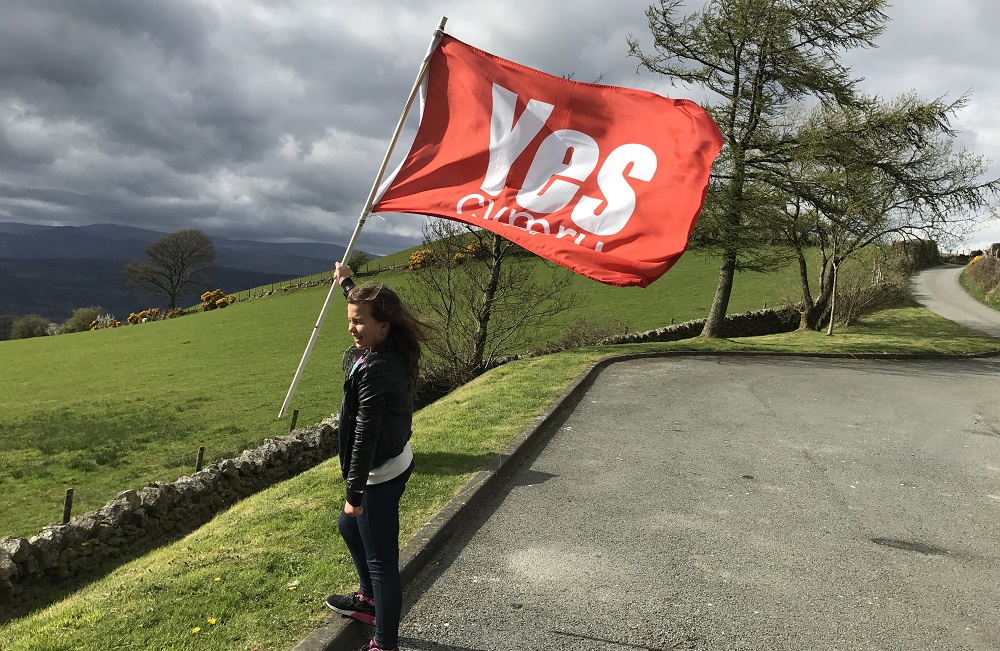
On the tenth anniversary of YesCymru, one of its co-founders reflects on how the movement transformed Welsh politics — and argues that independence must be judged not as an end point, but by whether it delivers real autonomy and freedom from domination.
Leon Noakes
February 20th marks the tenth anniversary of the launch of YesCymru. As one of several co-founders, there from its very beginnings, I take this opportunity to take stock of the movement’s progress, its impact upon Welsh politics, and ask: Does today’s YesCymru resolve any of the civic vacuum I felt back then?
People under a certain age may now find this unbelievable, but before the creation of YesCymru, the notion of Welsh independence was considered an anachronism.
Eager to prove themselves as professional and mainstream as any other political party, Plaid Cymru’s politicians became absorbed in the performative language of the new devolved settlement, hemmed in by language set out for it by its opponents, whether a scathing mainstream media or the trendy sophistries of academia.
Suddenly, Wales was the first ‘post-nation’, and the party had apparently never been in favour of ‘indy’.
Under the leadership of Ieuan Wyn Jones, and navigating the dizzying doldrums of power in Cardiff Bay, Plaid had loosed its moorings.
The election of Leanne Wood as leader in 2012 showed early promise but ultimately left unresolved the party’s ideological impasse.
I had countless conversations across Wales during that time, with people all wanting things to step up a gear. A long-time Plaid activist, Syd Morgan, created the Welsh Nationalism Foundation (with EU funding), and asked a question that resonated far beyond party structures: ‘What is Plaid Cymru for? Are we more than just a Lib Dems for Welsh-speakers?’
Scotland, meanwhile, had seen the SNP storm ahead and secure an independence referendum for September 2014.
The contrast was a cruel one, and some of us sought to address it. My own offering to this culture of frustration was to pen a stage-play, highlighting the complacency of former Welsh activists—those comfortably settled in Cardiff’s leafy suburbs, content to ride the promise of collective autonomy even as its energies ebbed away.
Result Night (co-written with Sara Hawys Roberts) was staged in Newport, Cardiff and Swansea. Its central character had once been a campaigner for Cymdeithas Yr Iaith, but now notoriously ‘wouldn’t lift a finger for Welsh independence’.
A modest intervention, but we managed to send the message: How are you lot going to feel, come September 18th? (We fully expected Scotland to go its own way.)
Spring and Summer 2014 saw the beginnings of what would become YesCymru. A small core team, comprising Hedd Gwynfor, Iestyn ap Rhobert, and Sion Jobbins, held meetings in Victoria Park, Cardiff, to organise a ‘Wales for Yes’ rally, designed to spur on our Scottish cousins.
Mere weeks in, several people crashed out; it was looking like coming to nought. Others withdrew, wary of potential professional or commercial repercussions, handing all tasks to a precarious few.
The previous two years had seen the stunted growth of something called the Welsh National Rights Movement, set up by me and musician-activist MC Mabon. This humble outfit boasted several dozen members and regular meetings in Pontcanna but saw scant activism.
Frustrations
As things turned out, people mostly wanted an outlet to vent their frustrations at what were deemed Plaid Cymru’s salaried select.
At our last ever meeting, in May 2014, Iestyn ap Robert arrived with a sense of foreboding: the September rally might not go ahead. It was from this that I became involved in a revamped organising committee for the Cardiff Bay rally.
Those early organisers were: Iestyn ap Robert, Hedd Gwynfor, Sion Jobbins, Branwen Alaw, Armon Gwilym, and myself.
Weeks after the rally and the referendum, several of us sat down to consider whether to set up a new campaigning organisation, to channel momentum for the independence cause in Wales itself.
For me, there was no question. And so, with no party machine, no funding, and no clear precedent, it was decided to shrug off some fetters and ensure that Welsh independence could become mainstream and a source of hope and national pride.

We did not know what YesCymru would become. A pressure group; a campaign network? What we did know was that Wales lacked a civic space in which independence could be imagined as something normal rather than eccentric — something discussed by ordinary people rather than whispered about at the margins.
As one of the co-founders, one of my contributions was symbolic but lasting: I devised the original YesCymru branding, the name, colours and logo. The circular roundel sticker, discovered on lampposts across Wales and beyond, designed on my own laptop in late 2014.
It mattered to me that our name be short, snappy, bilingual, and positive. ‘YesCymru’ might seem obvious now, but you should have seen some of the rival suggestions!
This was not a party brand, not an ethnic tribal badge, but something both assertive and inviting as a marker of civic involvement and grassroots activism.
Ten years on, YesCymru clearly succeeded in one crucial respect. It brought thousands of people into political activity who had never previously found a home in Welsh public life.
Through local branches, meetings, debates and acts of creativity, independence moved from being a fringe aspiration to a question that now sits firmly at the centre of Welsh politics.

Anniversaries invite celebration, but they should also invite reflection. Because the real achievement of YesCymru is not simply that independence is now discussable, but that Wales has begun—tentatively and imperfectly—to ask a deeper question: what would independence actually be for?
Independence is not simply about changing who governs Wales. It is about ensuring that Wales cannot be overruled, overridden, or structurally ignored, even by institutions that claim to act in our interests.
From a civic-republican perspective, freedom does not mean being left alone, nor does it mean simply choosing a different centre of power. It means living under rules we have the real capacity to shape, contest, and, if necessary, change—without being dependent on the goodwill of others.
Destination
Too often, independence is treated as a destination rather than a discipline of autonomy—as if constitutional change alone guarantees freedom.
But from the standpoint of autonomy and non-domination, simply exchanging one framework of dependency for another does not answer the question at all. Membership of larger political and economic blocs may be compatible with independence, but it cannot substitute for it; alignment is not the same thing as self-government.
Plaid Cymru is not unique in this regard. Across much of the democratic world, parties of all stripes have settled into a form of political inertia — more concerned with managing systems than challenging them.
As the American social critic Christopher Lasch warned decades ago, political life can harden into a self-referential professional class, increasingly detached from the civic energies and moral expectations of ordinary citizens. Seen in this light, the temptation to treat membership of large supranational institutions as an end-point rather than a context reflects a broader retreat from civic ambition.
Once the meaning and potential implications of the word ‘independence’ are mulled over in this way, the question then arises: What is YesCymru for? Independence from what, and for what?
For me, the answer lies in republican principles — above all, non-domination, whichever direction power flows. That does not require unanimity on every constitutional outcome, but it does require seriousness about the kind of self-government we seek.
If YesCymru’s first decade was about making independence mainstream, its second must ensure that it remains meaningful: a vehicle for autonomy, civic participation, and democratic responsibility, rather than merely a change of administrative alignment.
Would YesCymru campaign for a ‘Yes’ vote to become an equal member of a Confederation of the British Isles, provided London offered deeper autonomy than Brussels ever could? With the potential to play one union off against the other, Wales has been dealt a fecund hand.
Leon Noakes was a co-founder of YesCymru and gave the movement its branding. An author, he writes on Welsh politics, civic republicanism and culture.
Support our Nation today
For the price of a cup of coffee a month you can help us create an independent, not-for-profit, national news service for the people of Wales, by the people of Wales.
Get more trusted Welsh news
Choose Nation.Cymru as a preferred source in Google News to see more of our journalism.



YesCymru was needed. Plaid Cymru had got bogged down with Cardiff Bay politics and talk of independence (it’s primarily aim) was muted. To a certain extent – it is still muted. So there was a need for an organisation that was not hindered by the electorate – that could speak freely and openly about independence. Plaid are now on the cusp of power and hopefully with that power it can lay the groundwork for a future referendum on independence. However, it needs YesCymru to shout out the benefits of independence on its behalf – unshackled of potential voter rejection. The… Read more »
If Plaid’s plan is to let the people set the timetable as Rhun recently suggested then it needs others to get the polling consistently over 50%.
I am far from clear what Plaid’s plan is. It probably has more to do with not frightening Labour voters migrating to them; but still fundamentally unionist. Consistent polling over 50% for independence seems a very long way off.
A welcome and balanced piece as we stand on the cusp of a historic step forward. What’s more – now I’ve looked it up – I’ve learnt the meaning of the word ‘fecund’.
A ‘Confederation of the British Isles’ is not viable. Not because Wales is too small but because England is too big, with a large majority of population and GDP.
How would decisions with implications beyond the borders of individual members be taken if England wanted a policy that others didn’t? Equal votes per nation denies the rights of the majority; voting by population means England decides. Neither is satisfactory.
And why would Ireland want to give up the EU to join a body dominated by London?
England needs breaking up.
That would address the problem I raised. But there is no desire in England for breakup (not the same as devolution) and there would be no consensus on where the boundaries would lie. Wales has neither the right not the ability to tell England how to run its affairs.
The problem with confederation, federation, or other agreements is that ‘it takes two to tango’.
That fails to acknowledge that England was only a temporary alliance to defeat the Danes. The Yorkshire party came third in the 2021 West Yorkshire mayoral election.
It doesn’t matter. England is a nation in irs own right. Walk into a pub in Yorkshire, Northumbria, Somerset or Lancashire during the Six Nations or World Cup and they will be cheering on England. The Yorkshire Party are more of a devolutionist rather than a separatist party. The only part of England with a strong desire to separate is Cornwall.
What holds it together without the Danish threat is having Scotland and Wales to other. That’s why they can’t be allowed to leave, because the old Heptarchy rivalries will return.
Do you realise how desperate this sounds? Mercia and Wessex are not going to resurrect a more than millennium old war if Scotland and Wales became independent.
Without Wales to be worse they’ll quickly start to ask why the home counties have all the wealth and opportunity. Ultimately this is about quality of governance and there’s a reason why successful modern economies of this size aren’t operated from the centre. An independent England would only be beaten by Bangladesh, Turkey and Vietnam as the most fiscally centralised country.
Decentralisation is not the same as breakup.
Call it divide and rule if you prefer but what Scotland and Wales get the regions of England will want upto devomax. And a federal England is an England broken up into governable chunks. Full independence of these chunks isn’t likely except Kernow, Yorkshire and perhaps Celtic Cumbria.
The north-east of England voted against regional devolution shortly after the Welsh and Scottish votes for national devolution.
But they were promised “more doctors not politicians” by Dominic Cummings which never materialised (the money saved went instead to Crossrail which was greenlit by Blair weeks after the no vote) and they weren’t told it would make them the poorest part of the UK which is what happened. How long do you think that humiliation will fester without repercussions?
The case for redistributive recentralisation across England is strong, but that’s very different from dissolving the nation state.
thanks for this idea
All nation states are temporary. England has long duration, longer than Wales could claim as prior to conquest by Edward I it was a collection of warring lordships.
It could be argued that England’s longevity has not been continuous as it was disrupted by the Norman conquest and took centuries to re-establish itself on more or less its current borders. But it that case we should stop talking about an ‘English conquest’ by a Plantagenet monarch with extensive holdings in France.
https://www.theguardian.com/commentisfree/2026/jan/06/british-northerner-southerner-university-undergraduates-societies
https://www.theguardian.com/education/2026/jan/04/oh-my-gosh-theyre-all-from-london-and-cambridge-york-universitys-northerners-fight-back
There’s no unity.
There is never unity in a nation. All are imagined communities subject to different interpretations. There’s no unity in Wales. Nor has there historically been a simple north-south split in England. Remember the wars of the Roses?
The future is unwritten of course but England continuing on its path of massive regional inequality and highly centralised government isn’t going to happen. Some form of decentralisation is inevitable. And that’s why your dismissal of a restructured UK because England is too big incorrect. It is too big and that’s a problem that will be fixed one way or another. So a federal England within a UK confederation is possible. This might include the Isle of Man and the BOTs.
Even if England became a federal state, it could still act as a single unit within any confederation, as Germany does within the EU.
Agreed but that wouldn’t be at the whim of one person or department in Whitehall but the collective agreement of those federal regions. And as with the EU there would be measures to prevent the largest member from dominating the confederation.
While Trump is the obvious example of a federation acting as a single powerful unit to bully and intimidate, he is more constrained by the federal structure than he would be with a UK style system, and the neighbours aren’t any less exposed by being independent rather than in a confederation.
I no longer know what you’re arguing for. I started out by noting the limitations of a ‘Confederation of the British Isles’, which seems to make the future of Wales depend on what England wants. It’s all a bit fanciful.
The original post claimed a confederation was “unviable”. That’s all I was challenging because the dominance of a neighbour 18 times larger remains whatever the arrangement. What’s “unviable” is 56m folks being run from a desk in Whitehall.
I still defend my assertion that a ‘Confederation of the British Isles’ is unviable. The problem of a much larger neighbour certainly remains whatever the arrangements, a point I have repeatedly made to those supporters of Welsh independence who think it can be ignored. And I agree that the UK is over-centralised. A more viable solution would be for England, Wales and Scotland (alongside unified Ireland) all to rejoin the EU (or at least its economic structures) as equal status members. I was a ‘critical Remainer’ in 2016 and dislike the EU’s growing militarism but that would dilute English dominance… Read more »
It doesn’t negate the need to split up 56m into governable chunks to avoid the north rising up against the south and plunging this island back into the dark ages.
Decentralising the British state is not the same as independence.
In all scenarios, England is too big and needs to be broken up.
By whose reckoning? Should France be broken up, the USA broken up into 50 countries?
There’s nothing in the words “broken up” that implies independence. The USA is already broken up (aka divided) into 50 states, the largest of which is a third smaller than England. The USA is stronger as a result. No-one is demanding unification and complete control from DC.
California wants an independence vote now
Isn’t that a decision for the people of England?
The consequences of not reforming governance in England affects everyone on the island. Is Canada unaffected if the US slides back into civil war? Of course they will be, not just in economic terms but also the millions of refugees crossing their border and the risk of annexation by force. If it doesn’t happen that way it’ll be because of the federal structure more or less held together. A structure the UK, or an independent England doesn’t yet have. Not even close.
I agree that what happens within England matters to Wales. But we want a say on that beyond what might be within the scope of treaties, then we have to drop the idea of Welsh independence.
It’s like that TV show, Love it or List It. You fix all the problems before deciding whether to leave. Those that assume independence can only be a success if Wales remains impoverished and hard done by as a union member need to look at Catalonia. Being the richest part of Spain hasn’t dampened their enthusiasm to go it alone.
It’s better to address problems that to evade them.
Step one. Move central government out of London to avoid the outrageous £40bn refurb cost.
I get the point about England’s size and why that creates difficulties, but the relationship between the nations may not be as one‑sided as it’s often presented. A lot of what gives the UK its strategic prestige is not in England at all. Most of the North Sea oil and gas is in Scottish waters, and the UK’s nuclear deterrent and key military bases are also in Scotland. So in some crucial areas, England depends on Scotland just as much as Scotland depends on England. Even if the UK does break up, the nations across these islands would still have… Read more »
I entirely agree that if the UK did break up then there would be a need for joint arrangements in all the areas you mention and many more. It frustrates me that many advocates for independence ignore that. I’m not arguing that the balance is entirely one-sided although it is interesting that you quote Scottish examples rather than Welsh ones. Rather my point was about the difficulty of balancing democratic and national rights within an unbalanced (con)federation Achieving balance is an ongoing issue in both the US (where California has just 11% of total population) and the EU (Germany 18%).… Read more »
And Wales is going down the same path – for the Home Counties read greater Cardiff. It is no accident that 6 out of the 7 new railway stations announced yesterday are in the Cardiff/Newport area. The rest of Wales is over the next rainbow but one. We have swapped one highly centralised decision making process for another one.
That’s a concern, eventually. But not today when Cardiff is outperformed 2-1 by Swindon. The way to avoid the same mistake is to have a plan to move government out of the city once it approaches world city status. This is what’s needed in London and I was encouraged by a Matthew Parris interview on Sky yesterday that proposed a new parliament building in Birmingham to avoid spending an eye watering £40bn fixing up a crumbling fake Gothic white elephant that apparently no-one even likes working in and will never be fit for a modern democracy even after spaffing all… Read more »
I’m not sure upon what basis you are making the judgment between Cardiff and Swindon; but in the devolution context I’m more interested in comparisons between Cardiff and other parts of Wales. Btw, there is no more realistic prospect of Parliament moving to Birmingham than there was of the Senedd being anywhere else than Cardiff during that sham process run by Ron Davies nearly 30 years ago.
Relative and absolute size are important. You’re right that Cardiff’s growth shouldn’t come at the expense of the rest of Wales. But that doesn’t mean blocking Cardiff’s growth because all serious nations need a capital that can hold its own on the world stage. And why shouldn’t central government move out of London to somewhere more .. central. There are so many good reasons to do it, and the only reason not to is tradition. £40bn is unacceptable cost of tradition when ceremonial events can still continue in London by simply renting the chamber for a day from its new… Read more »
Devolution is indeed about more than Senedd but population will always carry weight in decisions.
True; but there is undoubtedly a Cardiff “bubble” just like Westminster. There is a recent and interesting podcast where Lee Waters and Laura McAllister got rather touchy about the suggestion from their fellow podcaster. Pontcanna and Pontlottyn are a million miles apart in the heads of most policy makers.
Having grown up at the head of the Rhymney valley then since lived in Cardiff, I won’t argue over the Pontlottyn/Pontcanna difference. The latest example is the refusal of Welsh Government to contribute to repairing the Tirphil-Pontlottyn road after a landslip, leaving Caerphilly Council to foot the £10mn bill.
Those railways decision’s are being set by Westminster, not the Senedd.
Maybe; but based upon plans from TfW aka Welsh Government. The Metro is certainly a WG programme.
Roots in Pontcanna ? Not a good start for anything that wants to speak to the rest of us in terms that we understand.
Does ‘ensuring that Wales cannot be overruled, overridden, or structurally ignored, even by institutions that claim to act in our interests’ mean that an independent Wales should accept no treaty or other international agreements? If not, what does it mean?
Remarkable or obviously not, this trip down memory lane conveniently ignores the fact that Yes exploded in a train wreck of waring factions, social media wars and a sacked chief executive. Nostalgia ain’t what it used to be, especially in Wales.
Author writes about activism but when it comes to action, where is his photo on this page?
What’s that got to do with activism and action?
Eh??
I am glad Plaid Cymru and YesCymru exist. Both have cancelled me. And Nation.Cymru often accepts my comments, and then deletes them. My crime? Saying that they need to get more than 50% of the votes, moderating the policies so all the Welsh can rally round. And for saying that we need to write a Constitution and crack all the arguing in circles which surroung this topic. Lets see if this post gets nixed!
Hiya! Not known any of yours deleted by the team – the down-voting from other commenters would be at fault there sorry.
Do you delete comments because they are unpopular?
No, we have an automated system do that when it’s down-voted by a considerable amount of people. We only personally don’t approve anything that is inflammatory such as racist posting, or anything libellous etc.
Exactly how many downvotes are needed for a comment to be deleted?
It’s a net minus vote of 10.
Just as well Galileo didn’t post on here! Seriously, it’s an excellent news site, even for sceptics, and comments below the line are not life or death, but it seems an odd system which I had no idea about.