


The Art of the Possible
Ben Wildsmith
In recent years, the practice of politics as a set of skills has come to be distrusted by a significant portion of electorates across the world. The facility of figures like Tony Blair, Barack Obama, Bill Clinton, David Cameron, Justin Trudeau, Angela Merkel etc. to sell us nothing as if it were everything has created a resentment that goes beyond party preferences.
The Reform UK accusation that the Conservatives and Labour have comprised a permanent ‘Uniparty’ government is grounded in observable behaviour.
Fiscal restraints from the bond market and international obligations severely limit how radical UK politicians can be in office. Commitments become ambitions, policies become consultation processes, and principles acquire the elasticity demanded by circumstance.
We have been sold the moon so often now that, for many, any appeal from within traditional political practice is treated with suspicion and hostility. Should Farage and his merry band of pretend revolutionaries ever find themselves encumbered with ministerial red boxes, disappointment will mar the enjoyment of even the wildest Countdown episodes for their voters. It’s unavoidable.
If over-promising is one infuriating political trait, it finds its reflection in the politics of those for whom nothing is ever enough.
This is a tendency most often seen in single-issue campaigners, for whom the interconnectedness of politics can be cheerfully ignored if reduced to hermetically sealed matters of principle. For instance, there is often consternation at unions for supporting polluting industries or weapons manufacture.
The RMT, when led by Mick Lynch, committed the ultimate liberal sin of supporting Brexit. Imagine!
For the union, though, freeing up a potential Labour government to subsidise rail in ways restricted by the EU was central to its mandate.
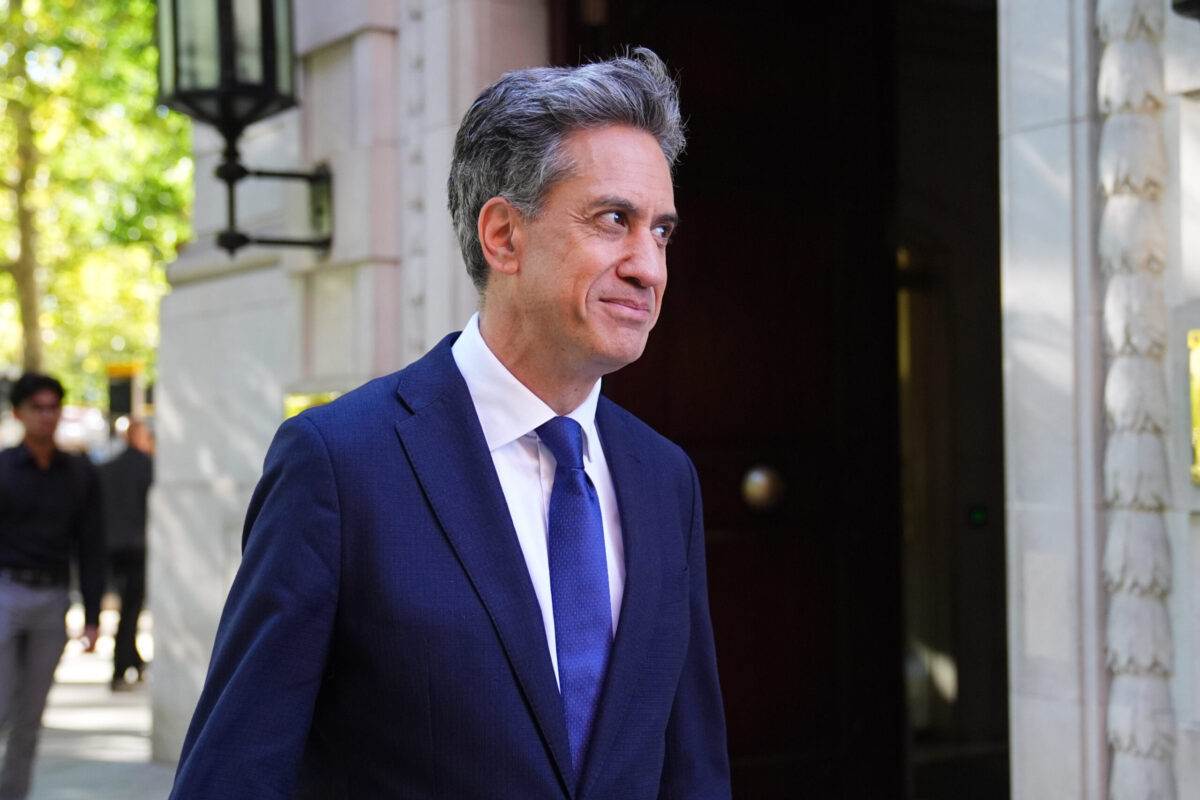
Politics is a scrap for resources that rarely takes a breather to indulge principles, and even then, only if the consequences are accounted for. Such a chink in the darkness was forced open this week by Ed Miliband.
Keir Starmer’s political mistake was that he didn’t understand how quickly political capital degrades. Politicians have a strictly limited window in which to capitalise on their novelty. Starmer thought he would solidify post-election goodwill by demonstrating caution but that, I’m afraid, ain’t how showbiz works.
Miliband has gone as big as it is possible to go in his first meaningful move as Foreign Secretary. Taking on the issue of terrorist settlers in the West Bank as an opening gambit is a clear contrast with the dithering inaction of Starmer’s era.
Like many former Labour supporters, my criticism of the party is spiced with the betrayal I feel over its continual failure to address big issues on behalf of the people who vote for it. The spiteful, insubstantial games favoured by its Senedd cohort are emblematic of a party that has driven most of Wales beyond frustration to permanent rejection.
Whatever our feelings about it, however, we remain in the UK and will do for the foreseeable future. So, a functioning, decent government in Westminster that reflects values we recognise is desirable.
Pragmatism
Palestine is an issue that cannot be approached with pragmatism alone. Bad faith arguments and disinformation are pumped into the debate from all corners of the world, distorting the issues and creating an atmosphere of mistrust.
For a nation state to hold a meaningful position requires the statement of its core values and a willingness to withstand attacks, rhetorical or physical, for doing so. In his speech this week, Miliband recovered an ethical footing for the UK which seemed to have been lost.
His approach was an example of how political skill can be harnessed for something finer than deception. The decision to sanction businesses in the occupied West Bank had been widely trailed for a couple of weeks. This drew responses from Israeli right-wingers that materially changed the terms of debate for UK-Israel relations.
The suggestion that the UK had no business in the Falkland Islands has soured an assumed affection between conservative opinion in the UK, which is strongly attached to the Falklands, and the current Israeli government.
Entrapped
By allowing the move to become known in advance, Miliband entrapped extremists in Israel into alienating the only section of UK opinion upon which they hoped to rely. Moderate Israeli opinion, from figures like former Prime Minister Ehud Olmert, has swung behind the UK move.
Miliband has repositioned the debate on Palestine away from a left/right paradigm towards one in which the Israeli government’s actions are framed as contrary to shared British values. In turn, this has exposed some pro-Israeli voices in the UK to emboldened criticism from within our Jewish community. In particular, the legitimacy of the Chief Rabbi as an unquestioned voice for that community has come under new scrutiny, with prominent rabbis expressing support for the new policy.
This second point underscores the daring of Miliband’s action. The Foreign Secretary will have known that pursuing this issue would expose him and his family to relentless criticism from around the world. By choosing to emphasise his Jewishness at the outset of his speech he took on the notion that support for Netanyahu’s government is somehow a token of authenticity. Indeed, he advanced the position that long-term support for Israel as a state is dependent upon creating a viable counterpart for Palestinians.
Suddenly, the photo of him clumsily eating a bacon sandwich which had been used by antisemites to suggest he wasn’t British enough back in 2014, was now being trotted out by supporters of Netanyahu to invalidate his Jewishness.
International weight
Announcing the sanctions in concert with France and Canada, but in the teeth of MAGA opposition in the USA provides international weight at a time when Donald Trump’s administration has squandered American claims to moral leadership. As conservatives in the USA begin to question the wisdom of and motives behind support for Netanyahu, Miliband has raised a flag for the UK’s relationship with America if Israel continues as it is.
Those who are disappointed with the scope of the government’s repositioning should look at how widely the ripples from it have spread around the world.
Effecting meaningful change in the world requires a tightly focused effort – in this case restricted to the West Bank and excluding Gaza – public support, which polls today confirm, and a viable coalition of partners.
To pull that off requires political skill and personal bravery. The Foreign Secretary possesses both and we should applaud him.
Support our Nation today
For the price of a cup of coffee a month you can help us create an independent, not-for-profit, national news service for the people of Wales, by the people of Wales.
Get more trusted Welsh news
Choose Nation.Cymru as a preferred source in Google News to see more of our journalism.



The irony of the RMT position is that a number of the train operating companies were owned by European state transport companies, and rolling stock is manufactured by foreign companies.
I won’t comment on politics, but economics as taught to me at Cardiff Uni in 1993 is simple. There are high tax, high productivity, high growth countries (now France / Germany) and low tax, low growth, low productivity countries on a downward economic spiral like England. Wales has a mixture of organisations such as Iceland / Gocompare / Celtic Collection that should grow in a boom or bust period; plus Leekes / furniture manufactures that cannot compete with organisations such as Amazon (Burnham maintains their Sunak given tax break – a competent politician would not give a tax break to… Read more »