


The Caerphilly TV Debate: any wiser?
Desmond Clifford
Good luck to any Caerphilly voters who were planning to decide how to vote based on the BBC Wales by-election debate!
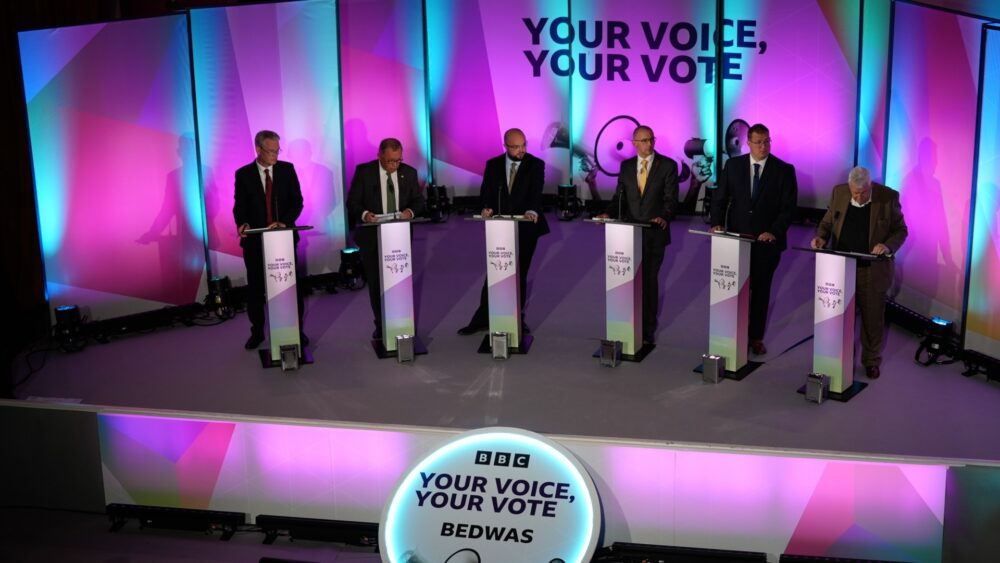
Apparently, there are no women in Caerphilly – who knew!? I hadn’t realised how men over a certain age start merging into one loud voice.
There were six candidates, all men, and a further two not on stage (Gwlad and UKIP). And, of course, they did that men-in-the-pub thing of shouting across each other so that no one could be heard a lot of the time.
I wonder whether the BBC slightly compounded the issue. I like Nick Servini as a presenter; he knows his politics and always does a good job. I just wonder if, on this occasion, a female presenter might have been better, if only to remind voters and viewers that women form around half the population!
Skewered
That said, the audience was balanced and on-point. A woman from the floor skewered Reform by describing her fears for her mixed-race son since the party started stirring tension about immigration, even though it’s statistically a negligible issue in Caerphilly.
The problem for voters was that candidates were difficult to distinguish from each other and said a lot of the same things. This debate format is more commonly used for leaders’ debates and, to be fair, it’s not the fault of candidates in a by-election that they arrive on TV without much prior recognition.
You could be forgiven for thinking this election is all about libraries – and no bad thing if it is.
Cutbacks and closures have afflicted Caerphilly as they have other parts of Wales. For what it’s worth, I’ll gladly pledge my vote in 2026 to a party which promises to legislate for protection of library and cultural services on a statutory basis.
It’s ruinous that reading, music and culture are treated like optional extras in a country whose national anthem declares it the land of poets and musicians (“…gwlad beirdd a chantorion..”).
NHS
All the candidates want a better NHS, and they are all, apparently, more or less committed to it. Ideas for making it work better were scarce.
What really struck me was the extent to which issues beyond the Senedd’s powers dominated debate.
The Greens’ aspiration for a new tax on wealth could only be introduced by the UK Government; the Welsh Government doesn’t have the powers. Reform’s obsession with migration – a non-issue statistically in Caerphilly – cannot be legislated on by the Senedd; again, a UK matter.
Voters are abandoning old loyalties. Contemporary politics suggests people are motivated as much by political culture as by policies. In other words, voters identify with a particular party in much the same way as people do with football clubs or music or religion.
A quick canter through performances.
Labour’s problems
The Labour candidate personified the party’s wider problem; it’s tricky defending a 26-year status quo, especially with an unpopular UK Government in the background. Opinion polls show Labour can’t plausibly be the “Stop Reform” option, in spite of their history in the seat.
Plaid has track record in Caerphilly. Their candidate is experienced and has served as a Senedd Member previously. This could be a mixed-blessing in this “plague-on-all-their-houses” age of iconoclasm. Nevertheless, he showed local passion, and he really is the Stop-Reform candidate according to the polls.
Reform’s candidate showed some confidence but nothing he said suggests Reform has any specific vision for Wales. It’s hard to pin down guiding principles beyond an obsession with migration, a significant issue at UK level but not immediately pressing in Caerphilly or most of Wales; he had no good answer to the woman who spoke from the floor.
The absence of track record or firm ideas may, oddly, be an asset; for now, Reform can be anything you want it to be.
There was nothing much wrong with the Lib Dem; there rarely is, but they’ve been squeezed from Wales. He wants tax rises to pay for social care. The Welsh Government can raise tax modestly, but it would collect shockingly little money (in the grand scheme of things) and make Wales less competitive economically – a real issue where most people live and work close to the English border.
Bellowed
The Green candidate bellowed across the stage like an angry Old Testament prophet – “You’re all damned, damned I tell you!”
Actually, he didn’t say that, but he did take a dim view of everyone and everything. All will be well if we impose a wealth tax, he argued. A wealth tax in Wales alone would raise practically nothing and, in any case, could only be implemented by the UK Government.
The Conservative was quietly spoken, and nothing wrong with that, but thought you could boost the NHS by closing Welsh Government offices at home and abroad. If you shut all the Welsh Government’s offices abroad, that would finance the NHS for the first five minutes of Monday morning.
If you made the Welsh Government homeless and sold off all its offices, that’d finance the NHS for around half a day.
As the Senedd’s official opposition, the Conservatives have had five years to come up with decent policy – what the heck have they been doing!
If voters didn’t already have an inkling, I’m not sure how all this would help a voter reach a decision.
I applaud the BBC’s public service effort to test candidates on air even if this format is a bit clunky for a by-election, especially with so many candidates.
Actually, in future, there won’t be any more Senedd by-elections. Under the new “list system” election in use from 2026 any vacancies will be filled automatically from within the party which held the seat and without a by-election – arguably, a reduction in the strength of democratic practice.
Whoever is elected in Caerphilly will only hold the seat for six months until next year’s Senedd election.
Draft budget
An immediate consequence may be short-term difficulty over the upcoming Draft Budget tabled by Finance Minister Mark Drakeford.
Even if Labour win the seat, the Welsh Government will still need another vote from somewhere. If Labour lose the seat, they’ll need two. Given that the Draft Budget includes some £300m unallocated spending up for grabs, it’s surprising that candidates in the debate didn’t go there.
Longer term, the by-election represents a real-world test of voting intentions. If Reform win, it will mean they have two seats in the Senedd, one properly won at an election.
It will put wind into their sails and give them a stronger platform for 2026.
If Plaid win, they will be mightily relieved since this is the sort of seat they ought to take if they’re to be the biggest party in 2026. On current trends, the most likely outcome next year is that the largest party now (Labour) will be third and the official opposition now (Conservative) fourth.
Strange days.
Support our Nation today
For the price of a cup of coffee a month you can help us create an independent, not-for-profit, national news service for the people of Wales, by the people of Wales.



The Reform candidate demonstrated exactly what we should all grasp his party actually offers: an ability to ride roughshod over proceedings, a total failure to listen, a lack of research, and a visible arrogance not demonstrated by any of the other candidates.
Well it was amusing that they all clamoured to be the most supportive of improving public services . Whittle does looks like the safe bet for residents. Powell seemingly unable to think on his feet. The Reform party stock answers clearly hadn’t contemplated the mother of a mixed race son throwing in a grenade , Then remembered the party line about too many immigrants. Which offered little comfort to the Caerphilly mother . His eye roll was very telling . “Conveys a range of negative emotions, such as contempt, frustration, or “here we go again” annoyance, and is often used… Read more »