
The case for cutting Wales’s professional clubs is not supported by evidence

By Professor Keith Davids, Dr Steve Bullough & Tim Vernon, Sheffield Hallam University
This is an extract from the Welsh Rugby Data Report, produced by academics in the School of Sport & Physical Activity at Sheffield Hallam University and dated November 2026. The report was commissioned by Ospreys Rugby.
The rationale for serious change in Welsh rugby is not supported by evidence. Reducing an elite professional group of four clubs to three or two would concentrate the pool of players in fewer locations and narrow down the competition pool.
This approach is not good for the quality of the whole player development system, including the talent pool and the performance of Welsh teams in competition.
The theory of nonlinear dynamics and the evolutionary and complexity sciences in nature show that greater variability in a gene or talent pool leads to better adaptation and thus better performance of the whole system, whether a group, flock, herd or community of athletes.
In research on professional sports, such concepts from social biology are regularly used to weigh the pros and cons of decisions in complex systems, particularly where different factors interact to shape selection through competition.
These ideas have been examined at the levels of sports organisations and of coach–player interactions.
These well-understood ideas from social biology also have serious implications for the proposed reduction in the number of Welsh rugby teams.
Talent development
Reducing the number of teams would constrain talent development by limiting the choices available to talented Welsh players. For example, they would have fewer opportunities to experience different coaching styles and performance philosophies and to compete against and cooperate with a wider group of talented players.
It would also narrow the talent pool by reducing the number of academy places, professional contracts and opportunities for players to develop.
That effect could be compounded if talented players move away from areas where rugby has historically played a prominent role in bringing communities together.
With fewer places in academies and teams across Wales, some players could have to move elsewhere. Removing a club would also mean fewer Welsh supporters attending professional matches and fewer elite playing opportunities in Wales.
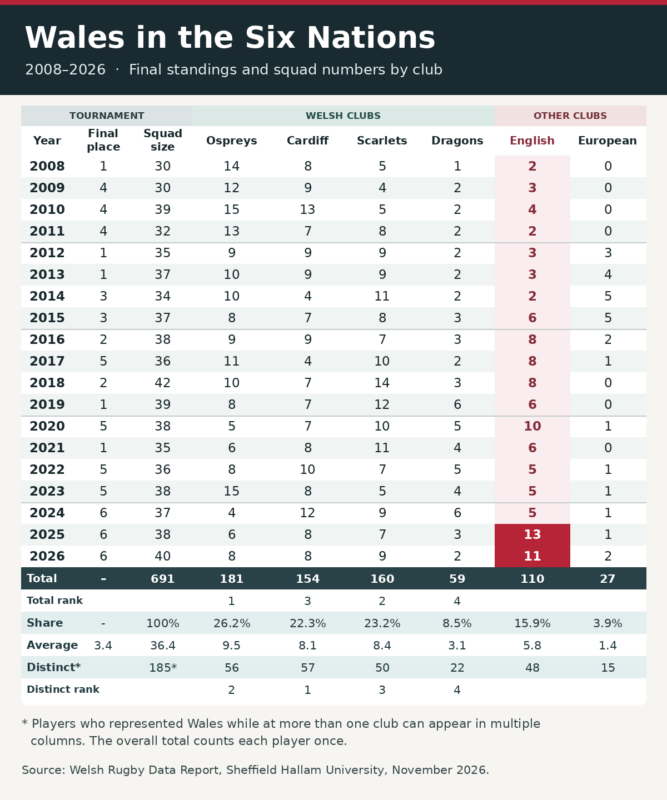
The table below shows that English clubs supplied five of Wales’s 37 Six Nations squad members in 2024, 13 of 38 in 2025 and 11 of 40 in 2026.
With professional clubs in Bristol, Gloucester, Bath and Exeter, as well as rugby schools across the border and potentially another professional option in Worcester, players looking to continue their development in England have several options within reach.
Previous studies have also shown how strongly social, cultural and historical factors shape the interest of fans and potential players in team sports in Britain and Ireland.
Football and rugby union, for example, both have professional leagues rooted in particular regions of Wales, Scotland, England and the island of Ireland.
Regional identities
Professional leagues in many sports grew out of clubs with strong regional identities, and some of those clubs built worldwide reputations through local rivalries. The pride those rivalries generate helps shape community identity and sustains the commitment of players and supporters at local, regional and national levels.
Reducing the number of competitive teams would be at odds with that loyalty, emotional attachment, pride and identity. It could lead talented athletes to take up other interests or choose another sport, shrinking the pool of players available to Welsh rugby.
Keith Davids is Professor of Motor Learning in the Sport & Human Performance Research Group at Sheffield Hallam University, UK. Internationally recognised for pioneering ecological dynamics and the constraints-led approach, he researches perceptual-motor learning, skill acquisition, nonlinear pedagogy and athlete development across elite sport and physical education. Tim Vernon (Principal Research Fellow) and Dr Steve Bullough (Senior Research Fellow) are academic staff in the School of Sport and Physical Activity at Sheffield Hallam University, UK.
Read the Welsh Rugby Data Report extract on commissioning and independence
Support our Nation today
For the price of a cup of coffee a month you can help us create an independent, not-for-profit, national news service for the people of Wales, by the people of Wales.
Get more trusted Welsh news
Choose Nation.Cymru as a preferred source in Google News to see more of our journalism.