


The future of Welsh renewable energy lies offshore
Jonathan Dean
If Wales is serious about becoming a world leader in renewable energy, it must be clear about which battles are worth fighting for the greatest reward.
Wales has arguably already lost the race for large-scale onshore wind, as Scotland’s capacity already exceeds anything Wales could realistically achieve.
The same is true for large-scale ground-mounted solar, where the eastern counties of England have built up an enormous planning pipeline. Wales needs to be strategic and focus on areas where it has genuine advantages.
Offshore wind is one such area. Fixed-bottom offshore wind is well established in the North Sea, where shallow waters make development relatively straightforward. Existing supply chains can be extended into the Irish Sea, where UK offshore wind first started.
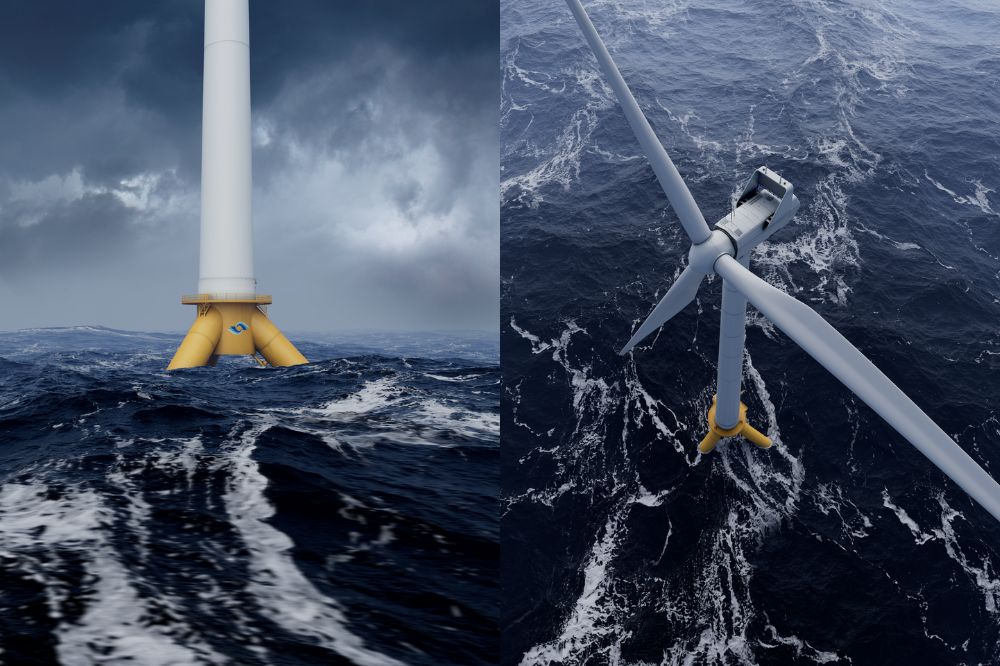
But the real opportunity lies in floating offshore wind. The Celtic Sea has the potential to provide up to 20% of the UK’s offshore wind requirement, offering Wales a chance to lead in a technology that is still emerging.
The National Energy Systems Operator (NESO) predicts that by 2050 Wales will need to generate at least 40 TWh of electricity, up from below 15 TWh today.
This level of generation could be met, and exceeded, through offshore wind alone. That creates the possibility of reaching net zero without making difficult trade-offs involving the loss of valued landscapes, carbon-rich upland peat and rare habitats, and the rural economy that depends heavily on tourism and agriculture.
Celtic sea
There are currently around 2,500 MW of offshore wind capacity in Welsh waters that is operational, under construction, or consented, all in the Irish Sea. The first major tranche of floating wind in the Celtic Sea has now been agreed at 4,200 MW.
With further opportunities in both the north and south, the 10,000 MW required by 2050 is within reach. Offshore wind also has the potential to support long-term service and maintenance jobs in coastal communities, in contrast to onshore wind, which tends to offer more limited long-term employment.
At the other end of the scale, something that has not yet been done well anywhere, but which has huge potential, is community-scale renewables.
Surveys consistently show strong public support for renewable energy in Wales, yet individual planning applications often meet fierce local opposition.
This apparent contradiction is partly explained by how questions are framed: people support renewables in principle, but react very differently when faced with large, highly visible infrastructure close to home.
The reality is that we do not yet have a clear model for how communities themselves want to contribute to the transition to net zero, because they have rarely been asked in a meaningful way.
Done properly, community-scale renewables, designed with local input and delivering local benefits, could be genuinely world-leading.
Grid capacity
One of the main barriers to this is grid capacity. To understand that it is important to recognise that there is no single “Welsh grid”, but layers of interconnected systems.
The transmission network operates at voltages above 132 kV across Great Britain, moving large amounts of electricity from where it is generated to where it is needed. That power is then stepped down through 132 kV, 33 kV and 11 kV distribution networks to reach homes, farms and businesses.
Most of the “grid issues” experienced by local users occur at these lower distribution voltages. This leads to situations where a farm may struggle to secure an 11 kV connection for rooftop solar, while a very large development nearby connects more easily to the transmission system.
Across Wales, the demand for electrification, electric vehicles, heat pumps, and local generation, is growing rapidly, but the final links in the network often lack capacity.
Investment
The next round of distribution network investment is now being planned, and it offers a real opportunity to address these constraints. Upgrading existing overhead lines with higher-capacity conductors could unlock significant additional capacity.
This reinforcement is needed anyway to support wider electrification, so enabling community-scale renewables is part of the same effort.
Community-scale projects are typically more acceptable because they are smaller, less intrusive, and deliver visible local benefits. Alongside the vast offshore resource, and the wider GB electricity system, they can play an important role in a balanced and resilient energy future for Wales.
Jonathan Dean is Director of The Campaign for the Protection of Rural Wales
Support our Nation today
For the price of a cup of coffee a month you can help us create an independent, not-for-profit, national news service for the people of Wales, by the people of Wales.
Get more trusted Welsh news
Choose Nation.Cymru as a preferred source in Google News to see more of our journalism.



I want NC to find out exactly who has been responsible for all this at WG level for the last 25 years. I want them named, shamed and their fat pensions removed. I want answers from Drakeford et al. To see us this far behind when it should be powering our economy and prosperity is an utter disgrace. Why has it not been happening? And what is the plan from the new WG? Put the previous governments’ inactivity alongside other self-harming gestures such as the M4 relief road and one could be forgiven for suggesting that it has all been… Read more »
You won’t get answers because there is no plan, never has been, and never will be. Meanwhile Scotland strides ahead. People whine on about the private sector but has the WG done a single thing to create jobs itself or encourage companies to invest?
Surely the principle is as ever, “The right development in the right place”. The frustration for me is that as has ever been the case, the ownership of energy production in Wales is, for the most part, for the profit of people outside of Wales. We do not own the infrastructure, we cannot tax the profits. Annibyniaeth cannot come soon enough.
We appear to concentrate on large scale onshore wind as if it is the only way to produce clean energy. There are several better alternatives that don’t destroy our precious uplands including offshore wind, tidal, small nuclear reactor and hopefully fusion sometime soon.
Large scale onshore wind is primarily for the enrichment of outside interests at the expense of local Welsh communities and habitats. There are better and less controversial alternatives.
Large scale onshore wind is the only chance Wales has to benefit. All offshore energy falls under the remit of the Crown Estate. That’s where all profits go (that or private non Wales groups) then they go straight to Westminster. There is currently no appetite in Westminster to devolve the Crown Estate and as much as we’d like to pretend Rhun could force the matter, he can’t. With on-shore wind energy the Future Generations Act may come into play with planning considerations and it’s much easier for the Welsh government to invest in Welsh energy suppliers and therefore benefit… even… Read more »
Energy security is an important concern. How secure can offshore wind be with the increasing presence of Russian ships around our shores? We have already seen attacks on underwater internet cables.
Who said it has to be off shore wind? There are options for tidal power in South Wales, tidal stream in the north around Anglesey, then there is also wave technology which is beginning to come to the fore – which is more constant than wind. Wind has a part to play, but it is not the be all and end all anymore.
You need a divers option for renewables. Not all your eggs in one basket. That includes onshore and solar options.
Also just look at the prices? Solar energy, by far the cheapest form of energy currently, bar none, cheap and quick to set up (see Nuclear as comparison) and bam no need for dirty polluting diesel tractors, HGVs, harvesters, landrovers.
The future of welsh renewable energy. Yes perhaps sometime in the distant… extremely distant… future post Welsh Independence. Right now, the Crown Estate remains the property of Westminster and there are no signs of us getting anything like the carve out that Scotland did. Right now, if we want energy to benefit Wales there are no ifs and buts, it MUST be on-shore energy generation, preferably by using EnergyLocal-esque schemes. Our immediate future for Welsh Energy is our hills to be covered in wind turbines and our farms to be filled with Agrivoltaics. Not withstanding car parks that should absolutely… Read more »
if we want to fail to hit out climate, nature, and energy targets and obligations by refusing to engage with the most easily deployable, most mature, and most cost effective technology, crack on. otherwise we need onshore wind. not sure where anyone is saying we only need onshore wind…..you can tell the next generation why we waited for perfect rather than acted.