


The hypocrisy of ‘animal lovers’: It’s time to follow Australia’s lead and give our wildlife a chance

Stephen Price
A songbird described as a ‘national rarity’ that had flown to the UK from Siberia has been found dead after being caught by a cat.
The cat’s owner, who wishes to remain anonymous, said her cat brought the killed Siberian rubythroat into her home in Brampton, Cumbria, last weekend.
Cumbria’s county recorder for birds, Chris Hind, shared there had only been 17 accepted records of Siberian rubythroats in Britain between 1975 and 2022.
He described the species, which are related to the European robin, as ‘very secretive’ birds, making this ‘an extraordinary scenario’.
The bird is thought to have flown to the UK from Siberia and was ‘very underweight at 28g’, Mr Hind added. Healthy Siberian rubythroats normally weigh around 75g.
The anonymous woman said her ‘heart sank’ when the cat brought the dead bird into her house, telling the BBC: “I saw the bird’s distinctive beautiful orange-red feather patch under its beak but I couldn’t recognise the species.”
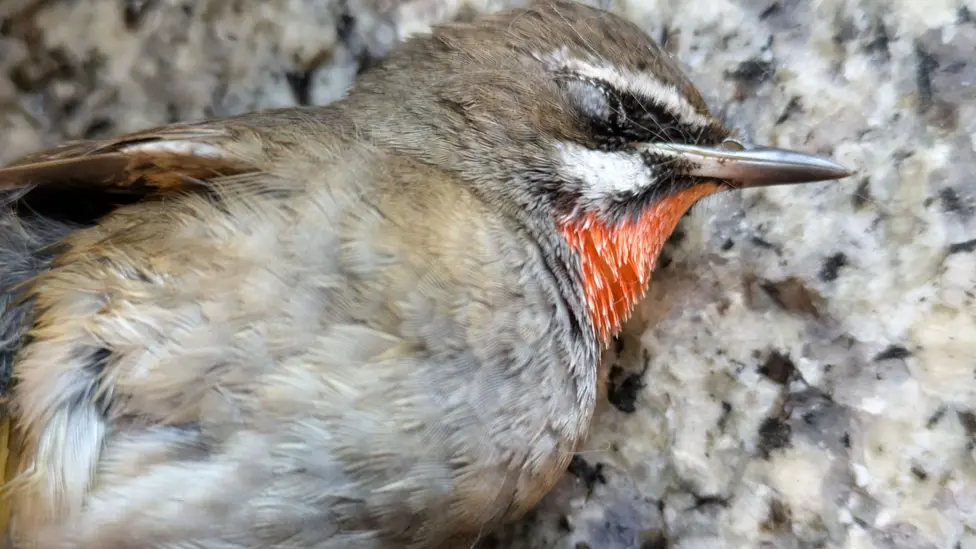
She stored the dead bird in her freezer while she researched what it was and contacted the RSPB.
Josh Jones, the senior editor of the website Bird Guides, said the bird probably had a ‘long journey from the vast wilderness of Siberia’, adding that it was ‘tragic’ it had likely been killed by a pet cat.
He said: “At this time of year, Siberian rubythroats should be heading south from their Siberian breeding grounds to spend the winter in South-East Asia, highlighting just how far off course this bird in Cumbria was.
“After such a long journey from the vast wilderness of Siberia, it has perished in the most unfortunate of circumstances.”
“It’s the natural cycle”… No, really, it’s not.
Sadly, this headline-grabbing casualty is far from a rare event.
Passing a ginger tom on a walk recently, I happened to notice he had something very rodent-like writhing in his mouth. A young vole, thrashing and fighting for its life and standing no chance.
Being the little wildlife warrior that I am, I did my best to get the cat to let go, and somehow managed to come out on top. A temporary win for the vole, which no doubt succumbed to its injuries soon after I let it go.
It’s not the first time I’ve tried to do such a thing. My one and only experience of feeling real moleskin was when I saved a poor critter from next door’s cat as a child, and I’ve also been witness to the way a (well fed) cat will play with and torture rodents – letting them run, clawing and biting them back in for fun. It’s painful enough to watch, let alone endure.
And I can’t fault the cats in any way. They’re doing what they’re programmed to do. They’re hunters.
But where I will point the finger is at most cat owners. Those 26% of cat owners in the UK who I would describe as ‘pet lovers’ as opposed to ‘animal lovers’.
And the usual argument is, ‘it’s just nature’ – but that’s the thing. It isn’t.
Domesticated cats are not native to these isles or even to this continent – and our native wildlife, fine-tuned to our ecosystems over many millennia, doesn’t stand a chance.
“This is fine”
I was once a paid-up member of a local bird rescue charity.
Again and again (and again and again, I could go on) pretty much each and every bird, both rare and common posted to their Facebook page, had been attacked by cats – or had lost their parents to… wait for it.. cat attacks.
I called it out once, and once only, with a comment along the lines of ‘I am so heartbroken seeing this – surely we need to do something to stop cats doing this day in and day out?!’
If I did.
Not only was my comment piled on by the ‘bird lovers’ who were quick to school me on the laws of nature, the bird rescuer herself told me that she could see both sides of the argument and to refrain from making such comments on the page.

Quite clearly, being a badge-wearing member of the V Gang (that’s vegans for the uninitiated), I adore the animal kingdom.
I actually mean it when I say that I prefer animals to humans, that my instinct is to always do good and to protect the weaker among us, and that goes for cats as much as any other animal. They’re brilliant. Each and every single one is different from the next.
I feed two stray ones regularly. So I have no issue with them on a personal level, but collectively, am I a fan of over ten million roaming the streets of the UK, killing frogs, toads, fledglings, voles, bats… you name it? No.
Sharing my opinion, Chris Packham has urged both the RSPB and RSPCA to speak out about the havoc wreaked by cats on garden birds for years now, but so far his calls have fallen on deaf ears.
He told Yahoo! News: “Most people would agree that if you’re taking 60 million songbirds out a year from one source, that’s 60 million deaths you don’t need.
“When it comes to cats it’s relatively easy to reduce that total. I don’t dislike cats, despite the reputation I have – it’s not the animal’s fault. Cats can end up in the hands of people who keep them out of habit and don’t always look after them.
“If there are fewer cats there is less of an impact on wildlife.”
He says that keeping cats in at night would reduce predation rates on birds and animals by 50%, while giving cats collars would take the number down by 45%.
The effect of these ‘relatively easy’ measures could save tens of millions of birds and small mammals each year, Packham says.
I say he’s not going far enough, and that domesticated cats should be kept indoors at all times.
The killings I’ve unfortunately witnessed have all been during the day – and it’s completely unnecessary and unjustifiably cruel.
Killing machines
According to People for the Ethical Treatment of Animals, free-roaming cats are responsible for the deaths of 2.4 billion birds and 12.3 billion (yes, billion!) mammals in the United States alone each year, but other studies suggest this figure is much higher.
They say: “People wouldn’t dream of opening the door and letting a toddler wander onto the road. Yet every day, cats are run over, poisoned by anti-freeze, or die at the hands of cruel humans – because their guardians do just that.
“If you love your cat (and care about other animals), for goodness’ sake, keep them indoors. Make your house their home, with views to enjoy, things to play with, and your love and attention.”
They argue that cats should be kept indoors at all times, and have given some practical advice on how to do so and to keep cats safe and healthy. But is anyone paying attention?
In the UK alone, cats in our suburbs may be killing up to 270 million animals per year, a study suggests.
Suburban cats living on the edge of natural areas kill an average of 34 animals each per year, according to the research.
Those living in suburbs but surrounded by other houses and further from natural habitats killed an average of 15 each.
Cats in both types of areas killed similar amounts of birds, but those on the edge of the green spaces killed more mammals, the researchers from the University of Reading and Royal Holloway University of London discovered.
In terms of the types of birds killed, the cats with easy access to the natural land killed far more robins, while the others killed far more blackbirds.
Wearing a bell was no deterrent, with these cats actually bringing home the most prey, the study found.
Dr Rebecca Thomas, from Royal Holloway University of London, who was part of the research team said: ‘They are a non-native species. ‘They reach incredibly – and unnaturally – high densities, especially in suburban environments.
‘They get fed by their owners and given veterinary care so you could consider them mini super predators.’
“Fear effect”
And it is not just the direct killing of prey that is the issue, said the lead author of the study Dr Tara Pirie, who is based at the University of Surrey.
The mere presence of cats in an area can have what is known as a ‘sub-lethal fear effect’ which then has consequences for animal numbers down the line.

Dr Pirie said: “Just the presence of a predator can cause wildlife to change their behaviour either reducing feeding through heightened vigilance or staying away from a nest leaving it exposed, for example.”
“This can reduce the survival of both adults and offspring.
“Cats can also carry diseases such as Toxoplasma gondii which can be transmitted to wildlife, again reducing their survival rate.’
For the study, published in the journal Landscape and Urban Planning, the team tracked the movements and amount of prey brought home by 79 cats living across Berkshire and Hampshire, over a period of a year.
They compared the predation rates of those living within 100 metres of natural land and those living around 1 kilometre from it.
The pets near the natural land ventured an average of 3.42 hectares around their home, while the others roamed in 2.01ha.
“A simple extrapolation based on the predation rates found in this study suggests that the 9.5 million pet cats in Great Britain may kill in the region of 160-270 million prey individuals per year,” the team wrote in their research paper.
They added: “Domestic cats bring great joy and companionship to their owners, with benefits for mental health and well-being.
“But they also cause the loss of tens of millions of animals each year through predation, which in some cases may go beyond animal welfare concerns and become conservation concerns.
“It is only by understanding the possible negative ecological effects pet cats may be exerting on their local biodiversity that we can begin to develop appropriate approaches to environmentally-sensitive cat ownership.”
Dr Pirie said that previous research had found that bell-wearing did help reduce killing and that it may be that the cats in their study were ‘very good hunters and the owners had put a device on because they were aware of it’.
But giving more food in the hope that filling them up will prevent hunting is unlikely to help.
She said: “As our research and other research suggest, leaving food out does not appear to reduce prey returns.”
“This does make sense because cats are intrigued by movement – think of a cat playing with a toy – and it could be the movement of prey that simply triggers the hunting behaviour of the cat.”
Over and over and over again
I previously kept ex-battery hens, and I know how troublesome rats and the like can be, but did I once put poison down to then enter the food chain? And did I buy a cat to kill them? No to both.
We have a very difficult relationship with animals we view as ‘pests’ here in Wales, and if we only took more care, and were less wasteful with food, opportunists would find no opportunity.
If my dogs were to escape into your garden and kill your pet rabbit or a migratory bird that’s just arrived on your table from Africa, or if they were to defecate on your lawn, I’m sure there’d be an issue with it. A cat doing it? Ah, cats being cats.
So why isn’t anything being done about it? Lost votes? Lost member donations? Apathy towards our native wildlife? ‘Cat ladies’ conspiring to take power across the land?
Writing for the Guardian, with an Australian perspective, Calla Wahlquist said: “I am not here to make the case that cats should be kept indoors for the sake of local wildlife – that case has been made over and over and over and over again.
“Cat owners know these arguments, and if they have not been persuaded by the fact that cats kill more than 6 million native animals in Australia a day they will not be persuaded by me.”
Wahlquist goes on to describe how a previous cat killed a ‘microbat’ and numerous mice, and hits on an important point in the debate about keeping cats indoors or not – and that is that it is for the cat’s safety as much as for the safety of our delicate ecosystems.
She says: “Nugget was the first cat in our family to die of old age. The two before her and Elmo were hit by cars, three before that simply disappeared. If Nugget hadn’t lost the leg and decided to stick closer to home, I doubt she would have lived past five. That is the average life expectancy for an outdoor cat in Australia. Indoor cats live into their late teens.
“Laurie, by mutual agreement, will live forever. As I write she’s snoring gently on a pile of heated pads that have been stacked, Princess and the Pea-style, on her bed next to the fireplace. She is safe and fulfilled, and the birds outside the window have no fear of anything stalking through the bushes. Keeping cats indoors is a rare solution where everybody wins.”
Why can’t we in Wales treasure our delicate ecosystems and the players within them as much as the Australians do?

I must admit, despite being aware of how loved pet cats are, I roll my eyes at lost cat posters and shared posts on social media.
So, a vulnerable animal you let out without monitoring, to wander roads and streets with no boundaries may have got lost or run over? Who saw that coming!
I love my dogs. I don’t let them wander the roads. I don’t let them play off-lead unless they and those around them are safe. I don’t let them kill things and think it’s entertaining or ‘dogs being dogs’ when they do. I also pick up after them.
Hope?
Wouldn’t it be a wonderful thing for Wales if we not only aimed to be a nation of sanctuary for humans, but for animals too?
Wales has led the way with banning snares and glue traps, so why can’t we do more for our native wildlife?
I await a telling off from supposed bird-loving cat-lovers for daring to suggest they take greater care of the world around them, but I expect nothing to be done by the powers that be.
As for the Siberian rubythroats, dormice, the slow worms, the moles, the bats, the hatchlings, the newts, and everything else under the sun in this beautiful land of ours – I’ll keep trying to do my best.
But while it’s one against millions, I don’t fancy my (or their) chances.
Support our Nation today
For the price of a cup of coffee a month you can help us create an independent, not-for-profit, national news service for the people of Wales, by the people of Wales.
Get more trusted Welsh news
Choose Nation.Cymru as a preferred source in Google News to see more of our journalism.


