


The Senedd’s summer-time scorecard
Desmond Clifford
By the sleepy standards of Welsh politics, this has been a term to remember. In May the waters beyond Cardiff Bay swelled into a great wave which crashed across the Senedd’s long political consensus.
Those who had scoffed at warnings of the coming storm went the way of Cantre’r Gwaelod, the Sunken Hundred, lying beneath Cardigan Bay. A phantom bell now rings where Labour’s call to order used to be.
On the sunny Saturday after May’s election, a crowd gathered outside the Senedd to welcome Plaid’s victorious Members. The First Minister-designate broke off an interview to respect a spontaneous singing of Hen Wlad fy Nhadau.
For someone my age it felt like Wales’ version of Tony Blair’s 1997 victory, a moment of general shift. It was the political moment of the year, and likely the decade.
Plaid Cymru won power a full century after they were formed. The boffins may correct me, but I can find no comparable example anywhere else. In contrast, Reform UK was established in January 2021 and became the Senedd’s second party barely five years later.
As for Labour, its surviving Members clung to a raft in Cardiff Bay, like survivors of the Medusa. As soon as the lifeboat came alongside Huw Irranca Davies hopped overboard with barely a “Hwyl fawr, guys!”
Ken Skates picked up the captain’s hat in a party so demoralised no one wanted to contest its leadership for the second time in succession. Time was when Labour’s leadership was the hottest issue in Welsh politics. Now, no one wants the job, and the rest of us don’t care.
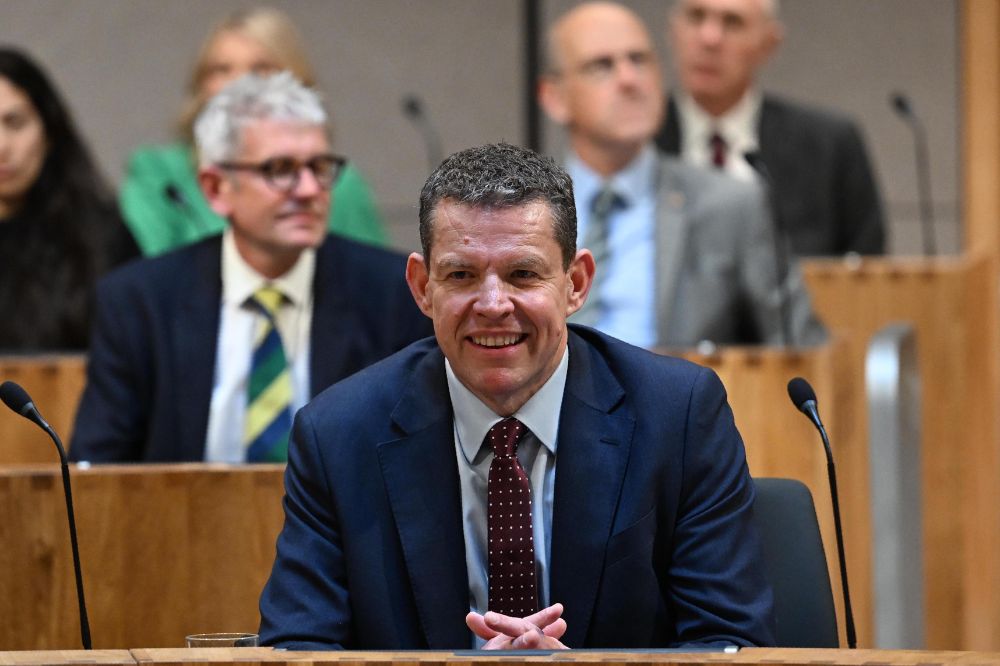
How is Rhun ap Iorwerth doing as First Minister? Plaid’s programme for the First 100 Days, panned as a gimmick during the election, turns out to be a very sound idea.
It has given the government some focus while they get to grips with office. They learned from Keir Starmer that winning and then doing nothing is a poor look.
The First Minister is justly admired as a communicator. He has the rare quality in Welsh politics of believing that tomorrow will be better than today. Contrast that with Starmer who made every sunbeam seem like a threat of rain next month. The challenge now is to convert future optimism into present action.
Government is collective, of course. The Cabinet generally seems sensible. They care about Wales and its issues. They haven’t promised the earth and, so far, no one has been twp.
Finance Minister Elin Jones has been appropriately downbeat – that’s her job, and unavoidable in a system where the Welsh Government doesn’t control the economic levers.
The 100 Days approach has got them to the summer intact, aided by lacklustre opposition. Plaid will complete its victory lap at the Royal Welsh, the Eisteddfod and I imagine Rhun will be mobbed at Primin Môn. Fair enough: Plaid toiled long and hard and won the right to enjoy a moment.
But come September all that must stop, and the Welsh Government will need running shoes on. Action is needed. They have three proper years in office.
They’ve published their legislative programme and must now crack on with it. The WDA Mk II (as we shouldn’t call it) should crack on in shadow form and start doing things. Let’s hear the M4 solution and see diggers in the ground. Wales’ feeble economy needs a plan. Let legislation and bureaucracy catch up later.
My friends tell me that the civil service has responded positively to the new government. I’m pleased to hear this. But I worry too. Take a glance at the enormous folder carried by the First Minister into his weekly questions session. It represents the bureaucratisation of politics, a huge compendium of bullet points describing how the civil service sees Wales and its issues.
All ministers have a version for their subject It’s the easiest thing in the world for ministers to get trapped by this, to start thinking and acting like spokespeople, instructed by the civil service to defend legacy positions of the Welsh government.
It’s amazing how ministers collude with this process as though the last thing they want to be is a politician. They gradually turn into civil service-mandated spokespeople, obsessed with mistakes and being held to blame – and so pursuing the line of maximum caution. It’s exactly where the previous government went wrong. A bunch of politicians forgot they were politicians and became government mouthpieces.
“Hell, or bust”, I say – you might never by in government again, so make it count now. If the civil service thinks you’re doing a great job, then you almost certainly aren’t.
Performative
The last week of term staged a Senedd row about the supplementary budget. In our limited model of devolution, the budget is the government’s main agent for change, and the opposition’s main chance to exert influence. It matters.
Even so, the row was spikey but largely performative. Plaid wants to demonstrate authority and change, Labour wants to demonstrate it still matters. If the two sides were looking to make a point, they’ve now made it. The result was Labour voting with Reform and the Tories, a bad habit to start. And Plaid failed get their measures through, which helps no one in the real world.
If there is to be a meaningful Progressive Block in the Senedd then the parties need to find ways of collaborating. Plaid is a minority government and must respect Senedd arithmetic.
Decimated Labour gets one chance a year to be relevant and can hardly be blamed for pushing at the same envelope Plaid used to push, but they can’t overplay their hand.
Labour has lost its “Plaid-whisperers” like Mark Drakeford and Jane Hutt and needs to find new channels if it is to bring influence, rather than noise, to bear.
Plaid needs to act like a minority government and show generous instincts. Both need to learn what a loose Progressive Block looks like in this larger, divided Senedd.
Dead wood
How is Reform doing? Well, not great and Plaid is fortunate in its opposition. Dan Thomas’ rural bank-manager style worked well enough during the election, but he hasn’t found a compelling Senedd voice. Is his heart really in this?
Reform’s election performance brought in a new group of people previously unengaged with politics, and it shows. The smarter ones among them will improve but already there feels like a fair amount of dead wood.
More problematic is Reform’s lazy resort to the culture wars, essentially because they have nothing else to say.
Disrespect towards Ukraine’s flag and war refugees is at odds with the instincts of most Welsh people, including Reform voters. Some odd characters have surfaced, and it’s only a matter of time, surely, before there are desertions, expulsions or both.
It is suggested that some are ambitious for seats in Westminster – an escape plan popularised by Conservatives over the years when they’ve concluded the Senedd has nothing to offer by way of preferment.
Nigel Farage’s bubble has burst somewhat. It’s far too early to write him off and we’ll see how he does with Count Binface. However, the weight of scrutiny is catching up with Reform.
In the Senedd, Reform’s voters will want to see something purposeful in return for the tax dollars spent on the members they voted for. Reform is the opposition – the government in waiting – but it’s a struggle to piece together what they’d do for Wales in office.
Traumatised
Labour’s problems are manifold. The party is traumatised but hasn’t even begun to deal with the sources of its defeat. I like Ken Skates personally but I’ve yet to hear a word of insight about Labour’s catastrophe.
I know he’s not pompous in real life, but he comes over a bit that way in the Senedd. He’d be better finding his own more natural voice. He seemed very pleased with himself when he asked at First Minister’s Questions about Plaid’s policy on NATO. I thought it was bizarre.
He might just as well ask about Plaid’s policy on moon colonies. Keep it real, Ken!
Labour returned two dynamic next-generation Members at the election, Huw Thomas and Shav Taj. Both have real strengths and the potential to be big hitters for a generation. One of them should lead Labour into the next election but the important work needs doing now.
They need to articulate past failings while positioning Labour to look forward. They need to take inspiration from the excellent Rhodri Morgan statue outside the Senedd and put the word “Welsh” back into the party, in practice and not in name only.
Chipper
I bumped into Conservative leader Darren Millar a while back. He was chipper in the circumstances. The election was bad but could have been worse. Kemi Badenoch has improved on the job although, for now, that has boosted her ratings rather than the Conservative party’s.
I challenged Darren for slavishly following a UK Conservative agenda rather than developing a distinctive Welsh outlook. There’s a wide Welsh conservative constituency searching for a leadership not provided by Welsh Conservatives.
I suspect Reform may not be around in 10 years but, for all its problems, there’s a good chance the Conservative Party still will be. They should use the time to think seriously about Wales and what a conservative agenda could offer.
Support our Nation today
For the price of a cup of coffee a month you can help us create an independent, not-for-profit, national news service for the people of Wales, by the people of Wales.
Get more trusted Welsh news
Choose Nation.Cymru as a preferred source in Google News to see more of our journalism.



Interesting end of term report, thank you!
Let us hope that our politicians are not too distracted by what is happening over the border, and that we get a Welsh focussed Secretary of State for Wales following the previous disaster.
Sadly what came to pass was that we got Hamlet, couldn’t been worse I guess, we could be living in Northern Ireland………….
Plaid Cymru faces bigger challenges than it yet realises. The supplementary budget impasse risks being repeated on any piece of legislation where it fails to negotiate a majority. An opposition party is under no obligation to support a minority government. The ‘voting with Reform’ mantra has diminishing returns. Every week Plaid Cymru MPs vote in Westminster against the UK government at the same time as Tories and Reform. The mantra has been exposed by Plaid Cymru voting for Reform’s motion opening the way to killing badgers. That stance will have disturbed many young urban voters who chose Plaid for the… Read more »