


The System’s Down
Ben Wildsmith
Unless all of the polling companies are out by a distance, Thursday’s election will bring a Plaid Cymru government, either in combination with other parties or in minority.
Even at this late stage, my conversations with voters suggest that a worrying amount of them don’t realise how the electoral system has changed or misunderstand what the implications of the changes are.
That’s hardly surprising, given that they system is at odds with the traditional idea of how elections work in Britain.
The notion of a definitive winner is baked into our experience of voting and the media, in particular, is addicted to a personality-driven framing of democracy that mimics the coverage of sports.
Despite the pluralist intentions behind our current system, old habits die hard, and the nation is captivated by which party wins the largest number of seats on Thursday.
This isn’t supposed to matter, seats are distributed proportionally according to our preferences and the eventual government, in theory, reflects that in its make up. We D’Hondt care about that, though, do we?
After months of foul-tempered online bickering, people want to see a knockout blow for their side.
Focussing on which is the largest party allows us the thrill of binary opposition in the namby-pamby, everyone gets a prize, European-style compromise that has replaced the ludicrous, but thrilling, system still used for Westminster.
It’s electoral drag hunting – obviously better than what its replacing but lacking the primal appeal.
There’s another problem, though. For power sharing to work, it’s essential that all participants have a commitment to the democracy and want to participate in government.
If a share of power is their goal, politicians can be surprisingly flexible about who they will work with, and which policies they are willing to let go. Instead of watered-down policy offerings to appeal to a broad voter base, parties can run on the full fat versions of their beliefs and then horse trade their most cherished ideas into governance.
Cooperation
Reform UK could, conceivably, get an M4 relief road like this. If their goal were eventually to lead a Senedd government and govern Wales into the future, accepting a left-of-centre victory and trading a big, visible project as the price of cooperation would set them up perfectly for 2031.
It would weaken Welsh Labour yet further, removing any need for a formal coalition, and position Reform as a reasonable and pragmatic force in Wales.
That’s not their goal, though, is it? As the campaign has progressed, Reform’s messaging has increasingly foregrounded the voting system as evidence that Welsh democracy is beyond saving. The existence of an ostensibly left of centre majority is explained away as an ‘establishment stitch-up’ between Labour, Plaid Cymru and, implausibly, the Greens.
To make sense of the notion that Plaid Cymru and the Greens represent the ‘Establishment’ requires some decoding. What’s being insinuated here is that the Senedd itself is an elitist, illegitimate body.
Peasant army
Any party which is willing to contribute to governance from Cardiff is de facto disqualified from representing Reform’s peasant army, whose loyalty is to Westminster where Reform can win an undiluted first-past-the-post mandate to do whatever they like, wherever they like.
The existence of a party which threatens the existence of Welsh democracy isn’t new. Indeed, many of Reform’s members supported the ill-fated Abolish party last time out, and Mark Reckless, Reform candidate in Caerdydd Penarth, ran for Abolish.
The difference here is that Reform’s potential in Westminster exceeds its prospects in Wales. The combination of an anti-devolution government in London with a Reform Opposition in Cardiff Bay threatens the existence of Wales at the institutional level.
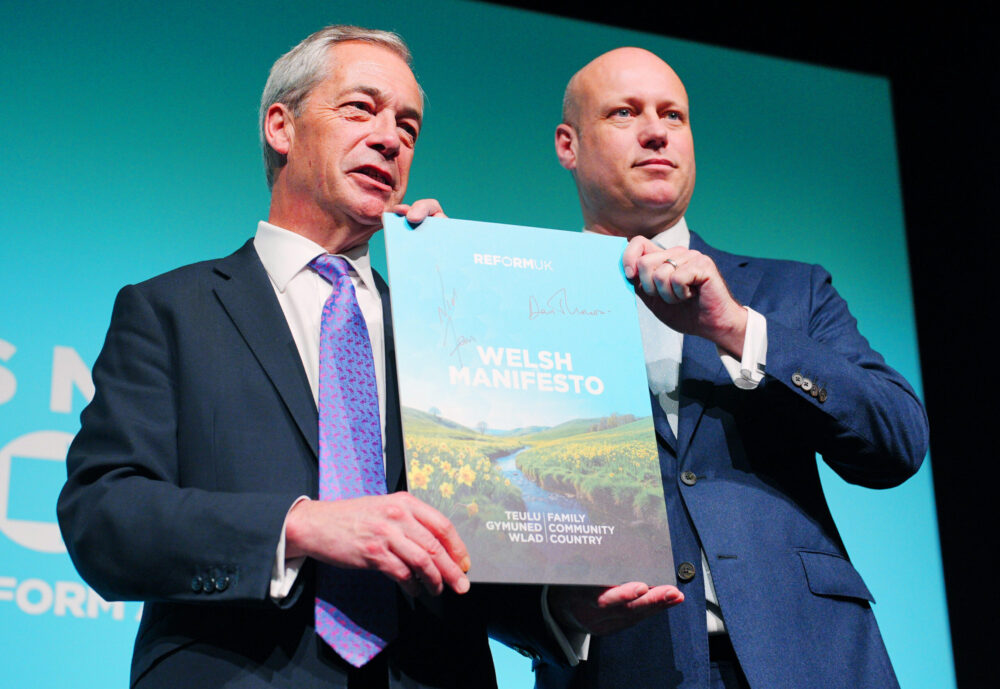
A Reform Opposition as the largest party would be an aggrieved megaphone for the wider UK’s ills according to N. Farage.
Urgency
The electoral system we have doesn’t account for actors who have no interest in governing. The outcome is that an obsession with which party wins the most seats has gained urgency because the legitimacy of Welsh democracy is being threatened by a party that doesn’t believe it should exist in the first place.
As we sweat over our phones for the results on Friday, it will be in the knowledge that the overall result is as nothing to the minute variations that award fifth and sixth places either way.
That is the precise opposite of what this system was supposed to produce. Our democracy is being gamed by people who seek its destruction
Support our Nation today
For the price of a cup of coffee a month you can help us create an independent, not-for-profit, national news service for the people of Wales, by the people of Wales.
Get more trusted Welsh news
Choose Nation.Cymru as a preferred source in Google News to see more of our journalism.



Too late now to howl about the defects of a system that will return 96 party-nominated Members to Y Senedd later this week. We will be stuck with it with little hope of advancing towards an improved system as the “winners” this time will seek to freeze frame the system as long as it keeps them on top. Which, of course, is a false premise. Reform has benefitted from Labour/Plaid’s folly and that is a curse on them all.
Spot on. Far too late. Labour insisted on the closed list only because they thought it would benefit them and their incumbents (forget all the tosh about the priority being progressive government). We could pay a high price come Thursday for this folly.
Beware of solicitor politicians, it’s the Thompson Twins wot did it….
Can anyone name me a Senedd Welsh Labour politician that has held a proper job.? Can anybody name me anyone in the Senedd that has run a business or worked in the private sector (lawyers and union officials don’t count)
Agreed, The closed list was a change to our constitution. Traditionally that would have involved a referendum. But Labour did not think that is Welsh merited such . We were not consulted, or perhaps we were consulted and ignored with respect to the 20 mph. And do it got in as a disaster. The gov was blaming the council, the councils were blaming the people, and eventually everyone is going at 30 except at the speed cameras. The voting system change has been sheer arrogance and it was an attempt to secure jobs for life for the boys(and girls). And… Read more »
The only light at the end of this tunnel is that Plaid (I think) have (almost?) committed themselves to introducing STV; but it may require the Labour rump to support the change.
All of this constitutional tinkering betrays the truth that the Senedd is too inward looking and cares little for the dealing with the actual issues facing Wales. 20mph and this new voting system shows a decadent establishment thats forgotten what its there for.
I agree. Increasingly I think a bold Plaid government is devolution’s last chance. There is a shrinking majority that support the Senedd and another 5 years of drift and rhetoric plus a Reform government at Westminster could finish the project.
The system is broken beyond repair just by any party from a foreign country being allowed to stand in a Cymru election anyway.
Cymru does not have real democracy.
Poster Boy RIP Jo Cox…
Poster Boy RIP Cymru…
(You don’t remember the Turkish travel agent!)