

The UK national anthem is an embarrassing dirge belted out by sycophantic fools who salivate at the thought of being awarded an MBE
Martin Shipton
The treatment meted out to newly elected SNP MP Lara Bird exemplifies the obnoxious combination of sneering condescension and blind deference to authority that makes a certain kind of Englishness so unappealing.
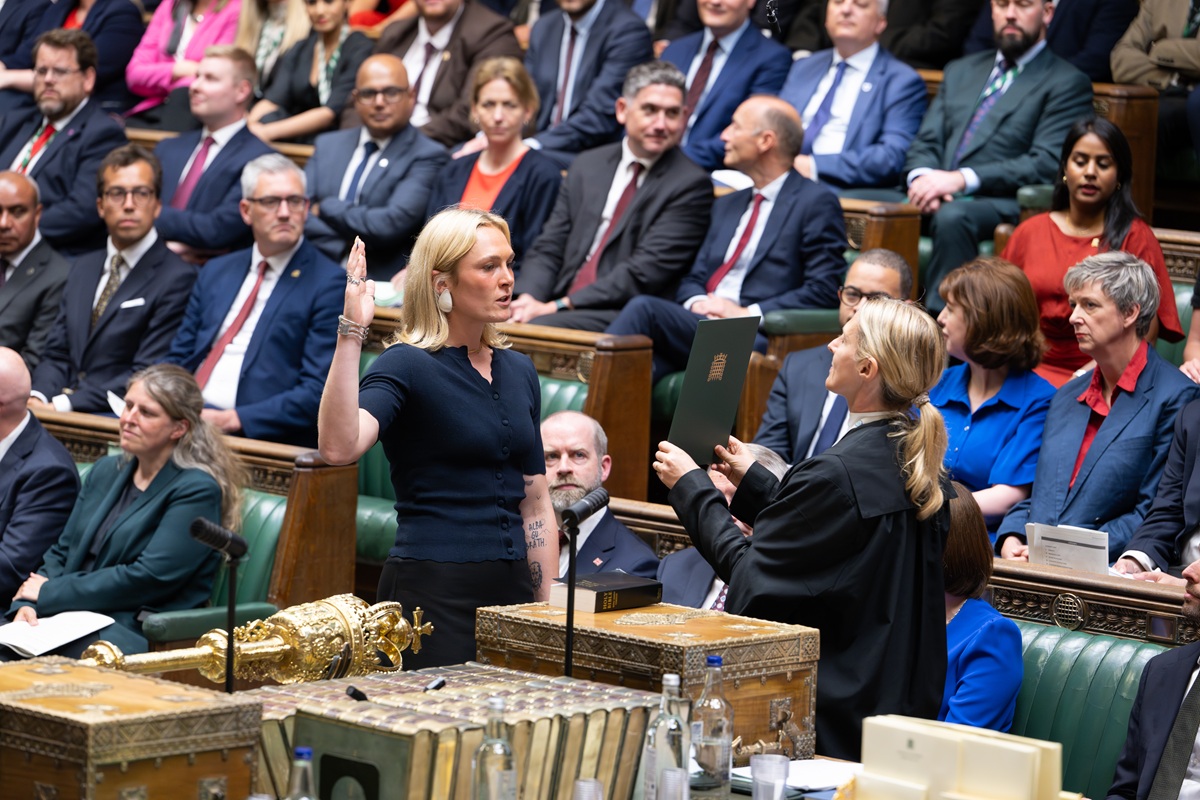
Having won a resounding victory in the Arbroath and Broughty Ferry by-election, Ms Bird had to go through the anachronistic and undemocratic ritual of swearing an oath of allegiance to the monarch before she could undertake her parliamentary duties.
In line with many republican MPs before her, she crossed her fingers before uttering the compulsory oath and declared that her loyalty was to the people of Scotland.
Within minutes, right-wing TV anchors were launching personal attacks on her dress sense, her accent and her finger crossing.
The idea that there might be something wrong with a political system that forces those who have been elected to swear allegiance to an unelected king does not deflect such people from their vitriol for an instant.
I doubt whether they have much knowledge of history, and particularly of how the oath of allegiance impinged on the last occasion when the UK underwent a break-up.
To listen to Talk TV hosts with their – to me – unappealing estuarial accents, one would think that Lara Bird’s principled act of defiance was a previously unimaginable example of lèse-majesté.
In fact, the oath of allegiance became a major stumbling block in the talks that led to the establishment of the Irish Free State more than 100 years ago. The issue was seen at the time as at least as important as the partition of Ireland, with six north-eastern counties hived off artificially to form a unionist statelet.
The British negotiators, overseen by David Lloyd George, were adamant that those elected to the Dáil should take an oath of allegiance to the monarch. The Irish nationalists were bitterly split between those who saw acceptance of partition and the oath as pragmatic stepping stones to an Irish republic and those who, at least initially, saw such compromises as a betrayal. The difference of opinion led to a civil war that resulted in a Pyrrhic victory for the stepping stone faction, whose charismatic leader Michael Collins was assassinated. Eventually, in 1933, the oath of allegiance for members of the Dáil was scrapped by legislation introduced by Éamon de Valera, the head of government at the time. Having previously threatened war over the issue, the British state did nothing.
Yet in Britain, the oath of allegiance is still regarded as sacrosanct. Those elected to the House of Commons, to the Scottish Parliament, or to the Senedd who refuse to take the oath or affirmation are barred from participating in any proceedings, and from receiving their salaries. Members of the House of Commons could also be fined £500, and have their seat declared vacant “as if [they] were dead”, if they attempt to do so.
To be specific, Section 23 of the Government of Wales Act 2006 requires members of the Senedd to take the oath of allegiance.
Likewise, Section 84 of the Scotland Act 1998 requires Members of the Scottish Parliament to take the oath of allegiance at a meeting of the Parliament.
Republicans have nevertheless continued to express opposition to a compulsory oath made to an unelected monarch.
In 1992, when taking the oath, Tony Benn stated: “As a dedicated republican, I solemnly swear …”
‘Under protest’
After the 1997 election, he expanded on his position, stating: “As a committed republican, under protest, I take the oath required of me by law, under the Parliamentary Oaths Act of 1866, to allow me to represent my constituency …”. Later he said: “When one looks at the oaths of a Privy Counsellor, a Member of Parliament and the Sovereign at the coronation, they throw an interesting light on the obligations by which we are bound. The reality is that nobody takes an oath to uphold democracy in Britain. The Queen takes an oath to govern the country and uphold the rights of the bishops. We take an oath to the Queen. Nobody in the House takes an oath to uphold democracy in Britain.”
However, members of the Northern Ireland Assembly are not required to take an oath of allegiance – proving yet again that taking up arms can be more persuasive than peaceful debate.
Instead, members are required to sign the Assembly’s roll of membership, designate their identity as “Nationalist”, “Unionist” or “Other”, and take a Pledge of Office.
Members pledge to discharge in good faith all the duties of office; commit to non-violence and exclusively peaceful and democratic means; commit to serve all the people of Northern Ireland equally, and to act in accordance with the general obligations on government to promote equality and prevent discrimination; undertake to promote the interests of the whole community represented in the Northern Ireland Assembly towards the goal of a shared future; participate fully in the Executive Committee, the North-South Ministerial Council and the British-Irish Council; observe the joint nature of the offices of First Minister and Deputy First Minister; uphold the rule of law based as it is on the fundamental principles of fairness, impartiality and democratic accountability, including support for policing and the courts; participate with colleagues in the preparation of a programme for government; operate within the framework of that programme when agreed within the Executive Committee and endorsed by the Assembly; support, and to act in accordance with, all decisions of the Executive Committee and Assembly; and, comply with the Ministerial Code of Conduct.
Democratically acceptable
Unfortunately, neither the Senedd nor the Welsh Government has the power to scrap the oath of allegiance or adapt it to a version more democratically acceptable like the Pledge of Office in Northern Ireland.
I know that the recently elected Plaid Cymru government will take the view that it has more important matters to prioritise. But for me, the continuation of this feudal, medieval custom is part of a bigger problem that holds Wales and Britain back. We continue to be subjects rather than citizens and deference to an unelected monarch remains the default position in British society, with those like Lara Bird who refuse to conform subjected in her case to misogynistic bullying by those able to misuse a public platform.
The UK national anthem is an embarrassing dirge belted out by sycophantic fools who salivate at the thought of being awarded an MBE – one of the lowest rungs in an honours hierarchy dedicated to perpetuating an empire that came to an inglorious end many decades ago. Whenever I hear it I want the other team to win.
Imperial nostalgia is especially beloved by the knuckle-dragging morons of the far right. The likes of Farage see it as a good mood to tap into as they dupe people into believing they are on their side.
Thankfully, there are signs that their allure is waning: they were, after all, decisively defeated in Wales, and polls show that their support continues to decline.
Support our Nation today
For the price of a cup of coffee a month you can help us create an independent, not-for-profit, national news service for the people of Wales, by the people of Wales.
Get more trusted Welsh news
Choose Nation.Cymru as a preferred source in Google News to see more of our journalism.




Your headline says it all. I heard the Tory broadcaster Richard Madeley describe Lara Bird as “so juvenile” for saying that her primary commitment is to the people of Scotland, as opposed to swearing allegiance to the racketeering Carlo. When are the Celtic nations going to say, in unison, that we’ve had enough of this outmoded Westminster model, and that we wish to be independent citizens, not suppressed subjects.
Exactly this
It’s indicative of the state of broadcast media in the UK when Richard Madeley can refer to himself as a journalist… life imitates parody to such an extent nowadays that I can’t tell whether he is modelled on Alan Partridge or vice versa.
We will have finally thrown off the English yoke when our representatives no longer swear an oath to a foreign king. Perhaps the new Celtic Alliance can demand the eradication of this requirement by Scotland and Wales insisting on parity with Northern Ireland.
One other thing the Senedd could do is revoke all royal exemptions contained in Welsh legislation so that, in Wales at least, King Charles and his successors are not above the law.
I don’t care about Talk TV hosts’ accents, only their opinions, which I definitely find unappealing. There are also decent people with “estuarine accents” and I’ve been on the end of too much accent prejudice myself to pass it on.
I agree. I don’t think there’s any need to sink to the same level as Talk TV hosts by making fun of people’s accents. Otherwise a valid article.
You must find Inspector Clouseau deeply triggering.
I don’t care much for the oath issue. Seems childish on all sides, and does anyone really care? Just get on with job you’ve been sent to do.
But the accent thing is just weird. Who goes from posh English accent to working class Scots in the matter of weeks?
Anyone who is commuting between Scotland and London tbh. I have zero ability to pick up accents, I even lost the one I was born with, so now I sound like generic brit, south of Scotland. Other people will go from London speaking clipped Kensington, to Somerset’s farmer banter, to the Newcastle’s geordie in the time it takes for a train ride. Depends who you are talking to at the time I guess.
Times are looking up when Cymru ‘senior’ journalist can justly & clinically, eviscerate the colonial anomaly of enforcing a royal oath on our representatives! To believe it may be pragmatic to put this prime example of our enforced subjugation on the ‘back burner’ for now is a mistake! This is exactly the sort of ‘line in the sand’ demonstration of our newly found self confidence that we need as a symbol of ‘never going back’! Let’s use it as a symbol of freeing ourselves from the hegemony of the English imperial state! Da iawn Martin Shipton!
I’m with you on the anthem, finger crossing, clothes etc. but her changed accent ? Did sound a bit strange I got to say , what was all that about?!?!?
The whole system is mired in ancient rituals that need to be expunged. I dont care if she swore on the Beano, just do the best job she can do. Farage made the same oath and he is bought and paid for by off shore billionaires. Same press said sod all.
The Sainted Billy Connolly suggested replacing that awful dirge with the Archer’s Theme. It’s a fine idea.
That would be Billy Connolly, Commander of the Order of the British Empire
The bigger issue is what it doesn’t say. Aside from no commitments to uphold the law, defend the constitution (understandable because there isn’t one) or work hard for their constituents, the Dutch oath highlight other awkward gaps:
“I swear that I have not accepted and will not accept, directly or indirectly, any promises or gifts from anyone whomever in order to do or refrain from doing anything whatsoever in this office.”
We are often told that we live in a “so-called” democracy, say those who support a United Kingdom that, in 2026, still does not adequately reflect Wales in any of its symbolism. Both the Senedd Cymru and Westminster Parliament require elected members to swear allegiance to an unelected English monarch before they can fully serve their constituents. It can feel as though we are living in a perpetual April Fools’ Day.
Or “imperial nostalgia” could be pride in how the home nations stood together and faced one of the greatest evils ever seen by mankind, or how we bequeathed the world extraordinary advances in culture, technology, medicine, engineering science etc.
Do you really think that ‘pride in how the home nations stood together and faced one of the greatest evils ever seen by mankind, or how we bequeathed the world extraordinary advances in culture, technology, medicine, engineering science etc.’ is what’s going through the minds of those twenty foot up a ladder hanging up numerous nylon made in China union jacks.
Indeed. Our greatest achievements have always been as part of something bigger.
If you mean as a member of the EU, then I agree.
Yes in the 4 UK nations we all sang Polly put the kettle on in our early years.
An evil that only took root because the Conservatives appeased it in Munich.
And before that, in Spain.
My oath when I accepted the elected position of Police and Crime Commissioner was to the people of North Wales and not to the monarchy.
That’s interesting. To comply with the Police Reform Act 2002, doesn’t every constable in Heddlu Gogledd Cymru have to swear a declaration (attestation) in English or Welsh to “truly serve” the monarch? And according to the Police Federation (2018): “Those who hold the Office of Constable are servants of the Crown”
I certainly don’t acknowledge that “God save the Queen/King” is the UK national anthem. Its words clearly show that it isn’t a national anthem at all but a Monarch Exaltation Anthem. It doesn’t mention any nation except “rebellious Scots to crush” in its 6th verse. However, it is England’s national anthem, certainly not the UK’s. Swearing allegiance to the monarch at the UK, Scottish and Welsh parliaments is a sick joke. Many who do don’t take it seriously and certainly don’t mean what they say.
Fortunately, the empire is well on its way out.
Putins gang can wrap themselves in the butchers apron, wear silly costumes, reminisce about the good old days of asbestos, white dog poo and carry on style humor till the TV stops playing Fawlty towers repeats, but they’re flogging a dead horse.
Symbolism, ritual, anthems and vexillology undoubtedly hold vital places in the life of nations. However, rather than politicians bookending their time in an institution or office with a traditional oath and a now seemingly obligatory “honour of my life” speech, might a formal employment-style contract with us, their employer, be more appropriate in this day and age?